Chhattisgarh Paddy Model Draws Maharashtra Delegation
Synopsis
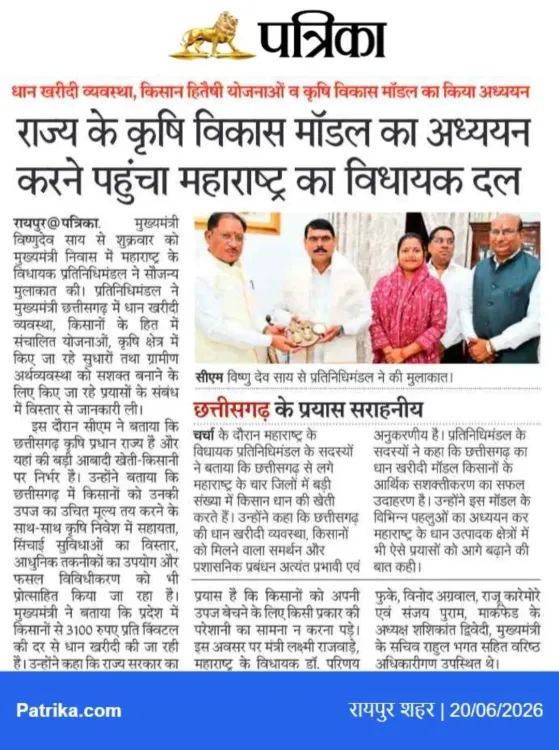
The Chhattisgarh CMO announced on 20 June 2026 that a Maharashtra legislative delegation arrived in the state to study its transparent, IT-enabled paddy procurement model, widely regarded as a benchmark for MSP-based farmer payments in India.
Key Takeaways
The Chief Minister's Office of Chhattisgarh announced on 20 June 2026 that a Maharashtra legislative delegation visited the state to study its paddy procurement model.
Chhattisgarh 's model is built on decentralised MSP-based purchases, digital farmer registration, and real-time mandi-level tracking to reduce middlemen and payment delays.
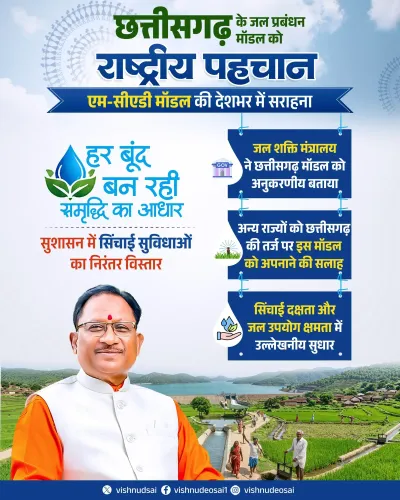
The CMO described the model as having 'emerged as a national ideal' for transparent governance and effective management.
The visit is part of a broader pattern of sub-national policy learning among Indian states on agricultural marketing and procurement reform.
Whether Maharashtra incorporates the model into its kharif season procurement guidelines will be the key development to watch.
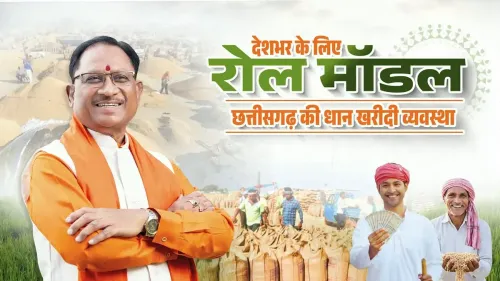
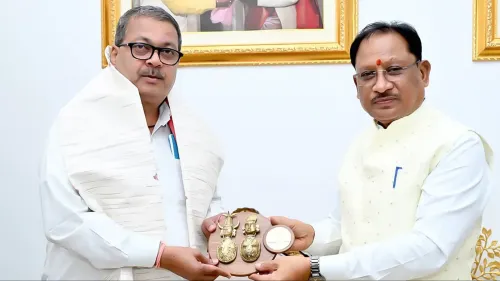
The Chief Minister's Office of Chhattisgarh announced on Saturday, 20 June 2026, that a legislative delegation from Maharashtra has arrived in the state to study its paddy procurement model, which the CMO described as a national benchmark for transparent governance and effective management.
The CMO's post, shared in Hindi, stated: 'देश के सामने आदर्श बनकर उभरा सुशासन सरकार का धान खरीदी मॉडल' ('The good-governance government's paddy procurement model has emerged as a national ideal'), adding that the Maharashtra delegation had travelled to Chhattisgarh specifically to examine its transparent systems and effective administrative practices.
Context
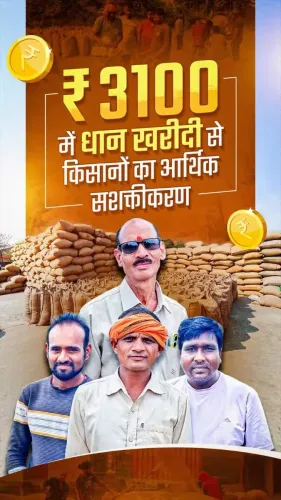
Chhattisgarh has built one of India's most closely watched state-level paddy procurement operations under the decentralised procurement scheme. The state conducts minimum support price (MSP)-based purchases through a network of primary agricultural credit societies and mandis, with digital registration of farmers and real-time tracking of arrivals designed to reduce the role of middlemen and ensure direct, timely payments to cultivators. The state scaled this decentralised model in the early 2000s and has since reported consistently high annual paddy arrivals, attributing volumes to bonus payments over MSP and a simplified farmer-registration process. The combination of IT-enabled monitoring and mandi-level oversight has drawn attention from other state governments grappling with procurement leakages and payment delays.Policy Backdrop
India's federal structure allows states to borrow administrative best practices from one another, and agricultural marketing has become a particularly active arena for such sub-national policy learning. States across the country have struggled with challenges including delayed farmer payments, opaque mandi operations, and high rates of procurement leakage — problems that Chhattisgarh's model claims to have significantly addressed through decentralisation and digital accountability. Maharashtra, one of India's largest agricultural economies, runs its own paddy and other crop procurement operations but has faced periodic criticism over payment delays and uneven coverage of small and marginal farmers. The delegation's visit signals an intent to examine whether elements of the Chhattisgarh approach — particularly its transparency mechanisms and management structure — can be adapted to Maharashtra's scale and context.Stakeholders and Impact
The primary beneficiaries of any procurement reform are paddy farmers, who depend on timely MSP payments for their seasonal cash flow. In Chhattisgarh, paddy is the dominant kharif crop, and the state's procurement system directly affects the livelihoods of a large share of its rural population. If Maharashtra adopts comparable mechanisms, a significant number of paddy growers in that state could see improved payment timelines and reduced dependence on private traders. State agriculture departments, cooperative societies, and mandi boards in both states are institutional stakeholders. The visit also carries a political dimension: for Chhattisgarh's current administration, the delegation's arrival is an endorsement of its governance credentials on a flagship agricultural issue.What's Next
The immediate question is whether the Maharashtra delegation's study visit translates into concrete policy action. Observers will watch whether the state incorporates elements of the Chhattisgarh model into its upcoming kharif season procurement guidelines or introduces corresponding legislative or administrative changes. A formal report from the delegation to the Maharashtra government, or any subsequent inter-state memorandum of understanding on agricultural practices, would mark the next milestone in this episode of federal policy exchange.Point of View
The optics are significant: being positioned as a model state on farmer welfare and procurement transparency strengthens its political narrative ahead of any electoral cycle. The visit also reflects a wider anxiety among state governments about procurement leakages and farmer payment delays, issues that have become politically sensitive across India's agricultural belt. If Maharashtra follows through with policy changes, it could accelerate a broader convergence toward IT-enabled, decentralised procurement as a national standard.
NationPress
19 Sept 2026
Frequently Asked Questions
What is the Chhattisgarh paddy procurement model?
The Chhattisgarh paddy procurement model is a decentralised, MSP-based system under which the state government purchases paddy directly from farmers through primary agricultural credit societies and mandis, using digital registration and real-time tracking to reduce middlemen and ensure timely payments.
Why did Maharashtra send a delegation to Chhattisgarh?
A Maharashtra legislative delegation visited Chhattisgarh on 20 June 2026 to study the state's transparent paddy procurement system and effective management practices, with a view to potentially adapting elements of the model for Maharashtra's own agricultural operations.
What makes Chhattisgarh's paddy procurement a national model?
Chhattisgarh's system is recognised for combining bonus payments over MSP, simplified farmer registration, and IT-enabled mandi monitoring, which together have helped the state achieve consistently high paddy arrivals and direct farmer payments, reducing leakage and middlemen.
How does Chhattisgarh's paddy model benefit farmers?
Farmers benefit from assured MSP payments, bonus top-ups, and a streamlined registration process that connects them directly to government procurement agencies, reducing their dependence on private traders and improving cash-flow certainty after the harvest.
Will Maharashtra adopt the Chhattisgarh paddy procurement system?
That remains to be seen. The delegation's study visit is the first step; observers will watch whether Maharashtra incorporates the Chhattisgarh approach into its upcoming kharif season procurement guidelines or introduces related administrative changes.