Maharashtra approves drug eradication policy by 2029, first state in India
Synopsis
Maharashtra has become the first Indian state to adopt a whole-of-government drug eradication policy with a firm 2029 deadline — assigning anti-drug duties to over a dozen departments, embedding awareness into school curricula from Class 5, and tying district-level performance to annual awards. If it delivers, it could redefine how Indian states execute the Centre's Nasha Mukt Bharat Abhiyan.
Key Takeaways
Maharashtra Cabinet approved a comprehensive drug eradication policy on 1 September , targeting complete elimination of narcotics by 2029 .
Maharashtra is the first state in India to launch a synchronised, multi-departmental anti-drug campaign at this scale.
Every government department must appoint a nodal officer of Deputy Secretary rank to coordinate with the Anti-Drug Task Force (ANTF) .
Drug awareness lessons will be added to school curricula from Class 5 starting academic year 2027 .
Annual awards for the best drug-free district will be declared on 26 June , with performance assessed from 2 October to 30 April .
The policy rests on four pillars : implementation, supply reduction, demand reduction, and addiction treatment and rehabilitation.
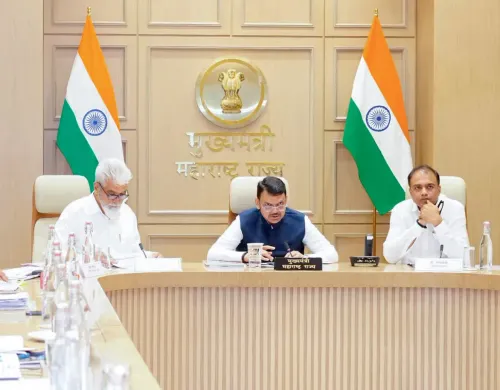
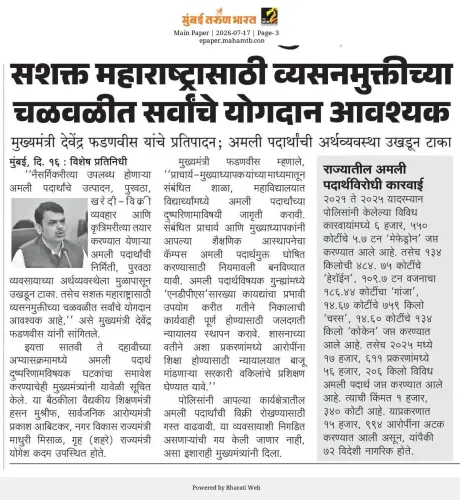
The Maharashtra Cabinet, chaired by Chief Minister Devendra Fadnavis, on 1 September approved a sweeping policy to completely eradicate narcotics and synthetic drugs from the state by 2029. With this decision, Maharashtra becomes the first state in India to launch a synchronised, multi-departmental anti-drug campaign of this scale, setting a new benchmark under the Union Government's Nasha Mukt Bharat Abhiyan (Drug-Free India Campaign).
A Whole-of-Government Framework
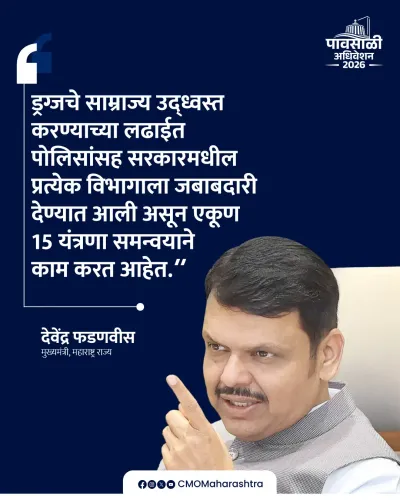
The policy establishes what officials describe as a 'Whole-of-Government Approach,' mandating seamless coordination across all administrative tiers — from village panchayats to district, divisional, and ministerial levels. Every government department will appoint a nodal officer of the rank of Deputy Secretary to coordinate directly with the Anti-Drug Task Force (ANTF), ensuring strict institutional accountability at each level.
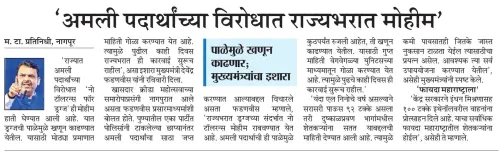
According to an official statement, 'strict action will be taken against the cultivation of crops responsible for the production of illegal drugs, production, transportation, sale and consumption of natural and synthetic drugs in the state.' A large-scale public awareness campaign will run in parallel with enforcement action.
Four Pillars of Drug Control
The policy is structured around four pillars: effective implementation, drastic reduction in drug supply, effective reduction in drug demand, and addiction treatment and rehabilitation. Responsibility for each pillar has been assigned to specific departments.
The Home, Transport, Ports, Law and Justice departments will oversee implementation. Curbing supply falls to the Revenue, Agriculture, and Forest departments, while the Food and Drug Administration and Industries departments will tackle artificially produced synthetic drugs. Demand reduction is the mandate of the School Education, Higher and Technical Education, Sports, Rural Development, Public Health, Women and Child Development, Skill and Entrepreneurship, and Information and Public Relations departments.
Education and Awareness Measures
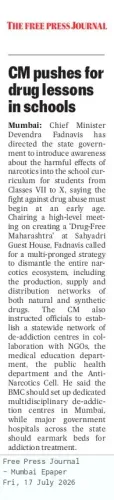
Starting from the academic year 2027, at least one lesson on drug awareness will be included in school curricula from Class 5 onwards. The Higher and Technical Education Department has been directed to ensure all educational institution premises are designated drug-free campuses.
Anti-drug awareness will carry additional marks under the Mukhyamantri Majhi Shala, Sundar Shala Phase-3 initiative, as well as under the Mukhyamantri Samriddhi Panchayat Raj Abhiyan and Maja Gaon, Arogya Sampan Gaon Abhiyan. Annual awards for the best drug-free district will be declared every year on 26 June, with each district's performance evaluated from 2 October to 30 April.
Rehabilitation and What Comes Next
Addiction treatment and rehabilitation responsibilities rest with the Social Justice and Special Assistance, Public Health, Medical Education, Urban Development, and Skill, Employment, Entrepreneurship and Innovation departments. The multi-agency structure is designed to prevent the siloed enforcement that has historically limited the impact of state-level drug control efforts.
With action plans prepared across departments and a hard deadline of 2029, Maharashtra's rollout will be closely watched as a potential model for other states seeking to operationalise the national drug-free mission at scale.
Point of View
But the real test will be inter-departmental coordination — historically the weakest link in Indian public policy. Assigning nodal officers at Deputy Secretary rank is a sound accountability mechanism, yet without a unified data dashboard tracking supply seizures, treatment admissions, and school compliance in real time, the 2029 deadline risks becoming aspirational rather than operational. The district-award incentive is a smart political nudge, but it also creates pressure to game metrics. Independent third-party audits of district performance will be essential if Maharashtra's model is to be credibly exported to other states.
NationPress
17 Oct 2026
Frequently Asked Questions
What is Maharashtra's drug eradication policy approved in September 2025?
It is a comprehensive, multi-departmental policy approved by the Maharashtra Cabinet on 1 September, aimed at completely eliminating narcotics and synthetic drugs from the state by 2029. Maharashtra is the first state in India to launch a synchronised campaign of this scale under the Centre's Nasha Mukt Bharat Abhiyan.
Who is responsible for implementing the Maharashtra anti-drug policy?
Responsibility is distributed across more than a dozen departments under a 'Whole-of-Government Approach.' The Home, Transport, Ports, Law and Justice departments lead implementation; Revenue, Agriculture, and Forest departments handle supply reduction; and Social Justice, Public Health, and Medical Education departments oversee rehabilitation.
How will schools be involved in Maharashtra's drug-free campaign?
From the academic year 2027, at least one lesson on drug awareness will be included in curricula from Class 5 onwards. Anti-drug awareness will also carry additional marks under the Mukhyamantri Majhi Shala, Sundar Shala Phase-3 initiative.
What is the Anti-Drug Task Force (ANTF) and what role does it play?
The ANTF is the central coordinating body for Maharashtra's drug control efforts. Every government department must appoint a Deputy Secretary-rank nodal officer to liaise directly with the ANTF, ensuring accountability from the ministry level down to the grassroots.
How will districts be evaluated under the new drug policy?
Each district's anti-drug performance will be assessed from 2 October to 30 April every year. Annual awards for the best drug-free district will be announced on 26 June, creating an incentive-linked accountability mechanism across Maharashtra's administrative units.