Mandaviya: India-New Zealand FTA enters force Oct 20
Synopsis
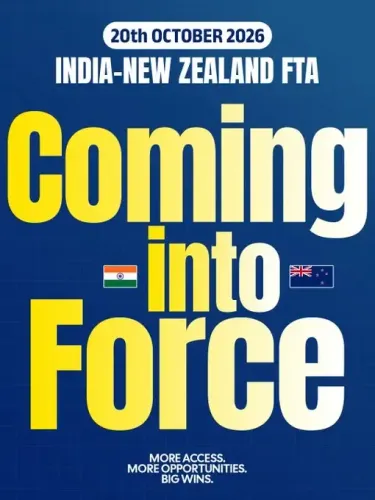
The India-New Zealand Free Trade Agreement enters force on October 20, 2026. Union Minister Mansukh Mandaviya announced the milestone on X, framing it as India's evolution from 'Vocal for Local' to 'Local for Global' under PM Modi's trade diplomacy push.
Key Takeaways
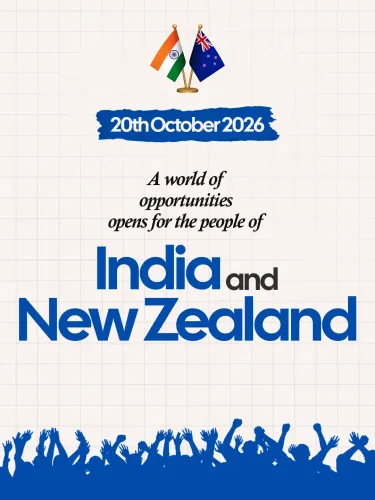
The India-New Zealand Free Trade Agreement officially comes into force on October 20, 2026 .
Union Minister Mansukh Mandaviya announced the development on X, calling it a 'new era of shared prosperity.' The agreement follows earlier fast-track FTAs with the UAE and Australia in 2022 , part of Modi government's bilateral trade sprint.
Key stakeholders include Indian exporters in goods and services and New Zealand's agricultural sector , including dairy and horticulture.
The phrase 'Local for Global' signals a strategic pivot — building on 'Vocal for Local' to project Indian manufacturing into global markets.
Trade economists will track first-six-month shipment and utilisation data as the real measure of the agreement's impact.
A new chapter in India's trade diplomacy opens on Tuesday, October 20, 2026, as the India-New Zealand Free Trade Agreement officially comes into force — marking the latest milestone in New Delhi's accelerating push to rewire its global economic partnerships. Union Labour and Sports Minister Mansukh Mandaviya hailed the development on Monday, framing it as a direct evolution of the government's signature 'Vocal for Local' manufacturing doctrine into something far more ambitious: a 'Local for Global' export drive.
Posting on X, Mandaviya wrote: 'From Vocal for Local to Local for Global!' — crediting the agreement's entry into force to Prime Minister Narendra Modi's leadership and calling it the dawn of 'a new era of shared prosperity' between the two nations.The phrase that signals a strategic shift
'Vocal for Local' was the rallying cry of India's pandemic-era push to champion domestic products and reduce import dependence. The deliberate inversion — 'Local for Global' — signals that the government now believes that foundation is solid enough to project Indian-made goods outward. The India-New Zealand FTA is the latest vehicle for that ambition, designed to lower tariff barriers and expand the flow of goods and services between the two economies.
The agreement is part of a broader pattern. India concluded fast-track trade pacts with the UAE and Australia in 2022, both framed under the same export-promotion strategy. Negotiations with New Zealand, a country with longstanding ties to India in agriculture, education, and dairy trade, have been in motion since the late 2000s — making this entry-into-force moment the culmination of nearly two decades of diplomatic groundwork.
What Indian exporters and New Zealand's farm sector stand to gain
For Indian exporters — particularly in textiles, pharmaceuticals, IT services, and manufactured goods — preferential access to the New Zealand market opens a new revenue lane in the Pacific. On the other side, New Zealand's agricultural sector, which counts dairy, meat, and horticulture among its strengths, will be watching closely for improved access to one of the world's largest consumer markets.
The real test, however, comes in the months ahead. Trade economists typically flag the first six months after implementation as the critical window: initial shipment data and industry utilisation reports will reveal whether the agreement delivers on its headline promise or whether non-tariff barriers blunt its impact.
India's bilateral FTA sprint under Modi
The speed at which India has concluded and activated bilateral trade agreements since 2022 marks a notable departure from a decades-long preference for slower, multilateral frameworks. The UAE deal, the Australia Economic Cooperation and Trade Agreement (ECTA), and now the New Zealand pact suggest a deliberate sequencing — each agreement adding a rung to a trade ladder that spans the Gulf, the Indo-Pacific, and the Pacific Rim.
For a minister whose portfolio spans labour and sports, Mandaviya's prominent post on a trade agreement underscores how the BJP government treats economic diplomacy as a whole-cabinet message — every senior leader amplifying the same narrative of outward-facing growth.
The countdown is over. As of tomorrow, Indian and New Zealand businesses begin operating under new rules — and the world's fifth-largest economy takes one more deliberate step toward making 'Local for Global' more than a slogan.
Point of View
Making export ambition feel like a natural extension of self-reliance. For India, the Pacific is an increasingly important theatre — this agreement adds diplomatic and economic ballast to its Indo-Pacific positioning. The first real test, however, is utilisation: earlier FTAs have sometimes underperformed because exporters were slow to claim preferential rates, making the next six months a crucial proof-of-concept window.
NationPress
19 Oct 2026
Frequently Asked Questions
When does the India-New Zealand FTA come into force?
The India-New Zealand Free Trade Agreement enters into force on October 20, 2026 , as announced by Union Minister Mansukh Mandaviya.
What is the India-New Zealand FTA about?
The India-New Zealand Free Trade Agreement is a bilateral pact designed to lower tariffs and expand the flow of goods and services between India and New Zealand, benefiting Indian exporters and New Zealand's agricultural sector.
What does 'Vocal for Local to Local for Global' mean?
'Vocal for Local' was the Modi government's call to support Indian-made products domestically. 'Local for Global' is its evolution — using that domestic manufacturing base to drive Indian exports into international markets through trade agreements like the New Zealand FTA.
Which other countries has India signed fast-track FTAs with?
India concluded similar fast-track bilateral trade pacts with the UAE and Australia in 2022 , part of the same export-promotion and bilateral trade strategy pursued under Prime Minister Modi.
How will the India-New Zealand FTA benefit Indian exporters?
The FTA gives Indian exporters — including in textiles, pharmaceuticals, IT services, and manufactured goods — preferential market access to New Zealand, while New Zealand's agricultural and dairy sectors gain improved access to the Indian market.