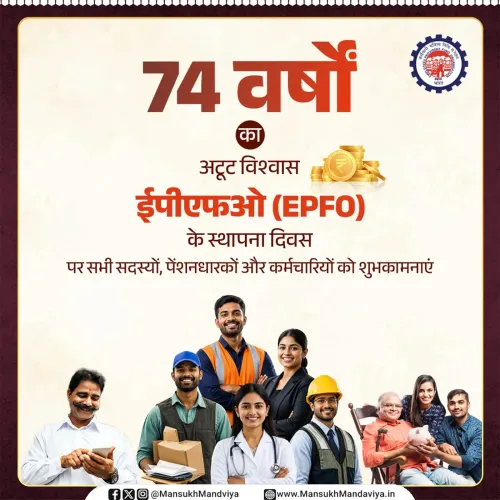
Mandaviya marks 74th EPFO Day, reaffirms worker welfare pledge
Synopsis
Union Labour Minister Mansukh Mandaviya marked EPFO's 74th Foundation Day in New Delhi by reaffirming the government's commitment to worker social security and self-respect, invoking PM Modi's Shramev Jayate vision.
Key Takeaways
Union Labour Minister Mansukh Mandaviya attended the 74th EPFO Foundation Day ceremony in New Delhi on 1 November 2026 .
EPFO was established on 15 November 1952 and administers provident fund, pension and insurance for organised-sector workers.
Mandaviya reaffirmed commitment to social security and worker dignity in line with PM Modi's Shramev Jayate vision, launched in 2014 .
The Code on Social Security, 2020 extended EPFO's ambit to gig and unorganised workers for the first time.
Key remaining task: full rollout of Code on Social Security provisions covering platform and gig workers.
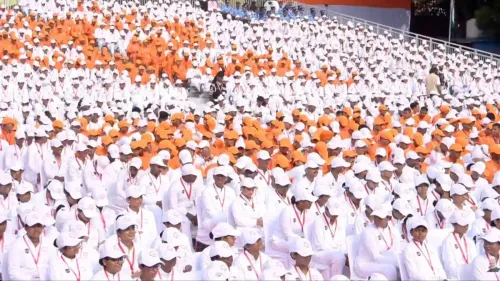
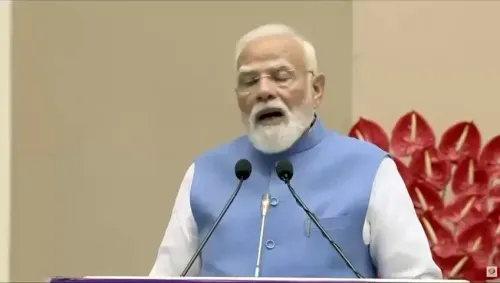
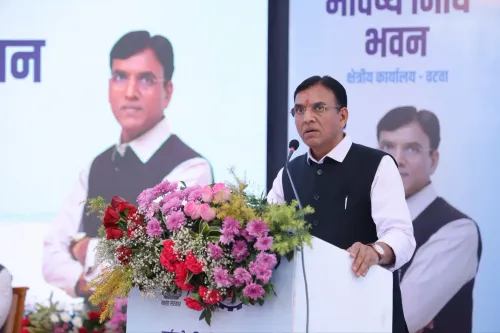
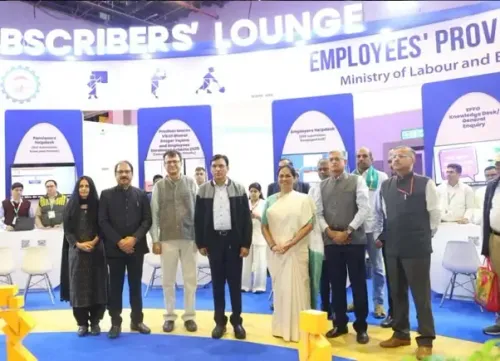
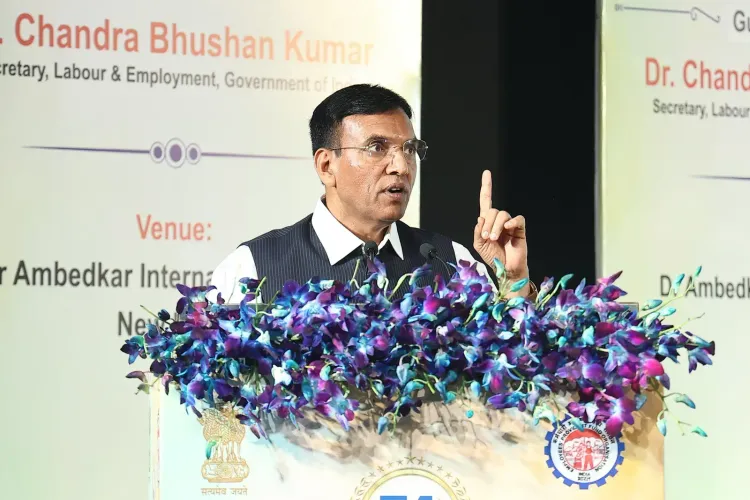
Seventy-four years after India built the scaffolding of organised-sector labour protection, Union Labour and Sports Minister Mansukh Mandaviya stood at the 74th EPFO Foundation Day ceremony in New Delhi on Sunday, 1 November 2026, and restated the government's commitment to every worker's social security and self-respect.
Posting in Hindi on X, the Minister framed the occasion around what he called the foundational ethic of the Modi government: 'Shram ka samman, surakshit kal ki pehchaan' — 'Honouring labour is the mark of a secure tomorrow.' He explicitly aligned the anniversary with Prime Minister Narendra Modi's Shramev Jayate vision, declaring: 'In keeping with the Shramev Jayate vision of respected Prime Minister Shri Narendra Modi, we are fully committed to ensuring the social security and self-respect of every worker.'
EPFO at 74: what seven decades of worker protection look like
The Employees' Provident Fund Organisation was established on 15 November 1952 under the Employees' Provident Funds Act — a founding compact between the Indian state and the organised workforce. It administers provident fund, pension, and insurance schemes that underpin the retirement and life-event security of millions of formal-sector employees. Over seven decades, successive governments expanded enrolment thresholds, introduced digital services, and pushed for broader coverage, but the architecture has remained intact.
The annual Foundation Day is not merely ceremonial. It serves as the Ministry's most visible moment to restate direction, signal intent, and benchmark progress on the formalisation agenda that has defined recent labour policy.
Shramev Jayate and the formalisation drive
The Shramev Jayate campaign — launched in 2014 — repositioned labour welfare as a political priority, pairing the dignity-of-labour message with simplified compliance and a push to bring more workers into the formal net. That drive was given legislative backbone by the Code on Social Security, 2020, which consolidated EPFO-related statutes and, for the first time, extended the ambit of social security to gig and unorganised workers — a category largely invisible to the provident fund system for most of EPFO's history.
Mandaviya, as the minister responsible for EPFO and the implementation of India's four labour codes, sits at the centre of that unfinished project. The remaining provisions of the Code on Social Security — particularly those covering platform and gig workers — are still awaiting full rollout, making each EPFO anniversary a marker of how far the architecture has stretched and how far it still needs to reach.
A promise measured in enrolment numbers
The real test of any social-security commitment is coverage breadth. Expanding automatic enrolment, reducing eligibility thresholds, and digitising claims have steadily widened EPFO's reach in recent years. The Ministry's next Labour Ministry review is expected to set fresh enrolment targets — a number that will translate Mandaviya's words on Foundation Day into a measurable benchmark.
Seventy-four years in, India's oldest worker-welfare institution is being asked to stretch further than its original architects imagined. Whether it reaches is the question every EPFO anniversary leaves hanging in the air — and every Labour Minister's job to answer.
Point of View
The single most consequential unfinished item on the labour-reform agenda. Each Foundation Day without a concrete new enrolment or coverage announcement makes the commitment harder to distinguish from its predecessors. The real test in coming months will be whether fresh EPFO enrolment targets or gig-worker notification timelines turn this platform declaration into measurable policy delivery.
NationPress
1 Nov 2026
Frequently Asked Questions
When was EPFO established?
EPFO was established on 15 November 1952 under the Employees' Provident Funds Act as India's primary social-security body for organised-sector workers.
What is Shramev Jayate?
Shramev Jayate is a labour outreach campaign launched by PM Narendra Modi in 2014 to promote the dignity of labour, simplified compliance, and expanded social-security coverage for workers.
What did Mansukh Mandaviya say at the 74th EPFO Foundation Day?
Mandaviya declared the government's full commitment to ensuring social security and self-respect for every worker, framing the pledge around PM Modi's Shramev Jayate vision.
Does EPFO cover gig workers in India?
The Code on Social Security, 2020 extended EPFO's social-security framework to gig and unorganised workers for the first time, but the relevant provisions are still awaiting full rollout.
What is the Code on Social Security 2020?
The Code on Social Security, 2020 consolidates multiple EPFO-related statutes and, crucially, extends social-security coverage beyond formal-sector employees to include gig and platform workers.