CM Bhagwant Mann Launches Tirth Yatra Buses from Ropar from Aug 1

Synopsis
Punjab CM Bhagwant Mann, at a Shiv devotion event in Rupnagar on 29 July 2026, announced new government pilgrimage buses from Ropar to Khatu Shyam, Salasar, Vrindavan, Rishikesh, and Haridwar from 1 August, framing it alongside free electricity and the Mawan-Dhiyan Satikar Yojana as core AAP welfare delivery.
Key Takeaways
Punjab CM Bhagwant Mann attended the 'Ikk Shaam Bhagwan Shiv De Naam' religious event in Rupnagar (Ropar) on 29 July 2026 .
New government Tirth Yatra pilgrimage buses from Rupnagar will launch on 1 August 2026 , serving Khatu Shyam, Salasar, Vrindavan, Rishikesh, and Haridwar .
Mann cited free electricity for households as an existing AAP welfare delivery, introduced after the party formed government in Punjab in March 2022 .
The Mawan-Dhiyan Satikar Yojana was highlighted as the government's dedicated scheme to honour and support women, especially mothers and daughters.
The announcement extends AAP's Tirth Yatra model — already operational in other parts of Punjab — to Rupnagar district , broadening its reach beyond major urban centres.
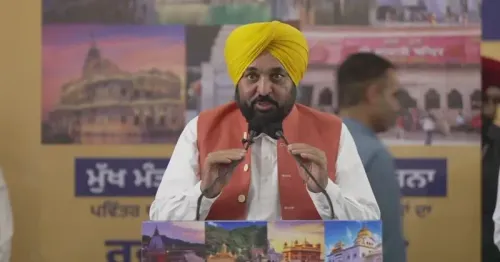
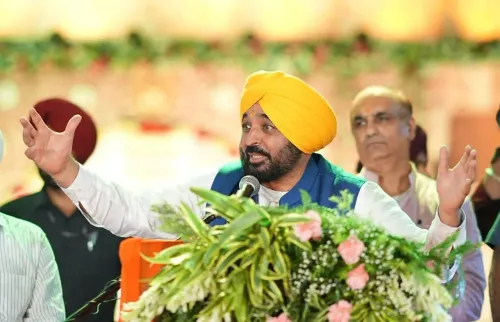
At a packed religious gathering in Rupnagar (Ropar) on Wednesday, 29 July 2026, Punjab Chief Minister Bhagwant Mann joined devotees for the 'Ikk Shaam Bhagwan Shiv De Naam' ('An Evening in the Name of Lord Shiva') event — and turned a moment of faith into a welfare announcement that will move people, literally.
Responding to what he described as heavy public demand, Mann declared that new 'Tirth Yatra' pilgrimage buses will begin operating from Rupnagar starting 1 August 2026, covering destinations including Khatu Shyam, Salasar, Vrindavan, Rishikesh, and Haridwar. The announcement landed in front of a congregation already gathered in a spirit of devotion — making the timing as deliberate as the message.
What the Ropar Pilgrimage Route Means for Punjab's Devotees
Rupnagar, the district headquarters in central Punjab, sits at a natural crossroads for Hindu pilgrims heading toward Rajasthan's Khatu Shyam and Salasar shrines, Uttar Pradesh's Vrindavan, and Uttarakhand's twin pilgrimage towns of Rishikesh and Haridwar. For many devotees in rural Punjab — particularly elderly residents and women — the cost and logistics of reaching these sites independently have long been a barrier. A government-facilitated bus service directly addresses that gap.
Punjab's Aam Aadmi Party government, in power since March 2022, has run a Tirth Yatra scheme as part of its broader welfare architecture — a model it first demonstrated in Delhi before replicating it in Punjab. The Ropar extension signals an effort to deepen that reach into districts beyond the state's major urban centres.
Mann's Welfare Pitch: Electricity, Women's Dignity, Schools, Hospitals
The Chief Minister used the occasion to frame his government's spending philosophy in a single breath: public money, he argued, flows back to the public — through free electricity for domestic consumers, through the 'Mawan-Dhiyan Satikar Yojana' (a scheme honouring mothers and daughters with financial support and recognition), through pilgrimage facilitation, and through investment in schools and hospitals.
The Mawan-Dhiyan Satikar Yojana has positioned the AAP government's outreach specifically toward women — a constituency that welfare economists note is often the most responsive to direct-transfer and dignity-linked schemes. Pairing it with a religious travel announcement in the same post is a studied combination of material and cultural appeal.
Mann closed his post with 'Har Har Mahadev' — the traditional Shaivite invocation — underscoring the devotional register of the evening even as the policy content dominated the headline.
The real test arrives on 1 August: whether the buses roll on schedule, how many routes are operational from day one, and whether the uptake from Rupnagar's pilgrim community matches the enthusiasm of the announcement.
Point of View
Rather than a press conference, signals that the government sees religious sentiment and welfare delivery as mutually reinforcing rather than separate lanes. For a party that has faced pressure to demonstrate governance depth beyond its urban base, extending pilgrimage infrastructure to a district headquarters like Rupnagar is a visible, low-friction signal to rural and semi-urban constituencies. The 1 August start date gives the announcement an immediate accountability clock.
NationPress
13 Sept 2026
Frequently Asked Questions
When do the new Tirth Yatra buses from Rupnagar start?
The new Tirth Yatra pilgrimage buses from Rupnagar are set to begin on 1 August 2026 , as announced by Punjab CM Bhagwant Mann on 29 July 2026.
Which pilgrimage destinations will the Rupnagar Tirth Yatra buses cover?
The announced routes from Rupnagar cover Khatu Shyam, Salasar, Vrindavan, Rishikesh, and Haridwar .
What is the Mawan-Dhiyan Satikar Yojana mentioned by Bhagwant Mann?
The Mawan-Dhiyan Satikar Yojana is a Punjab government scheme that provides financial support and recognition to women, particularly mothers and daughters, as part of the AAP government's welfare agenda.
Does the Punjab government offer free electricity to households?
Yes. The Aam Aadmi Party government in Punjab introduced free electricity for domestic consumers up to a fixed limit as a flagship welfare measure after coming to power in March 2022 .
What was the 'Ikk Shaam Bhagwan Shiv De Naam' event in Ropar?
' Ikk Shaam Bhagwan Shiv De Naam ' — meaning 'An Evening in the Name of Lord Shiva' — was a religious congregation held in Rupnagar (Ropar) on 29 July 2026 , attended by CM Bhagwant Mann along with local devotees.