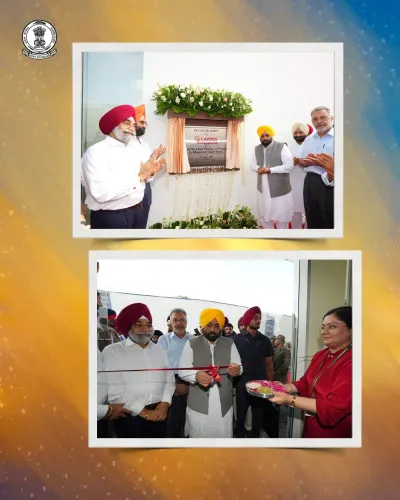
CM Bhagwant Mann Inaugurates NABH-Accredited Capitol Hospital in Moga
Synopsis
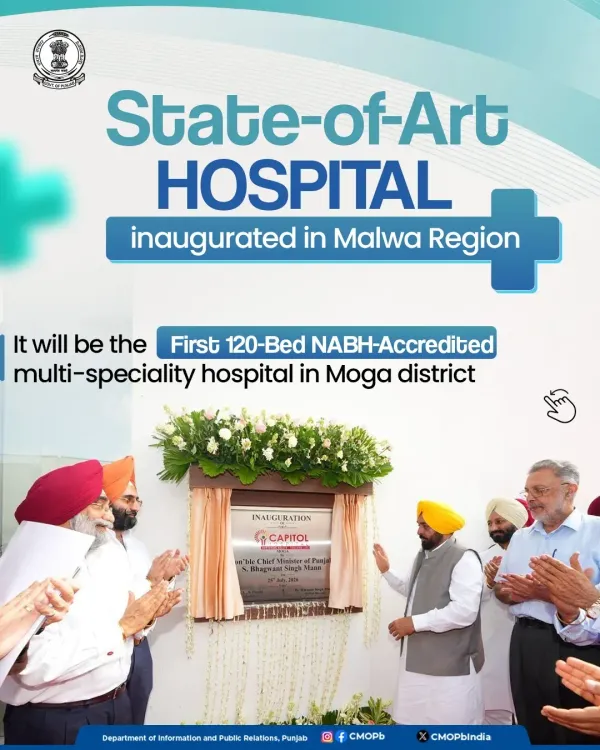
Chief Minister Bhagwant Mann on 26 July 2026 inaugurated the 120-bed Capitol Hospital in Moga — Punjab's first NABH-accredited multi-speciality hospital in the district — aiming to bring specialised critical care closer to residents of the Malwa region.
Key Takeaways
CM Bhagwant Mann inaugurated Capitol Hospital in Moga on 26 July 2026 .
The facility is a 120-bed multi-speciality hospital.
It is the first NABH-accredited multi-speciality hospital in Moga district .
The hospital is intended to provide specialised treatment for critical illnesses in the Malwa region without requiring patients to travel to larger cities.
NABH (National Accreditation Board for Hospitals and Healthcare Providers) is an autonomous body under the Quality Council of India that certifies hospitals meeting national quality standards.
The development aligns with Punjab's broader push to upgrade district-level healthcare infrastructure in the Malwa belt .
The Chief Minister's Office of Punjab announced on Sunday, 26 July 2026 that Chief Minister Bhagwant Mann inaugurated the 120-bed Capitol Hospital in Moga, describing the facility as the first National Accreditation Board for Hospitals and Healthcare Providers (NABH)-accredited multi-speciality hospital in the district.
Context
Moga, a district in Punjab's Malwa region, has historically depended on larger urban centres for tertiary and specialised medical care. The inauguration of Capitol Hospital marks a significant addition to the district's healthcare infrastructure, with Mann stating the facility will 'provide specialised treatment for critical illnesses closer to people's homes.'
The hospital's NABH accreditation distinguishes it as a quality-certified institution meeting nationally benchmarked standards for patient safety, clinical outcomes, and hospital management — a credential that has become an important marker of credibility for multi-speciality facilities across India.
Policy Backdrop
The NABH, an autonomous body under the Quality Council of India, sets and enforces hospital quality standards nationwide. State governments across India have increasingly partnered with or supported private multi-speciality hospitals meeting NABH norms as a strategy to expand advanced care beyond metropolitan centres.
Punjab's focus on the Malwa belt — which includes districts such as Moga, characterised by a primarily agricultural economy and a high burden of farming-related health conditions — aligns with a broader pattern of directing healthcare investment toward underserved southern Punjab. This approach also complements the national Ayushman Bharat Pradhan Mantri Jan Arogya Yojana, launched in 2018, which provides cashless coverage for secondary and tertiary care to eligible families and can be utilised at NABH-accredited empanelled hospitals.
Stakeholders and Impact
Residents of Moga and surrounding Malwa districts stand to be the primary beneficiaries. Previously, patients requiring specialised interventions — cardiac care, oncology, or advanced surgical procedures — often had to travel to Ludhiana, Amritsar, or Chandigarh, adding financial and logistical strain to medical emergencies.
A 120-bed multi-speciality facility with NABH accreditation can meaningfully reduce that travel burden, particularly for agricultural communities where time away from work carries significant economic cost. The availability of accredited specialised care locally may also reduce out-of-pocket expenditure for families covered under national health insurance schemes.
What's Next
The inauguration raises the question of whether the Punjab government will pursue similar accredited facilities in other Malwa districts that currently lack NABH-certified multi-speciality hospitals. Patient utilisation rates and the hospital's empanelment under state and central health schemes will be key indicators of its real-world impact in the months ahead.
CM Mann's emphasis on NABH accreditation as a quality benchmark signals that the state may use this standard as a criterion for future healthcare infrastructure partnerships, potentially setting a precedent for district-level hospital development across Punjab.
Point of View
Measurable step in Punjab's effort to decentralise advanced healthcare — a policy priority that carries both public health and political weight in the Malwa belt, a region that has long felt underserved in tertiary care. For the Bhagwant Mann government, anchoring the announcement to a nationally recognised quality standard like NABH accreditation is a deliberate signal: this is not just infrastructure, but certified infrastructure. The move fits a wider national pattern where state governments use accreditation frameworks to lend credibility to district-level health investments. Whether Capitol Hospital becomes a replicable model or remains a standalone showcase will depend on follow-through — specifically, whether similar facilities emerge in other Malwa districts in the near term.
NationPress
25 Oct 2026
Frequently Asked Questions
What is Capitol Hospital in Moga?
Capitol Hospital is a newly inaugurated 120-bed multi-speciality hospital in Moga , Punjab, inaugurated by Chief Minister Bhagwant Mann on 26 July 2026 . It is the first NABH-accredited multi-speciality hospital in Moga district.
What does NABH accreditation mean for a hospital?
NABH (National Accreditation Board for Hospitals and Healthcare Providers) accreditation means a hospital meets nationally benchmarked standards for patient safety, clinical processes, and quality of care, as certified by an autonomous body under the Quality Council of India .
Which region does Moga district fall under in Punjab?
Moga is part of Punjab's Malwa region , the southern belt of the state known for its agricultural economy and historically limited access to tertiary healthcare.
Why is a new hospital significant for the Malwa region?
The Malwa region has historically lacked sufficient tertiary and specialised care, forcing patients to travel to cities like Ludhiana or Chandigarh . A local NABH-accredited facility reduces that travel burden and associated costs, especially for farming communities.
Can Ayushman Bharat beneficiaries use Capitol Hospital in Moga?
NABH-accredited hospitals are eligible for empanelment under the Ayushman Bharat Pradhan Mantri Jan Arogya Yojana , which provides cashless tertiary care coverage to eligible families. Whether Capitol Hospital is formally empanelled under the scheme has not been confirmed in the announcement.