MATSYA-6000 clears unmanned trials at Kattupalli in Samudrayaan milestone
Synopsis
India's indigenously built deep-ocean submersible MATSYA-6000 has cleared unmanned trials at Kattupalli, Tamil Nadu — a pivotal step in the Samudrayaan Project that aims to send three humans to 6,000 metres below the ocean surface. When crewed dives succeed, India will join a tiny global club capable of deep-ocean human exploration at that depth.
Key Takeaways
MATSYA-6000 successfully completed unmanned trials at L&T Shipyard, Kattupalli , on 6 November 2026 .
The submersible is designed to carry 3 crew members to depths of 6,000 metres under the Samudrayaan Project .
Trials assessed flotation, submerged stability, ballast systems, power network, manoeuvrability, and communication systems.
MATSYA-6000 was indigenously developed by the National Institute of Ocean Technology (NIOT) and first arrived at Kattupalli in 2025 .
MoES Secretary Srinivasa Kumar Tummala and NIOT Director G.
Ramadass oversaw the exercise.
The refit of research vessel Sagar Manjusha at the same shipyard was also reviewed during the visit.
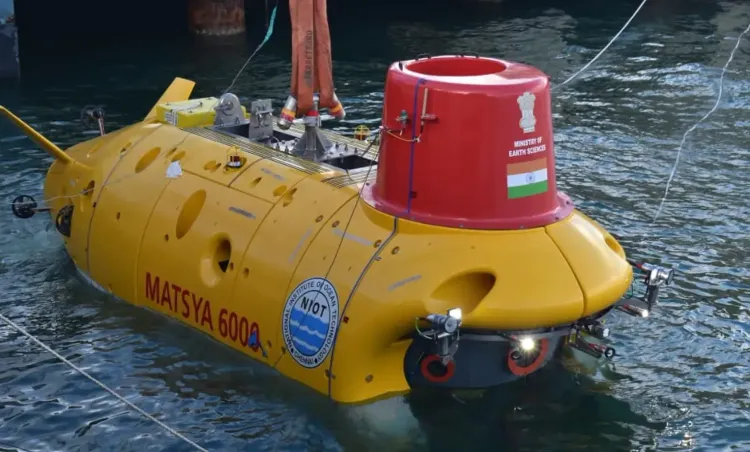
India's deep-ocean human scientific submersible MATSYA-6000 successfully completed its unmanned trials at the L&T Shipyard, Kattupalli, Tamil Nadu, on 6 November 2026, marking a critical milestone in the country's flagship Samudrayaan Project. The evaluations were conducted strictly in accordance with the prescribed test protocol, clearing the vessel for its next phase of advanced testing.
Who Oversaw the Trials
Srinivasa Kumar Tummala, Secretary to the Ministry of Earth Sciences (MoES), was present alongside G. A. Ramadass, Director of the National Institute of Ocean Technology (NIOT). The MoES Secretary systematically assessed the submersible's flotation, submerged stability, ballast systems, and various subcomponents during the exercise.
What MATSYA-6000 Is Designed to Do
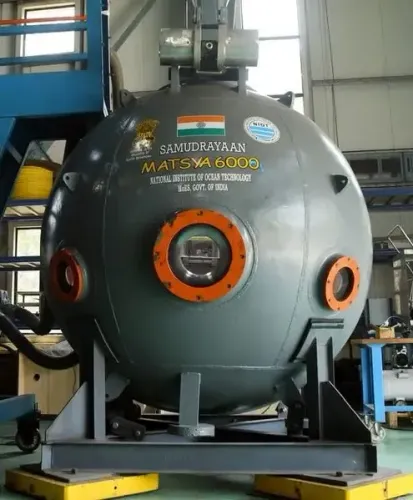
Indigenously developed by NIOT, MATSYA-6000 is India's fourth-generation human submersible, engineered to carry three crew members inside a 2.1-metre diameter spherical pressure hull. Under the Samudrayaan Project, the vessel is designed to dive to depths of up to 6,000 metres, enabling researchers to study deep-sea mineral resources and marine biodiversity — areas of growing strategic and economic interest for India.
The submersible integrates a main ballast system for diving operations, multi-directional thrusters, an onboard battery bank, and syntactic foam for structural buoyancy. Its sophisticated power distribution network is paired with cutting-edge control hardware and software, alongside advanced underwater navigation instruments.
Key Systems on Board
For communications above and below the surface, MATSYA-6000 relies on an acoustic modem, an underwater telephone, and VHF radio equipment, supported by underwater acoustic positioning systems and surface GPS tracking. Inside the pressure hull, specialised human life-support systems, environmental monitoring displays, and navigation joysticks have been integrated. Externally, the vessel carries high-intensity underwater lighting, cameras, and an array of oceanographic sensors.
Testing History and Progress
MATSYA-6000 was first transported to the Kattupalli facility in 2025 to undergo wet tests and demonstrate operational functionality. Since then, it has completed a structured series of controlled manned and unmanned trials focused on power network robustness, vehicle stability, human safety systems, and manoeuvrability — including forward and reverse motion. Navigation, communication systems, and scientific payloads with multiple oceanographic sensors have also been rigorously assessed.
Sagar Manjusha Refit Also Reviewed
During the same visit, MoES Secretary Tummala and NIOT Director Ramadass reviewed ongoing dry-dock repair and refit activities of the research vessel Sagar Manjusha at Kattupalli. Operated by NIOT since its construction in 2006, the 60-metre-long multidisciplinary ocean research vessel has an 11-metre beam and a gross tonnage of 1,065–1,075 tonnes. Capable of accommodating 11 scientists, 8 officers, and 10 crew members, the ship supports coastal and offshore survey missions through specialised onboard laboratories, including a sub-bottom profiler, a gravity corer, an Acoustic Doppler Current Profiler, and a CTD device capable of profiling water conditions to 1,000 metres.
With unmanned trials now cleared, MATSYA-6000 moves a step closer to its eventual crewed deep-dive, a moment that would place India among a select group of nations capable of deploying humans to the ocean floor beyond 5,000 metres.
Point of View
But the larger test is timeline and depth credibility — going from unmanned shallow-water trials to a crewed 6,000-metre dive is an enormous engineering leap, and few details on the intermediate milestones have been made public. India's Samudrayaan ambitions sit alongside comparable programmes in China and the US, where deep-ocean human access is already operational; the gap remains significant. The strategic value is real — deep-sea polymetallic nodules and cobalt-rich crusts could be transformative for India's critical mineral supply chain — but that case is rarely articulated clearly enough in official communications. The Sagar Manjusha refit review in the same visit quietly signals that NIOT's surface support infrastructure also needs upgrading before any crewed mission is viable.
NationPress
7 Nov 2026
Frequently Asked Questions
What is MATSYA-6000 and what is it designed for?
MATSYA-6000 is an indigenously developed deep-ocean human submersible built by the National Institute of Ocean Technology (NIOT) under India's Samudrayaan Project. It is designed to carry three crew members inside a 2.1-metre diameter spherical hull to depths of up to 6,000 metres, enabling research into deep-sea mineral resources and marine biodiversity.
What was tested during the unmanned trials at Kattupalli?
The trials assessed MATSYA-6000's flotation, submerged stability, ballast systems, power network robustness, manoeuvrability (forward and reverse motion), navigation and communication systems, human safety systems, and scientific payloads including multiple oceanographic sensors.
What is the Samudrayaan Project?
The Samudrayaan Project is India's flagship deep-ocean mission overseen by the Ministry of Earth Sciences, aimed at developing the capability to send humans to 6,000 metres below the ocean surface. It is part of India's broader Deep Ocean Mission targeting deep-sea resource exploration and scientific research.
What happens next after the unmanned trials are cleared?
With unmanned trials completed successfully, MATSYA-6000 is cleared for its next phase of advanced testing. The progression will ultimately work toward crewed deep-dive missions, though intermediate milestones and a final crewed mission date have not yet been officially announced.
What is the Sagar Manjusha and why was it reviewed at the same visit?
Sagar Manjusha is a 60-metre-long multidisciplinary ocean research vessel operated by NIOT since 2006, capable of hosting 11 scientists, 8 officers, and 10 crew members. MoES officials reviewed its ongoing dry-dock repair and refit at the Kattupalli shipyard during the same visit, as the vessel supports coastal and offshore survey missions critical to the Samudrayaan programme's surface operations.