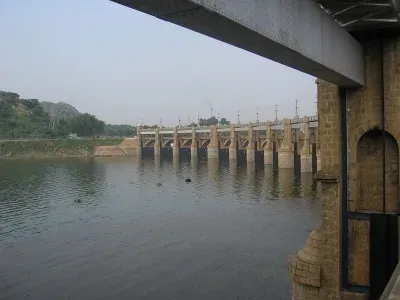
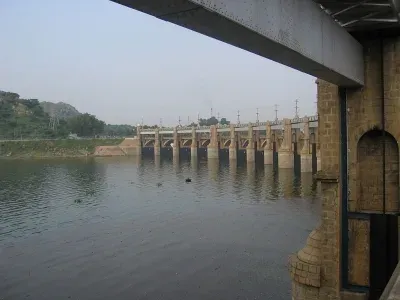
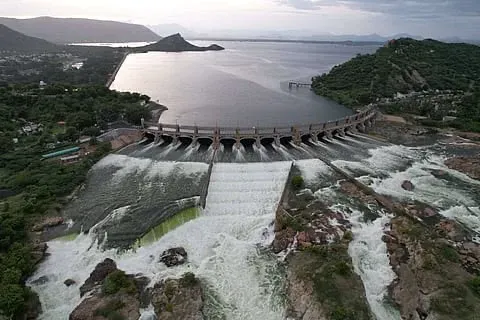
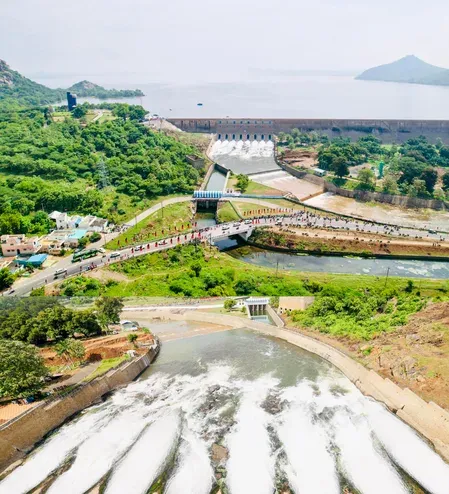
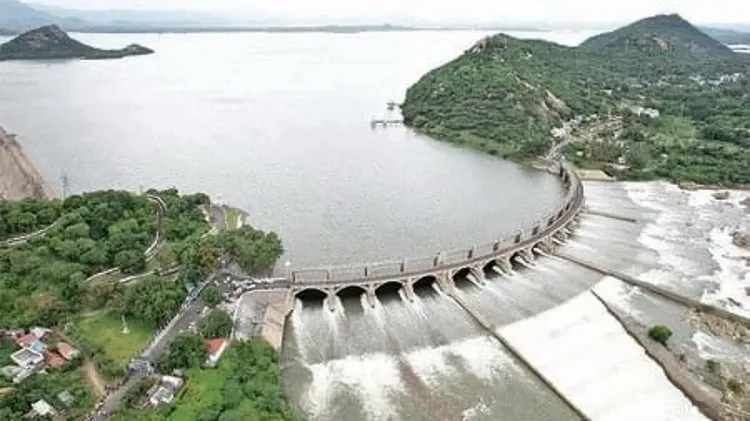
Mettur Dam June 12 opening unlikely as storage at 41 tmcft
Synopsis
Mettur Dam holds barely 41 tmcft — less than half its 93.47 tmcft capacity — as June 12 approaches, the traditional date for kuruvai irrigation in Tamil Nadu's Cauvery delta. With Karnataka's upstream reservoirs also critically low and IMD forecasting a below-normal monsoon, cultivable area could shrink from last year's record 6.09 lakh acres to just 2.5 lakh acres.
Key Takeaways
Mettur Dam held only 41 tmcft as of 31 May 2025 against a full capacity of 93.47 tmcft .
The customary June 12 opening for kuruvai irrigation is considered increasingly unlikely by senior officials.
IMD has forecast a delayed southwest monsoon onset and revised rainfall to 90% of the long-period average.
Karnataka's KRS and Kabini reservoirs together hold just 16.09 tmcft against a combined capacity of 68.97 tmcft .
Kuruvai coverage may be limited to 2.5 lakh acres , down sharply from last year's record 6.09 lakh acres .
The state government is reportedly weighing a farmer assistance package and promotion of pulse cultivation as an alternative.
The customary June 12 opening of Mettur Dam for kuruvai irrigation in Tamil Nadu's Cauvery delta looks increasingly doubtful this year, with reservoir storage at less than half its capacity and the southwest monsoon forecast revised downward. Senior state government officials confirmed that current water levels are far from sufficient to support the traditional release date.
Current Storage Situation
As of Saturday, 31 May 2025, the Mettur reservoir held approximately 41 tmcft against its full capacity of 93.47 tmcft — a shortfall of more than 50 tmcft. The dam was receiving an inflow of roughly 1,950 cusecs while releasing around 1,000 cusecs downstream.
The situation upstream in Karnataka compounds the concern. According to data from the Karnataka State Natural Disaster Monitoring Centre, the combined storage in the Krishnaraja Sagar (KRS) and Kabini reservoirs stood at just 16.09 tmcft against a total capacity of 68.97 tmcft. The Harangi and Hemavathy reservoirs together held 17.75 tmcft against a combined capacity of 45.6 tmcft.
Monsoon Forecast Adds to Worry
The India Meteorological Department (IMD) has forecast a delayed onset of the southwest monsoon and revised its rainfall projection to 90 per cent of the long-period average. This below-normal forecast has intensified concerns over water availability ahead of the critical kuruvai sowing window.
Notably, despite the current shortfall, Tamil Nadu has already received about 330 tmcft of Cauvery water at Biligundulu during the 2025-26 water year — significantly exceeding its annual share of 176.85 tmcft.
Impact on Kuruvai Cultivation
Officials estimate that with present storage levels, kuruvai cultivation may be supported across only about 2.5 lakh acres, aided by nearly one lakh borewells and filter points. This is a steep drop from recent years: normal kuruvai coverage has been around 4.4 lakh acres, while last year it touched a record 6.09 lakh acres.
Agricultural experts note that irrigating even three lakh acres would require at least 80 tmcft of water — nearly double what is currently available. The state government is reportedly considering a special assistance package for affected farmers.
Historical Pattern and Alternatives
During the previous Dravida Munnetra Kazhagam (DMK) government's term from 2021 to 2026, the Mettur Dam was opened on schedule in three out of five years. In 2022 it was opened ahead of schedule, but in 2023 irrigation releases were delayed until 29 July, when storage had reached nearly 88 tmcft.
Agricultural experts have advised farmers to complete pulse sowing — particularly black gram — by the second week of June to avoid damage from heavy rain during the latter phase of the southwest monsoon or the onset of the northeast monsoon. The state is also reportedly exploring measures to encourage pulse cultivation as an alternative crop this season.
With upstream reservoirs critically low and the monsoon forecast uncertain, the coming weeks will be decisive for millions of delta farmers dependent on the Cauvery for their livelihoods.
Point of View
Depleted Karnataka upstream storage, and a reservoir at less than half capacity form a rare convergence of risks. What deserves scrutiny is whether the state's contingency planning — pulse promotion, borewell support, farmer assistance packages — is being activated early enough or will, as in past lean years, arrive after the sowing window has closed. The record 6.09 lakh acres achieved last year also raises the question of whether that expansion was sustainable given the hydrological baseline, or whether it set farmer expectations that this season's reality cannot meet.
NationPress
14 Oct 2026
Frequently Asked Questions
Why is the Mettur Dam June 12 opening unlikely in 2025?
The Mettur Dam's customary June 12 opening for kuruvai irrigation is in doubt because the reservoir holds only about 41 tmcft against its full capacity of 93.47 tmcft. Upstream Karnataka reservoirs are also critically low, and IMD has forecast a delayed, below-normal southwest monsoon.
What is the current water level at Mettur Dam?
As of 31 May 2025, Mettur Dam held approximately 41 tmcft of water, with an inflow of around 1,950 cusecs and a downstream release of about 1,000 cusecs. The dam's full storage capacity is 93.47 tmcft.
How much kuruvai area can be irrigated this year?
Officials estimate that current storage may support kuruvai cultivation across only about 2.5 lakh acres, aided by nearly one lakh borewells and filter points. This compares with last year's record coverage of 6.09 lakh acres and a normal coverage of around 4.4 lakh acres.
What are Karnataka's reservoir levels and why do they matter?
Karnataka's KRS and Kabini reservoirs together hold just 16.09 tmcft against a combined capacity of 68.97 tmcft; Harangi and Hemavathy hold 17.75 tmcft against 45.6 tmcft. These upstream reservoirs feed the Cauvery system, so their low levels directly reduce inflows into Mettur Dam.
What alternatives are being considered for farmers this season?
The Tamil Nadu government is reportedly considering a special assistance package for farmers hit by the water shortage. Agricultural experts have also advised early sowing of pulses — particularly black gram — by the second week of June, and the state is exploring measures to encourage pulse cultivation as an alternative to paddy this season.