Modi at Prambanan: India's decade-long push to restore Asia's Hindu heritage
Synopsis
Modi's visit to Prambanan is more than a diplomatic photo-op — it caps a decade of India-funded restoration spanning Myanmar's Bagan, Cambodia's Angkor, Nepal's earthquake-hit temples, and Bangladesh's Ramna Kali Temple. The Letter of Intent signed with Indonesia on 8 July 2025 adds the region's largest Hindu complex to that list, signalling a deliberate civilisational diplomacy doctrine taking shape across the Indo-Pacific.
Key Takeaways
India and Indonesia signed a Letter of Intent on 8 July 2025 for conservation of the Prambanan Temple complex , a UNESCO World Heritage Site in Yogyakarta.
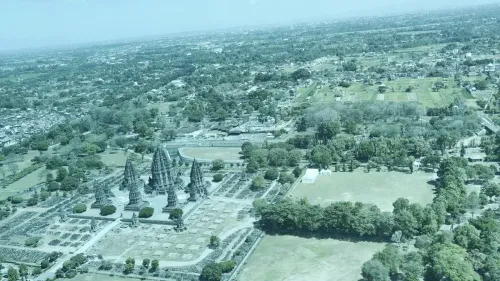
The Prambanan complex , built in the 10th century , originally comprised 240 temples and is the largest Hindu temple complex in Indonesia.
Since 2014 , India has funded or co-funded restoration at heritage sites in Vietnam, Myanmar, Nepal, Bangladesh, Sri Lanka, Cambodia, Laos, and Bahrain .
India's US$50 million Nepal reconstruction programme covered 28 cultural heritage sites after the 2015 earthquake .
The Archaeological Survey of India (ASI) restored 12 pagodas and the Ananda Temple in Myanmar's Bagan Archaeological Zone .
India extended LKR 326 million in grant assistance to restore Sri Lanka's Thiruketheeswaram Temple under a 2015 MoU .
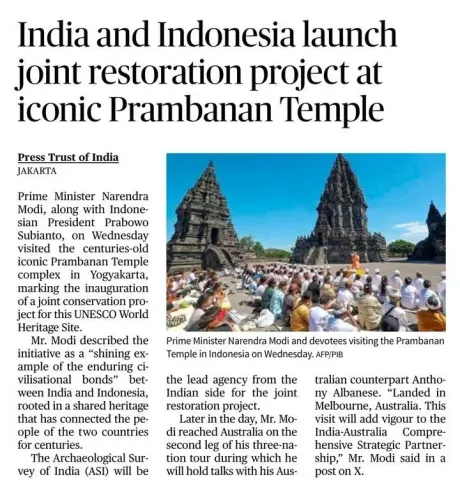
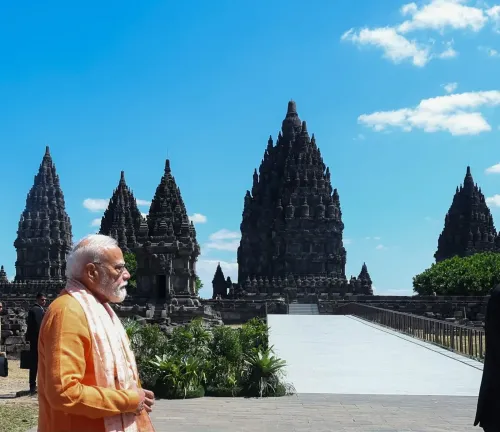
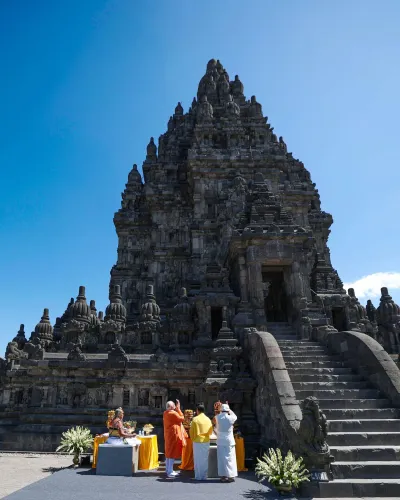
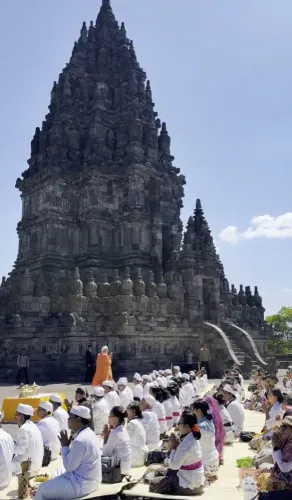
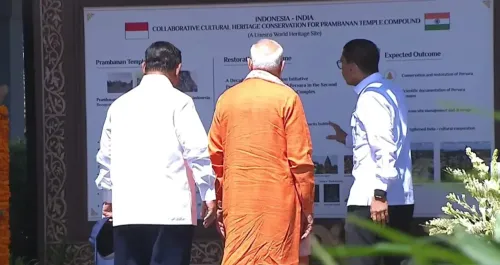
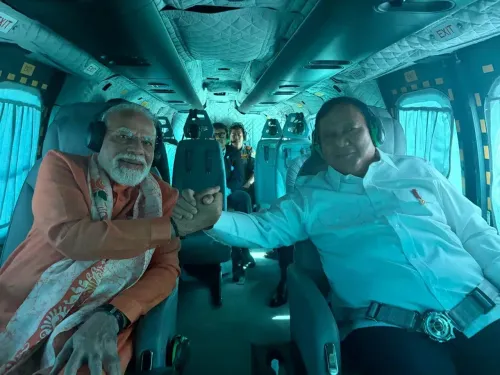
Prime Minister Narendra Modi visited the Prambanan Temple complex in Yogyakarta, Indonesia on 9 July 2025, a day after India and Indonesia formalised an India-backed conservation and restoration project at the UNESCO World Heritage Site through a Letter of Intent. The exchange followed bilateral talks between Modi and Indonesian President Prabowo Subianto, underscoring the two nations' commitment to deepening their Comprehensive Strategic Partnership and advancing shared civilisational ties across the Indo-Pacific.
What the Prambanan Temple Represents
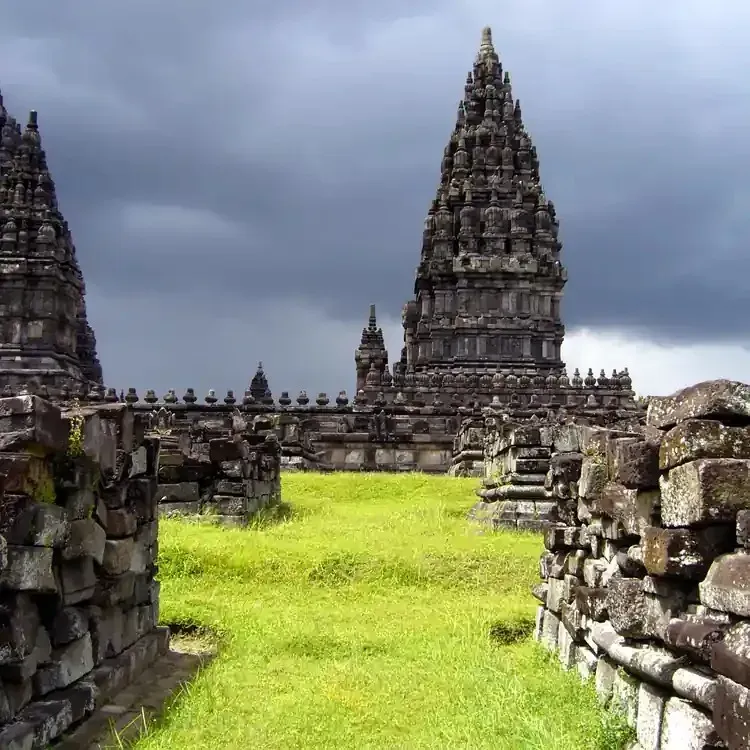
Constructed in the 10th century, the Prambanan Temple complex is the largest Hindu temple complex in Indonesia and is dedicated primarily to Lord Shiva. The complex features towering shrines to the Hindu trinity — Shiva, Vishnu, and Brahma — alongside temples devoted to their divine vehicles. Its stone walls carry intricate reliefs depicting scenes from the Ramayana, a testament to the deep spiritual and cultural currents that once flowed between the Indian subcontinent and Southeast Asia.
At the heart of the complex stands the 47-metre Shiva temple — the tallest structure at Prambanan and widely regarded as one of the finest surviving examples of ancient Hindu architecture. The sprawling site originally comprised 240 temples, placing it among the largest Hindu temple complexes anywhere in the world.
A Pattern of Cultural Diplomacy Across Asia
The Prambanan initiative is the latest in a pattern of heritage diplomacy that India has pursued across the region since 2014. In Vietnam, an MoU signed in 2014 enabled India to undertake conservation work at the UNESCO-listed Mỹ Sơn Sanctuary, the religious centre of the ancient Champa Kingdom and one of Southeast Asia's most significant Shaivite complexes.
In Myanmar, India signed an MoU in 2017 to restore earthquake-damaged monuments in the UNESCO-listed Bagan Archaeological Zone. The Archaeological Survey of India (ASI) went on to restore 12 historic pagodas and complete conservation work at the renowned Ananda Temple. Since 2022, India has continued conservation work at Cambodia's Angkor Heritage Complex, including Ta Prohm, Angkor Wat, and Preah Vihear. In Laos, India restored key structures of the UNESCO-listed Vat Phou Temple, a nearly 1,000-year-old Shiva temple considered one of Southeast Asia's oldest surviving symbols of Sanatan civilisation.
Restoration Work in South Asia and the Gulf
Closer to home, India's heritage outreach has been equally active. Following the devastating 2015 earthquake in Nepal, India launched restoration and conservation of 28 cultural heritage sites under a US$50 million reconstruction assistance programme, including the Seto Machhindranath Temple and the Budhanilkantha Temple Dharamshala.
In Bangladesh, India announced assistance for the reconstruction of the historic Ramna Kali Temple — destroyed during Pakistan's Operation Searchlight in 1971 — which was inaugurated in 2021. India also financed the restoration of the nearly 300-year-old Joy Kali Mata Temple in Natore through grant assistance in 2020, along with the Anandomoyee Kali Mata Mandir and the Ramakrishna Temple.
In Sri Lanka, under an MoU signed in July 2015, India extended LKR 326 million in grant assistance to restore the historic Thiruketheeswaram Temple, one of Sri Lanka's five ancient Pancha Ishwarams dedicated to Lord Shiva. During his 2019 visit to Bahrain, Modi inaugurated the US$4.2 million redevelopment of the 200-year-old Shreenathji (Shri Krishna) Temple in Manama, preserving one of the Gulf region's oldest Hindu temples.
Why This Matters Beyond Diplomacy
This comes amid a broader Indian foreign policy posture that has increasingly woven civilisational and cultural threads into its strategic outreach — particularly in the Indo-Pacific, where historical Hindu and Buddhist linkages offer India a form of soft power distinct from economic or military leverage. Notably, the majority of sites India has chosen to restore are either UNESCO-listed or carry significant Shaivite heritage, reflecting a coherent thematic focus rather than ad hoc cultural goodwill.
How effectively these restoration commitments translate into lasting diplomatic capital — and whether recipient nations view them as genuine cultural partnership or strategic positioning — will shape the long-term impact of this approach.
Point of View
Not just a gesture — but the doctrine deserves scrutiny. Every site India has chosen to fund is either Shaivite or broadly Hindu in character, which raises the question of whether this is civilisational partnership or civilisational branding. The Prambanan Letter of Intent arrives as India courts Indonesia, the world's largest Muslim-majority nation, on strategic and trade grounds; the temple diplomacy adds cultural texture but also carries the risk of being read as identity politics projected abroad. The harder test is execution: India's record at Angkor and Bagan has been creditable, but the Nepal programme — 28 sites, US$50 million — has moved unevenly. Prambanan is a higher-profile commitment, and shortfalls here will be more visible.
NationPress
7 Oct 2026
Frequently Asked Questions
What is the Prambanan Temple and why is India involved in its restoration?
The Prambanan Temple complex is a 10th-century UNESCO World Heritage Site in Yogyakarta, Indonesia, and the largest Hindu temple complex in the country. India signed a Letter of Intent with Indonesia on 8 July 2025 to fund and support its conservation and restoration, reflecting a broader Indian policy of preserving shared civilisational heritage across Asia.
What did Modi and Prabowo Subianto discuss during the bilateral talks?
Prime Minister Narendra Modi and Indonesian President Prabowo Subianto held talks focused on deepening their Comprehensive Strategic Partnership and ensuring a peaceful Indo-Pacific. The Letter of Intent on Prambanan conservation was among the outcomes exchanged after those discussions.
Which other countries has India helped restore heritage sites in?
Since 2014, India has funded or co-funded heritage restoration in Vietnam (Mỹ Sơn Sanctuary), Myanmar (Bagan Archaeological Zone), Nepal (28 sites post-2015 earthquake), Bangladesh (Ramna Kali Temple, Joy Kali Mata Temple), Sri Lanka (Thiruketheeswaram Temple), Cambodia (Angkor complex), Laos (Vat Phou Temple), and Bahrain (Shreenathji Temple in Manama).
How significant is the Prambanan Temple complex historically?
Built in the 10th century, Prambanan originally comprised 240 temples and is dedicated primarily to Lord Shiva. Its 47-metre central Shiva temple is one of the finest examples of ancient Hindu architecture, and its walls carry Ramayana reliefs that reflect centuries-old cultural ties between India and Southeast Asia.
How much has India committed to heritage restoration in Nepal?
India launched a US$50 million reconstruction assistance programme in Nepal following the devastating 2015 earthquake, covering the restoration and conservation of 28 cultural heritage sites, including the Seto Machhindranath Temple and the Budhanilkantha Temple Dharamshala.