Kishan Reddy shares Modi's push to boost ANRF research funding
Synopsis
Union Minister G. Kishan Reddy shared PM Narendra Modi's statement that ₹12,000 crore has been committed to commercialising lab-ready technologies under the ANRF, with private investors matching that figure — a total of ₹24,000 crore mobilised within a year toward India's ₹1 lakh crore research vision.
Key Takeaways
₹12,000 crore committed within a year to commercialise lab-ready technologies under the Anusandhan National Research Foundation .
Private investors have matched the government's ₹12,000 crore with an equal contribution, bringing total deployed capital to ₹24,000 crore .
The broader pledge stands at ₹1 lakh crore for research, development, and innovation under the Viksit Bharat framework.
The ANRF was created by statute in 2023 to replace the Science and Engineering Research Board and fund research across all disciplines.
The foundation's design explicitly targets the 'valley of death' between laboratory results and commercial products through public-private co-investment.
India's ambition to become a research-driven economy by 2047 got a fresh public airing on Thursday, 29 October 2026, when Union Coal and Mines Minister G. Kishan Reddy shared a statement by Prime Minister Narendra Modi underlining the government's accelerating push behind the Anusandhan National Research Foundation (ANRF) — and the private capital now flowing alongside it.
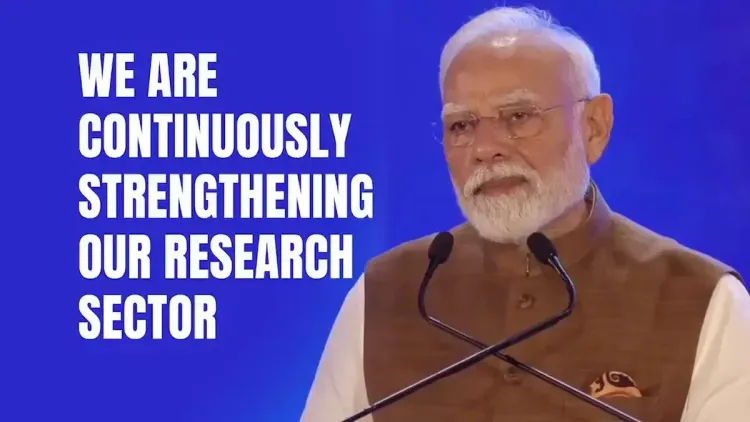
Quoting the Prime Minister directly, Reddy's post carried Modi's assertion: 'To build a #ViksitBharat, we are continuously strengthening our research ecosystem.' The statement pointed to a pledge of ₹1 lakh crore made at an earlier platform for research, development, and innovation — and declared that, within a single year, ₹12,000 crore has already been committed toward commercialising lab-ready technologies.
ANRF: from statute to ₹12,000 crore in motion
The Anusandhan National Research Foundation was established under the ANRF Act 2023, replacing the older Science and Engineering Research Board to create a broader, better-capitalised body capable of funding research across all scientific disciplines. Its founding logic was deliberate: move Indian science away from isolated grant cycles and toward mission-oriented projects with a clear path from laboratory bench to commercial shelf. That philosophy is now producing numbers. According to Modi's statement as shared by Reddy, private investors have matched the government's ₹12,000 crore commitment with an equal investment of their own — bringing the total capital deployed toward lab-to-market translation to ₹24,000 crore in under a year. Co-investment of this scale signals that the private sector views the ANRF not as a government subsidy exercise but as a credible deal-flow pipeline.Why the public-private match matters
For decades, India's gross expenditure on research and development has lagged well behind peer economies, hovering around 0.7 percent of GDP while countries like China and South Korea push past two percent. Government-only funding, historically the backbone of Indian R&D, has rarely been sufficient to bridge the 'valley of death' between a proven laboratory result and a scaleable product. The ANRF model attempts a structural fix: government seed capital de-risks early-stage research, and matching private investment carries it through commercialisation. The fact that private investors are now reported to be 'actively joining this effort' — in Modi's words — suggests the mechanism is working as an incentive, not merely as an aspiration.Viksit Bharat's R&D engine
The Viksit Bharat vision — a developed India by 2047, the centenary of independence — has become the organising frame for a range of flagship programmes, from infrastructure to manufacturing. Research and innovation have increasingly occupied a central pillar of that narrative, with the ANRF positioned as the institutional engine to drive it. Kishan Reddy's decision to amplify the Prime Minister's statement signals that the BJP's political messaging is now leaning into research funding as a tangible deliverable — not just a budgetary line item. The ₹12,000 crore committed within a year, and the matching private capital, are the kind of concrete figures that translate an abstract 'developed India' promise into something voters and scientists alike can benchmark against. The real test will arrive when those committed funds produce visible products, patents, and employment — and Parliament scrutinises exactly which technologies have made the journey from lab to market.Point of View
Output-light R&D funding culture — and the reported private match of ₹12,000 crore, if sustained, would mark a genuine inflection in how Indian industry engages with early-stage science. By amplifying Modi's figures, Kishan Reddy is helping the BJP stake a political claim on the innovation economy ahead of a budget cycle where R&D expenditure will face parliamentary scrutiny. The Viksit Bharat framing also ties short-term funding milestones to a long-horizon national identity project, making it harder for critics to dismiss individual numbers without appearing to oppose the broader aspiration. The credibility of this narrative will ultimately rest on auditable outputs — patents filed, technologies licensed, firms spun out — rather than capital-committed figures alone.
NationPress
29 Oct 2026
Frequently Asked Questions
What is the Anusandhan National Research Foundation?
The Anusandhan National Research Foundation (ANRF) is a statutory body established under the ANRF Act 2023 to fund and coordinate research across scientific disciplines in India, replacing the earlier Science and Engineering Research Board. It is designed to support mission-oriented research with clear commercialisation pathways.
How much has India committed to ANRF research funding?
According to PM Narendra Modi's statement shared by Union Minister G. Kishan Reddy, the government has pledged ₹1 lakh crore for research, development, and innovation under the Viksit Bharat vision. Within one year, ₹12,000 crore has been committed specifically toward commercialising lab-ready technologies.
Are private companies investing in India's ANRF?
Yes. PM Modi's statement indicates that private investors have matched the government's ₹12,000 crore commitment with an equal investment of their own, bringing the total capital mobilised for lab-to-market technology commercialisation to ₹24,000 crore.
What is Viksit Bharat and how does research fit into it?
Viksit Bharat is PM Modi's vision for India to become a fully developed nation by 2047, the centenary of independence. Research, development, and innovation — anchored institutionally by the ANRF — are positioned as a central pillar of that long-term economic transformation.
Why did Kishan Reddy post about ANRF and Modi's research pledge?
G. Kishan Reddy, Union Minister of Coal and Mines and BJP Telangana state president, shared PM Modi's statement on his official X account on 29 October 2026, amplifying the government's research funding milestones as part of the ruling party's broader Viksit Bharat political messaging.