Kishan Reddy: India Leading in Intangible Assets Under Modi
Synopsis
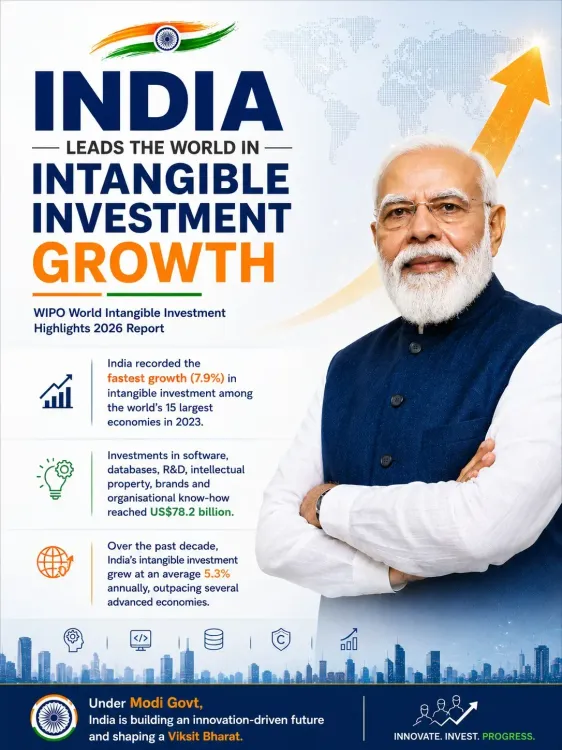
Union Minister G. Kishan Reddy on 20 July 2026 credited PM Modi's policies with pushing India ahead of major advanced economies in intangible assets — software, R&D, and IP — framing the trend as a pillar of the Viksit Bharat 2047 vision.
Key Takeaways
Kishan Reddy claimed on 20 July 2026 that India is outpacing major advanced economies in intangible assets under PM Modi .
The minister highlighted investments in software, R&D, and intellectual property as the key drivers of this growth.
The Digital India programme ( 2015 ), National IPR Policy ( 2016 ), and Startup India ( 2016 ) form the policy backbone of this push.
The claim of outpacing advanced economies rests on no named data source in the post and cannot be independently verified.
The Viksit Bharat 2047 vision frames these intangible-asset gains as foundational to achieving developed-country status.
Upcoming Union Budget R&D allocations and pending AI and data-protection legislation will be key markers to watch.
Union Coal and Mines Minister G. Kishan Reddy on Monday, 20 July 2026 credited Prime Minister Narendra Modi's government with steering India ahead of major advanced economies in intangible assets, citing sustained investments in software, research and development, and intellectual property as the driving force.
Context
In his post on X, Kishan Reddy stated that India is 'seamlessly steering the nation toward a digitally advanced, knowledge-driven economy' under PM Modi's leadership. He framed this momentum as a 'sustained upward trajectory' and a 'testament to the robust policies laying the foundation for a Viksit Bharat 2047.' The minister, who also serves as BJP Telangana state president, made no reference to a specific report or data source in the post.
The claim that India outpaces major advanced economies in intangible assets has not been independently verified against a named dataset or methodology, and should be read as a political assertion rather than a confirmed statistical finding.
Policy Backdrop
The Modi government has pursued a cluster of intangible-asset-focused policies since 2014. The Digital India programme, launched in 2015, expanded digital infrastructure and the software ecosystem, while the National Intellectual Property Rights Policy of 2016 was designed to strengthen IP protection and incentivise R&D commercialisation.
The Startup India initiative, also introduced in 2016, offered tax benefits and funding support for technology startups and boosted intellectual property filings. Together, these programmes have sought to shift India's growth model from physical capital toward software, patents, and brands — mirroring a broader global trend visible among high-income economies.
Since the liberalisation era, India's service sector — particularly IT and software exports — has formed the backbone of this intangible-asset base. The current government has maintained and deepened that trajectory through public procurement mandates, production-linked incentives for electronics, and expanded science and technology budgets.
Stakeholders and Impact
The primary beneficiaries of this policy direction are India's software services firms, R&D institutions, and the broader startup ecosystem. Increased IP filings and a stronger legal framework for intellectual property protection directly affect the valuation and global competitiveness of these entities.
For ordinary citizens, the knowledge-economy push carries implications for high-skill employment, digital public services, and India's long-term per-capita income trajectory — all central to the Viksit Bharat 2047 vision of achieving developed-country status within the next two decades.
Global investors and multinational corporations evaluating India as a destination for R&D centres and technology partnerships also watch these indicators closely, making the government's framing of intangible-asset growth a signal with both domestic and international resonance.
What's Next
Attention will turn to the next Union Budget for concrete R&D expenditure allocations and any revision of the National IPR Policy. Parliament is also expected to take up data-protection and AI governance legislation, which will shape the regulatory environment for the knowledge economy.
How the government substantiates intangible-asset growth claims with verifiable data — and whether an updated national IP or innovation index is released — will determine how this narrative translates into measurable policy outcomes on the road to 2047.
Point of View
' the minister connects a broad macroeconomic claim to a flagship long-term target, reinforcing the government's preferred frame of continuity and ambition. The absence of a cited data source, however, leaves the core statistical claim open to challenge, which is a recurring vulnerability in ministerial social-media commentary on economic performance. Analysts will look for Budget numbers and a revised IPR policy to test whether the rhetoric is matched by measurable public investment.
NationPress
19 Oct 2026
Frequently Asked Questions
What did G. Kishan Reddy say about India's economy?
Kishan Reddy said that under PM Modi's leadership, India is outpacing major advanced economies in intangible assets such as software, R&D, and intellectual property, calling it a foundation for Viksit Bharat 2047.
What is Viksit Bharat 2047?
Viksit Bharat 2047 is the Indian government's national vision to achieve developed-country status by the centenary of independence in 2047, anchored in economic transformation, technological self-reliance, and higher per-capita income.
What policies has the Modi government introduced to grow intangible assets?
Key initiatives include the Digital India programme (2015), the National Intellectual Property Rights Policy (2016), and the Startup India scheme (2016), which together aim to expand software, IP filings, and R&D commercialisation.
Is India really ahead of advanced economies in intangible assets?
Kishan Reddy's post makes this claim, but it does not cite a specific report or dataset. The assertion has not been independently verified against a named methodology and should be treated as a political statement pending official data.
What should we watch next on India's knowledge economy push?
Key developments to track include R&D expenditure in the next Union Budget, any revision of the National IPR Policy, and parliamentary progress on data-protection and AI governance bills.