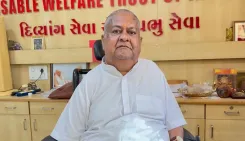
Padma Shri weaver Khemraj Sundriyal credits Modi govt for handloom sector's revival
Synopsis
A Padma Shri-winning weaver with nearly 60 years in handloom has publicly credited the Modi government for giving India's artisan community the recognition it long deserved — a human story that puts a face to broader policy debates around cultural heritage, rural livelihoods, and State support for traditional crafts.
Key Takeaways
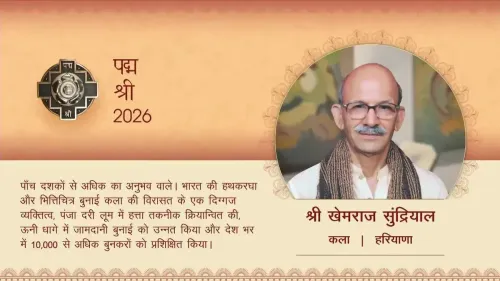
Khemraj Sundriyal , a Padma Shri awardee from Uttarakhand , has dedicated nearly 60 years to India's handloom sector.
He credited the Modi government for recognising weavers and giving the handloom industry a renewed national identity.
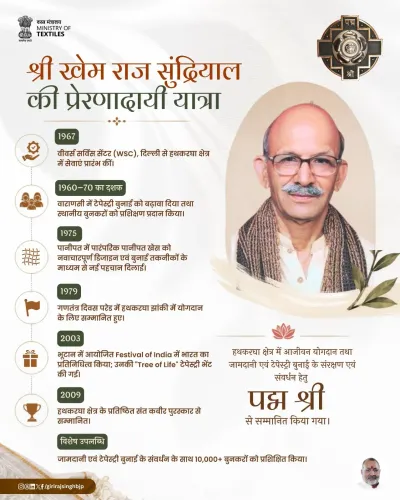
Sundriyal received formal training in weaving and dyeing in Srinagar during the 1960s and later travelled across India to master indigenous techniques.
His son Ajay Sundriyal described the Padma Shri notification call as 'a proud and emotional moment' for the family.
The story highlights ongoing government efforts to honour artisans who have preserved India's traditional cultural heritage.
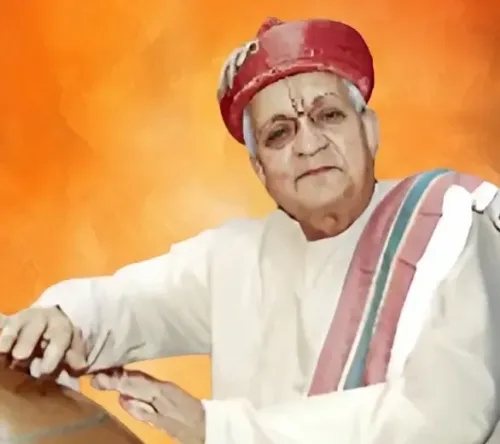
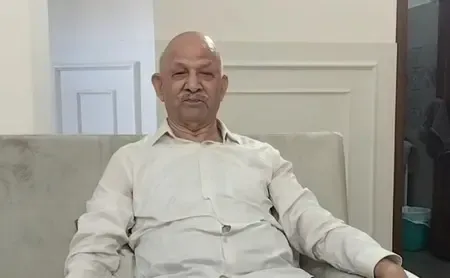
Padma Shri awardee Khemraj Sundriyal, a veteran handloom artisan with nearly six decades of experience, on Thursday, 17 September said that the Narendra Modi-led government has played a pivotal role in giving a renewed identity and recognition to India's handloom industry and its weaving community. Sundriyal made the remarks in Panipat, also extending his birthday wishes to Prime Minister Narendra Modi.
Decades of Unrecognised Craftsmanship
Sundriyal noted that for many years, the skills and craftsmanship of countless artisans and weavers across the country remained largely unacknowledged, despite their immense contribution to preserving India's traditional craft heritage. He recalled that the handloom industry was struggling in the mid-1970s, prompting the Government of India to establish training centres and introduce initiatives aimed at equipping weavers with modern skills and technical knowledge.
Born in the Himalayan region of Uttarakhand, Sundriyal developed an early passion for textiles and traditional weaving techniques. He underwent formal training in weaving and dyeing in Srinagar during the 1960s and subsequently travelled extensively across India to learn indigenous weaving methods from master craftsmen, eventually earning recognition as one of the country's most respected handloom artisans.
The Padma Shri and a Family's Pride
Sundriyal credited Prime Minister Modi for recognising his lifelong contribution to the handloom sector through the prestigious Padma Shri award. His son, Ajay Sundriyal, said that although his father had been engaged in the handloom sector for nearly 60 years, the exceptional craftsmanship had not received the recognition it deserved for a long time.
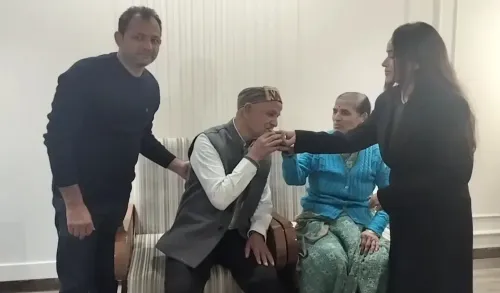
'It was a proud and emotional moment for our family when we received a personal call informing us that my father had been selected for the Padma Shri,' Ajay said, also conveying his gratitude and birthday wishes to the Prime Minister.
A Broader Message on Artisan Recognition
Sundriyal's journey reflects a wider narrative about the importance of recognising talent, hard work, and self-reliance in transforming the lives of ordinary families. It also underscores government efforts to honour artisans who have preserved India's rich cultural and traditional heritage over generations.
This comes amid sustained policy attention on India's handloom sector, which employs millions of weavers and artisans, particularly in rural and semi-urban pockets, and represents a significant strand of the country's cultural export identity. The government has periodically rolled out schemes targeting market access, skilling, and branding for handloom products.
What It Means for the Handloom Community
Stories like Sundriyal's carry symbolic weight for weaver communities nationwide, signalling that decades-long contributions to traditional craftsmanship can receive formal State recognition. Industry observers note that while awards and visibility matter, sustained demand creation and fair pricing remain enduring challenges for the sector's grassroots workforce.
As the handloom industry continues navigating competition from power-loom and synthetic alternatives, the spotlight on veteran artisans such as Sundriyal is expected to reinforce calls for stronger institutional support and market linkages going forward.
Point of View
And the conflation of the two deserves scrutiny. Recognition through awards is meaningful but distinct from systemic reform — the handloom sector still faces structural pressures from power-loom competition, synthetic substitutes, and thin margins for grassroots weavers. The government's training-centre push dates to the 1970s, predating the current dispensation, and its scale relative to the sector's workforce of several million remains modest. Honouring individual artisans is necessary, but the harder question — whether policy has materially improved livelihoods across the weaver community, not just its most decorated members — remains underexplored in coverage of this kind.
NationPress
17 Sept 2026
Frequently Asked Questions
Who is Khemraj Sundriyal?
Khemraj Sundriyal is a Padma Shri-awarded handloom artisan from Uttarakhand who has worked in India's weaving sector for nearly six decades. He trained in weaving and dyeing in Srinagar in the 1960s and is regarded as one of India's most respected traditional handloom craftsmen.
Why did Khemraj Sundriyal praise the Modi government?
Sundriyal credited the Modi government for giving a renewed identity and recognition to India's handloom industry and its weaving community. He specifically acknowledged Prime Minister Modi for honouring his lifelong contribution through the prestigious Padma Shri award.
What challenges did the handloom sector face historically?
According to Sundriyal, the handloom industry was struggling in the mid-1970s, and artisans' skills went largely unrecognised for decades. The Government of India subsequently established training centres and introduced skilling initiatives to help weavers adopt modern techniques.
What did Ajay Sundriyal say about the Padma Shri?
Ajay Sundriyal, Khemraj's son, called the Padma Shri notification a 'proud and emotional moment' for the family, noting that his father's exceptional craftsmanship had gone unrecognised for far too long despite nearly 60 years of dedicated service to the sector.
What is the broader significance of Sundriyal's story for Indian weavers?
Sundriyal's recognition is seen as a signal that decades of contribution to traditional craftsmanship can receive formal State acknowledgement, offering hope to artisan communities nationwide. It also draws attention to ongoing debates about sustainable livelihood support and market access for India's handloom workforce.