Modi at Viksit Bharat Sabha: India moved from 'policy paralysis' to 'reform express' since 2014
Synopsis
At the Viksit Bharat Sankalp Sabha, Modi drew his starkest before-and-after portrait of Indian governance yet, invoking 'policy paralysis' as shorthand for the pre-2014 era and 'reform express' for the decade-plus since. The speech is less a policy announcement and more a reframing: an attempt to lock in a dominant narrative of transformation ahead of future electoral cycles.
Key Takeaways
PM Narendra Modi addressed the Viksit Bharat Sankalp Sabha in New Delhi on 7 October 2026 .
He described pre- 2014 India as immersed in despair and disappointment, contrasting it with the current government’s ‘reform express’ trajectory.
Modi claimed the decade from 2015 to 2025 recorded the highest consistent agricultural growth since Independence — claims not independently verified at the time of reporting.
He cited Made-in-India mobile phones , rising solar power capacity , and new export records as markers of transformation.
He articulated a ‘saturation’ governance model under Sabka Saath, Sabka Vikas , aimed at ensuring no eligible beneficiary is excluded from government schemes.
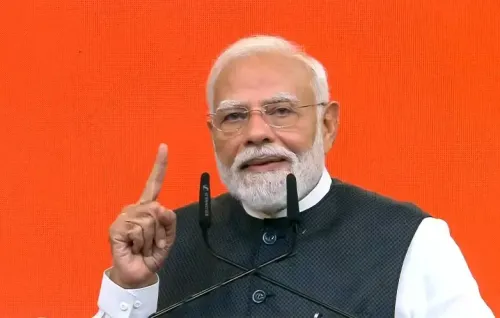
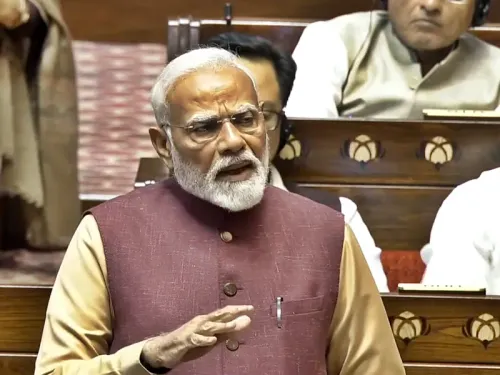
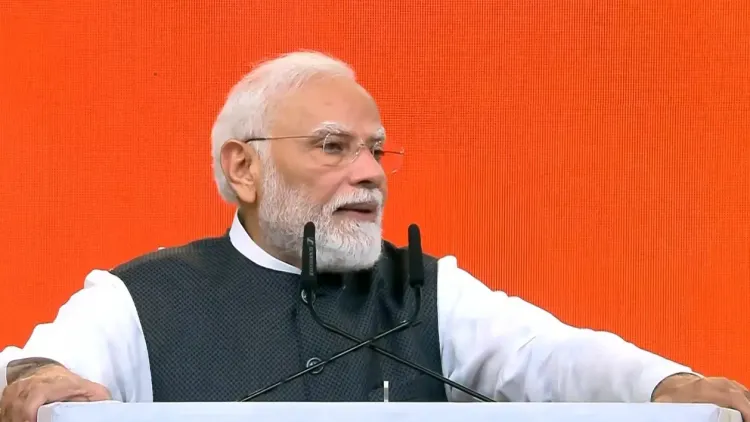
Prime Minister Narendra Modi on Wednesday, 7 October drew a sharp contrast between what he described as pre-2014 India — ‘immersed in despair and disappointment’ — and the country’s current trajectory under the Bharatiya Janata Party (BJP)-led National Democratic Alliance (NDA) government. Speaking at the Viksit Bharat Sankalp Sabha in New Delhi, Modi said the nation had travelled from ‘policy paralysis’ to a ‘reform express’ over the past 12 years.
What Modi Said at the Viksit Bharat Sankalp Sabha
Addressing the gathering, Modi recalled the state of the economy when he assumed office. He said that in 2014, formidable challenges stood before the country, problems seemed to be everywhere, and every citizen was looking for a new path. ‘Regarding India’s economy, the world had started saying, “It’s a gone case”. There was no growth to be seen anywhere, inflation was touching the sky, and a country immersed in despair and disappointment once again needed a new sense of confidence,’ he said.
Modi added that his response in 2014 was to invoke collective will. ‘I called upon the collective strength of crores of Indians and once again told them, “We will do it!”’ he said. ‘And today, 12 years later, the picture has changed completely.’
Key Claims: From Imports to Exports, Blackouts to Solar Power
The Prime Minister listed several markers of what he called India’s transformation. On trade, he noted that earlier India sought ways to increase imports, whereas today new export records are being set. He also pointed out that India once imported mobile phones it needed, while today Made-in-India mobile phones are making their mark globally. On energy, he contrasted past power outages — which he said would become global headlines — with India’s rising solar capacity, now the subject of international discussion.
Modi also argued that during the previous government’s tenure, a crisis would shake the Indian economy, whereas now ‘India’s strength and resilience are discussed’ when a crisis occurs.
Agricultural Growth: A Decade of Records, Modi Claims
Modi cited agriculture as an ‘excellent example’ of the change he described. He claimed that the decade from 2015 to 2025 had delivered the highest consistent agricultural growth since Independence, outpacing even major agricultural economies globally. ‘This happens only when the intentions are clear, and the policies are clear,’ he said. These claims were not independently verified at the time of reporting.
Governance Philosophy: Saturation Over Segmentation
The Prime Minister articulated what he called the ‘saturation’ principle — ensuring every eligible beneficiary is covered, with no one left out and no one able to deprive another of their rightful entitlements. He connected this to his government’s Sabka Saath, Sabka Vikas motto, arguing that dividing society along caste or community lines for electoral purposes was ‘one of the major tragedies’ of India’s governance history.
‘Just think, if water does not reach the fields, who suffers? Are only farmers of one caste affected by it? If electricity is not available, does darkness prevail only in the homes of one community? The answer to all these questions is no. If the problem affects everyone, the solution should also be for everyone,’ he said.
What Comes Next
The Viksit Bharat Sankalp Sabha is part of a broader government outreach to showcase welfare and development milestones. Modi’s remarks come as the government increasingly frames its economic narrative around structural reforms. The Opposition had not formally responded to Wednesday’s address at the time of reporting, though Congress leaders have previously disputed government data on agriculture and employment. Further engagements under the Viksit Bharat framework are expected in the coming weeks.
Point of View
But it elides a more complex picture. India’s agricultural growth data and export milestones are contested terrain — independent assessments of farm income and rural distress often diverge from official output figures. The ‘saturation’ principle is genuinely significant as a welfare delivery philosophy, but its actual coverage gaps remain under-reported. Most critically, the speech is as much electoral architecture as governance review — and in that context, what Modi chose not to address about unemployment or income inequality is as revealing as what he did.
NationPress
7 Oct 2026
Frequently Asked Questions
What did PM Modi say at the Viksit Bharat Sankalp Sabha on 7 October?
PM Modi said India had transformed from ‘policy paralysis’ under previous governments to a ‘reform express’ over the 12 years since he took office in 2014. He cited agricultural growth, mobile phone manufacturing, solar energy expansion, and export records as evidence of this change.
What is the Viksit Bharat Sankalp Sabha?
The Viksit Bharat Sankalp Sabha is a government outreach programme designed to highlight welfare and development milestones under the NDA government. It is part of the broader Viksit Bharat (Developed India) framework that the Modi government has positioned as its long-term governance vision.
What did Modi mean by the ‘saturation’ model of governance?
Modi used ‘saturation’ to describe a welfare delivery model where every eligible beneficiary is covered and no one is left out. He linked this to his government’s Sabka Saath, Sabka Vikas principle, arguing that development must cut across caste, community, and other social divisions.
What agricultural growth claim did Modi make?
Modi claimed that the decade from 2015 to 2025 delivered the highest consistent agricultural growth since Independence, surpassing even major global agricultural economies. These claims were not independently verified at the time of reporting.
How has the Opposition responded to Modi’s remarks?
The Opposition had not formally responded to Wednesday’s address at the time of reporting. Congress leaders have previously disputed government data on agriculture and employment outcomes and are likely to contest some of the claims made at the Sabha.