PM Modi: Social security coverage up from 25 crore to 100 crore since 2014
Synopsis
At Ekta Nagar on Sardar Patel's 151st birth anniversary, PM Modi claimed India's social security net has expanded fourfold — from under 25 crore to nearly 100 crore people since 2014. Backed by a World Bank poverty statistic and the DBT framework, it is among the most sweeping welfare claims of his third term, and a pointed electoral signal.
Key Takeaways
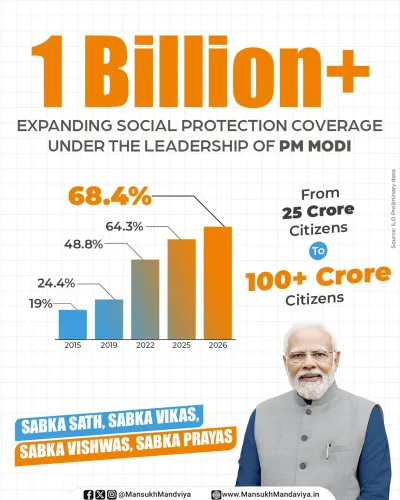
PM Modi claimed social security coverage has risen from under 25 crore to nearly 100 crore people since 2014 .
The expansion was attributed to Direct Benefit Transfer (DBT) , free foodgrain, housing, sanitation, and clean cooking fuel schemes.
Modi cited a World Bank report stating 50 crore Indians exited extreme poverty in the 10–12 years before 2024 .
Extreme poverty rate reportedly fell from 27 per 100 to under 3 per 100 , according to the data Modi referenced.
The address was delivered at Ekta Nagar, Gujarat , on 31 October — Rashtriya Ekta Diwas — marking Sardar Patel's 151st birth anniversary .
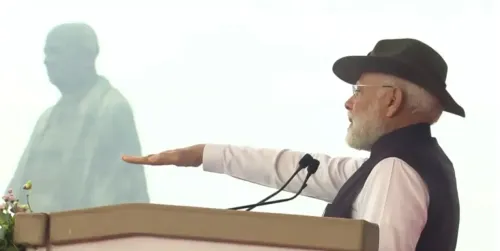
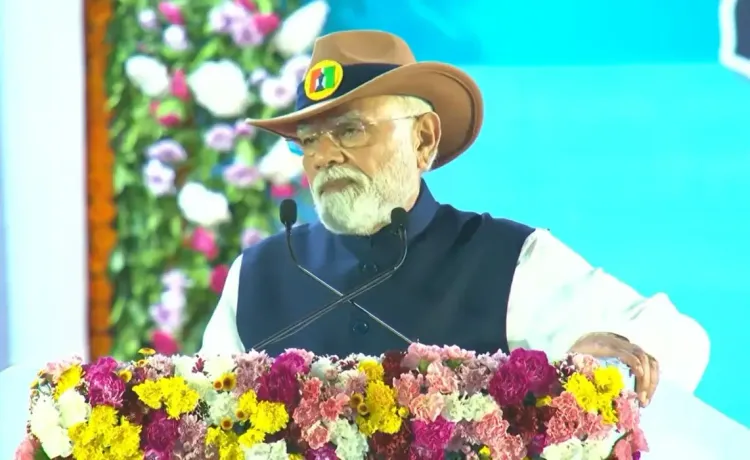
Prime Minister Narendra Modi on 31 October 2026 said nearly 100 crore Indians are now covered under social security schemes — a fourfold jump from the fewer than 25 crore who had such protection before 2014. The Prime Minister made the claim while addressing the Rashtriya Ekta Diwas programme at Ekta Nagar in Gujarat, held on the 151st birth anniversary of Sardar Vallabhbhai Patel.
What Modi Said
'Before 2014, not even 25 crore people in the country had a social security cover. Today, nearly 100 crore people have been brought under social security coverage,' the Prime Minister said. He attributed the expansion to a government-wide push on welfare delivery and what he described as a leakage-free benefit system.
Modi specifically credited the Direct Benefit Transfer (DBT) framework, saying it had ensured that funds released by the Centre reached beneficiaries directly, 'reducing the scope for leakages in the delivery of welfare assistance.'
Schemes Cited as Evidence
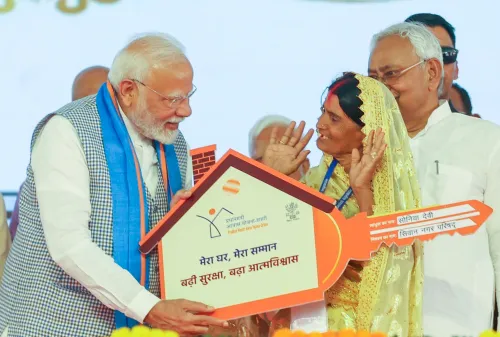
Modi listed several flagship programmes as contributors to the expanded social protection net — free foodgrain distribution, subsidised healthcare, construction of permanent houses and toilets, and access to clean cooking fuel. He argued these had collectively reduced out-of-pocket expenditure for poor households and provided a financial buffer during crises through insurance coverage.
'These initiatives had reduced the financial burden on families by helping them save money on essential needs. Insurance coverage had provided support to millions of people during periods of crisis,' he said.
World Bank Poverty Data Invoked
Earlier in his address, Modi cited a recent World Bank report to claim that 50 crore Indians had moved out of extreme poverty in the 10–12 years preceding 2024. He said the proportion of people living in extreme poverty had declined 'from 27 per 100 to fewer than three per 100,' describing it as evidence of the transformative impact of welfare measures and improved delivery infrastructure.
Notably, independent economists have at times flagged the methodology used in poverty measurement, and the World Bank's own poverty line remains a subject of ongoing academic debate. The Prime Minister did not specify which exact World Bank report or dataset he was referencing.
Context: Rashtriya Ekta Diwas Address
The address was delivered at Ekta Nagar, the town formerly known as Kevadia, which is home to the Statue of Unity — a site that has become synonymous with National Unity Day observances under the current government. Modi framed the social security expansion as part of a broader national story of empowerment, contrasting his government's approach — 'welfare and empowerment of poor people' — with what he described as earlier governments' reliance on promises alone.
With key state elections on the horizon, the data points Modi invoked are likely to shape the ruling party's welfare narrative in the months ahead.
Point of View
But its credibility hinges on how 'coverage' is defined — whether it means active, functional protection or mere enrolment in a scheme. India's welfare architecture has historically suffered from high enrolment-to-utilisation gaps. Modi's invocation of the World Bank poverty data is politically effective but academically contested; the World Bank's poverty line methodology is regularly challenged by development economists. The DBT framework has genuinely reduced leakage in measurable ways, but attributing the full fourfold coverage expansion to it risks overstating a single instrument. With assembly elections approaching, these numbers will be tested not just by opposition parties but by voters who know whether their local ration shops and Ayushman Bharat cards actually work.
NationPress
31 Oct 2026
Frequently Asked Questions
What did PM Modi say about social security coverage at Rashtriya Ekta Diwas 2026?
PM Modi said nearly 100 crore Indians now have social security coverage, up from fewer than 25 crore before 2014. He made the claim at Ekta Nagar, Gujarat, on 31 October 2026, during the National Unity Day programme marking Sardar Patel's 151st birth anniversary.
What is Direct Benefit Transfer (DBT) and why did Modi highlight it?
Direct Benefit Transfer is a government system that channels welfare payments directly into beneficiaries' bank accounts, bypassing intermediaries. Modi credited DBT with reducing leakages in the delivery of welfare assistance and ensuring Centre-released funds actually reach intended recipients.
Which World Bank report did PM Modi reference on poverty reduction?
Modi referred to a World Bank report claiming 50 crore Indians exited extreme poverty in the 10–12 years before 2024, with the extreme poverty rate falling from 27 per 100 to fewer than 3 per 100. He did not specify the exact report title or dataset.
What welfare schemes did Modi cite as driving the social security expansion?
Modi cited free foodgrain distribution, subsidised healthcare, construction of permanent houses and toilets, access to clean cooking fuel, and insurance coverage as the key programmes that expanded the social protection net and reduced financial burdens on poor households.
Why is Rashtriya Ekta Diwas celebrated on 31 October?
Rashtriya Ekta Diwas, or National Unity Day, is observed every year on 31 October to mark the birth anniversary of Sardar Vallabhbhai Patel. The 2026 edition marked his 151st birth anniversary and was held at Ekta Nagar in Gujarat, home to the Statue of Unity.