Modi govt's 12-year welfare record: Jitendra Singh flags 25 crore poverty exits
Synopsis
At a press conference marking 12 years of the Modi government, Union Minister Jitendra Singh claimed nearly 25 crore Indians have exited multidimensional poverty — a striking headline figure that the government attributes to a saturation-based, technology-driven welfare model it says has cut out vote-bank politics entirely.
Key Takeaways
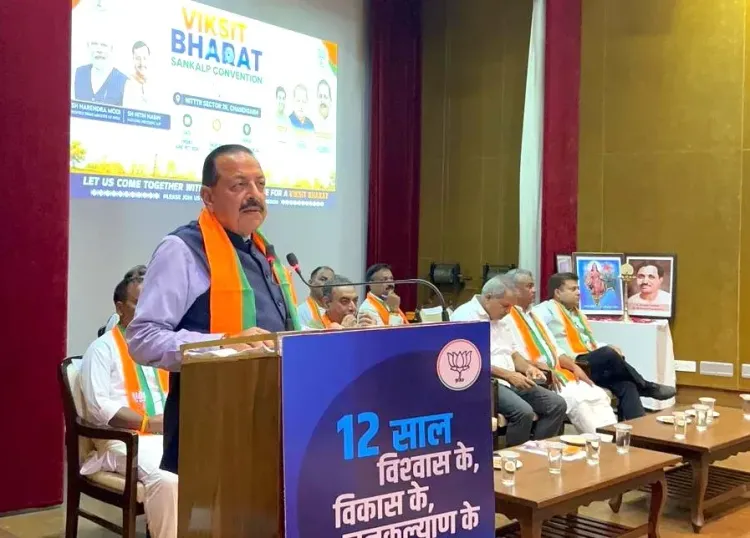
Union Minister Dr Jitendra Singh addressed a press conference in Chandigarh on 19 June marking 12 years of the Modi government .
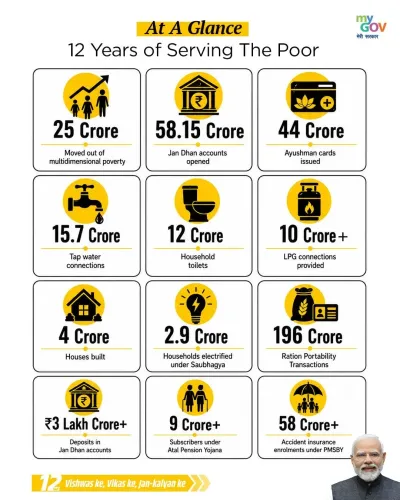
The minister claimed nearly 25 crore people have exited multidimensional poverty over this period.
Welfare schemes spanning housing, sanitation, healthcare, financial inclusion, food security, clean cooking fuel , and social security were cited as key drivers.
The government's approach was described as saturation-based — benefits disbursed on eligibility alone, not political considerations.
Dr Singh said governance has shifted from creating dependency to empowering citizens through digital platforms and direct benefit transfers.
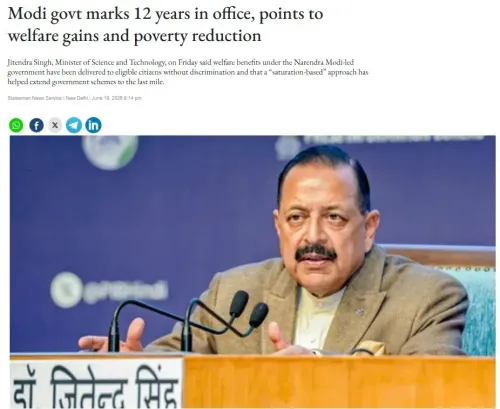
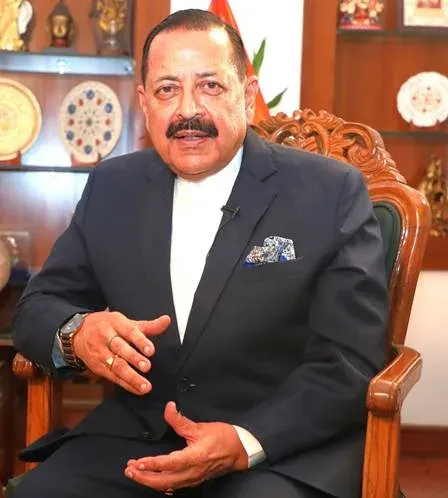
Union Minister of State (Independent Charge) Dr Jitendra Singh on Friday, 19 June said the defining feature of the Modi government's 12-year tenure has been the equitable distribution of welfare benefits to every eligible citizen, free from discrimination based on caste, creed, religion, or vote-bank considerations. Addressing a press conference in Chandigarh to mark the completion of 12 years of the government led by Prime Minister Narendra Modi, the minister described the period as one of fundamental transformation in governance delivery.
Key Claims on Welfare Delivery
Dr Jitendra Singh said that schemes covering housing, sanitation, healthcare, financial inclusion, food security, clean cooking fuel, and social security have collectively improved the quality of life of millions of families across the country. He emphasised that welfare initiatives have reached the last mile through a saturation-based approach, with benefits disbursed solely on the basis of eligibility and need rather than political affiliation.
The minister attributed this reach to transparency, accountability, and technology-driven implementation, which he said have ensured that public resources flow directly to intended beneficiaries.
Poverty Reduction and Socio-Economic Progress
Citing India's socio-economic trajectory over the past decade-plus, Dr Singh stated that nearly 25 crore people have moved out of multidimensional poverty — a figure he linked to sustained welfare interventions and inclusive growth policies. He said the benefits of development have reached sections of society that had remained underserved for decades, thereby strengthening social equity and economic participation.
Notably, the claim of 25 crore people exiting multidimensional poverty aligns with figures cited by the government in earlier reports referencing the NITI Aayog Multidimensional Poverty Index, though independent assessments of the methodology have varied.
Empowerment Over Dependency
The minister argued that governance over this period has shifted focus from creating dependency to empowering citizens, with expanded access to basic amenities, financial services, digital platforms, and public welfare schemes enabling wider participation in the development process. He said improvements in living standards among lower-income groups have contributed to enhanced self-confidence and self-esteem, allowing citizens to pursue better livelihoods.
Dr Singh further stated that the democratisation of resources and opportunities has made citizens active stakeholders in India's growth journey rather than passive recipients of state support.
Outlook for the Coming Years
Expressing confidence in the trajectory ahead, the minister said the coming years will witness even greater citizen participation in India's development as the country moves towards becoming a leading global force in innovation, economic growth, and human development. The press conference was held as part of the ruling Bharatiya Janata Party (BJP)-led government's outreach marking the 12th anniversary of Prime Minister Modi's first term, which began in May 2014.
Point of View
But it rests on the NITI Aayog's Multidimensional Poverty Index — a composite measure that has drawn methodological scrutiny from independent economists who argue it can overstate income-poverty reduction. The broader claim of vote-bank-free delivery is also difficult to verify independently, given that welfare scheme rollouts have historically tracked electoral cycles. What is less contested is the expansion of direct benefit transfer infrastructure, which has genuinely reduced leakage — but whether that translates into the quality-of-life transformation Dr Singh described remains a matter of ongoing debate among development economists. The BJP's decision to hold a press conference in Chandigarh — a Union Territory that borders politically contested Punjab and Haryana — signals that this anniversary messaging is as much electoral positioning as governance review.
NationPress
24 Sept 2026
Frequently Asked Questions
What did Union Minister Jitendra Singh say about the Modi government's 12-year record?
Dr Jitendra Singh said the defining feature of the past 12 years has been equitable welfare delivery to every eligible citizen without discrimination based on caste, creed, religion, or vote-bank politics. He made these remarks at a press conference in Chandigarh on 19 June marking the government's 12th anniversary.
How many people have exited poverty under the Modi government, according to the minister?
Dr Singh claimed that nearly 25 crore people have moved out of multidimensional poverty over the past 12 years, attributing this to sustained welfare interventions and inclusive growth policies. The figure is based on the government's own Multidimensional Poverty Index assessments.
Which welfare schemes did Jitendra Singh highlight?
The minister highlighted schemes covering housing, sanitation, healthcare, financial inclusion, food security, clean cooking fuel, and social security as collectively improving the quality of life of millions of families across India.
What is the saturation-based approach the minister referred to?
The saturation-based approach means welfare benefits are extended to all eligible citizens in a given area or category until full coverage is achieved, rather than selectively targeting beneficiaries. Dr Singh said this model ensures benefits reach the last mile based solely on eligibility and need.
Why was the press conference held in Chandigarh?
The press conference was held in Chandigarh as part of the BJP-led government's nationwide outreach marking 12 years since Prime Minister Narendra Modi first took office in May 2014. Chandigarh serves as the capital of both Punjab and Haryana, making it a strategically significant location for such outreach.