Sitharaman: 12 Years of Modi Govt Lifted 25 Cr Out of Poverty
Synopsis
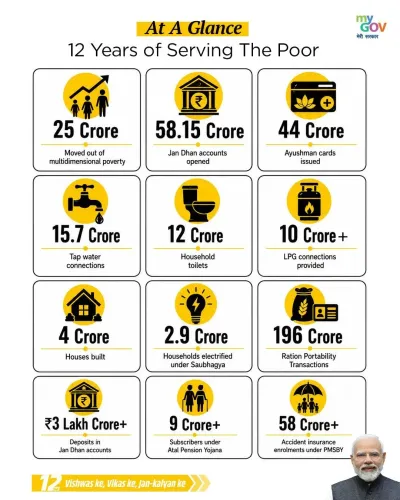
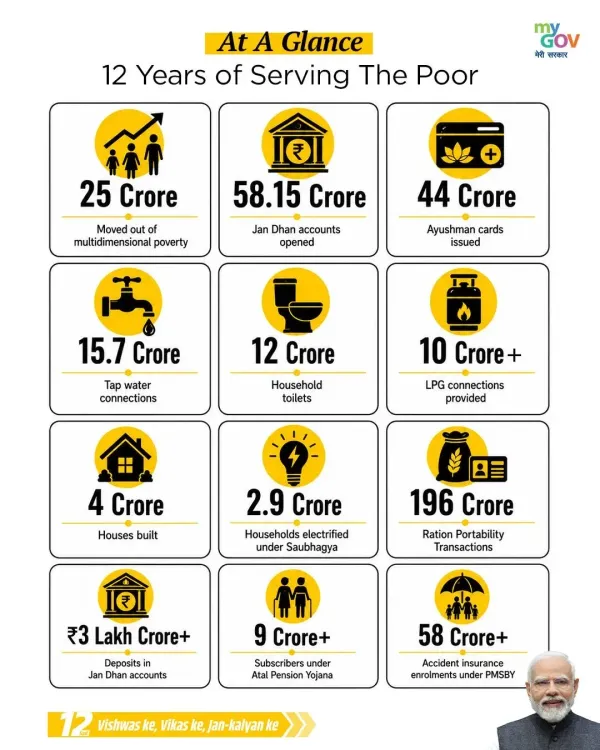
Finance Minister Nirmala Sitharaman marked 12 years of the Modi government on June 8, 2026, citing exponential gains in healthcare, housing, clean fuel and financial inclusion, and claiming 25 crore people have been lifted out of multidimensional poverty under #12YearsOfGaribKalyan.
Key Takeaways
Nirmala Sitharaman posted on June 8, 2026 marking 12 years of welfare delivery under the Modi government .
The post claims 25 crore people have been lifted out of multidimensional poverty.
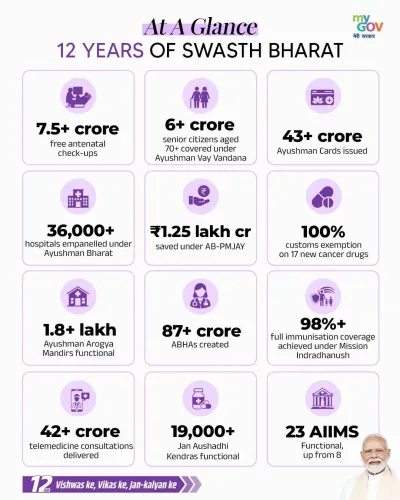
Welfare gains cited span healthcare, housing, financial inclusion, tap water, clean fuel and social security.
Key schemes referenced include Pradhan Mantri Jan Dhan Yojana (2014), Pradhan Mantri Ujjwala Yojana (2016), Ayushman Bharat (2018) and Jal Jeevan Mission (2019).
NITI Aayog's Multidimensional Poverty Index , tracked since 2021 , is the official metric used to measure these gains.
The next NITI Aayog MPI update and 2026-27 Union Budget welfare allocations will be key markers to watch.
Union Finance Minister Nirmala Sitharaman on Monday, June 8, 2026, highlighted the welfare achievements of the Narendra Modi-led government over the past 12 years, citing gains in healthcare, housing, financial inclusion, clean fuel, tap water and social security as evidence of a deepened grassroots delivery architecture.
Context
Posting under the hashtag #12YearsOfGaribKalyan — meaning '12 Years of Welfare for the Poor' — Sitharaman stated that the government's efforts had brought 'greater transparency, speed and impact' to welfare delivery at the ground level. She credited the initiatives driven by Prime Minister Narendra Modi for what she described as an 'exponential' increase in access to essential services. The post marks a milestone in the BJP government's public communication around its social policy record since May 2014.
Policy Backdrop
The welfare architecture the minister references spans more than a decade of scheme launches. Pradhan Mantri Jan Dhan Yojana, introduced in 2014, extended bank accounts and direct benefit transfers to previously unbanked households, while Pradhan Mantri Ujjwala Yojana, launched in 2016, provided LPG connections to below-poverty-line families for clean cooking fuel. Pradhan Mantri Awas Yojana addressed rural housing from 2015 onward.
In 2018, Ayushman Bharat scaled health coverage to low-income families, and the Jal Jeevan Mission, launched in 2019, targeted piped drinking water supply to every rural household. The government's policy think tank, NITI Aayog, began publishing a Multidimensional Poverty Index (MPI) from 2021, tracking deprivations across health, education and living standards as an official governance metric. Central to Sitharaman's post is the claim that 25 crore people have been lifted out of multidimensional poverty over this period.
Stakeholders and Impact
The primary beneficiaries of these programmes are poor rural households, women in low-income families, and first-generation recipients of formal financial and health services. The direct-benefit-transfer model, which underpins schemes from Jan Dhan to PM-KISAN, has been designed to reduce leakage and deliver entitlements directly to individual accounts. Sitharaman framed the cumulative outcome as India's 'development journey reaching every home with dignity, opportunity and trust.'
For the political establishment, the #12YearsOfGaribKalyan messaging serves as a consolidated narrative ahead of ongoing budget and policy cycles, reinforcing the government's claim that welfare delivery has shifted from entitlement-on-paper to measurable on-ground impact.
What's Next
Attention will now turn to the next NITI Aayog MPI update, which will provide independently compiled data on the trajectory of multidimensional poverty in India. Welfare allocations in the 2026-27 Union Budget will also be closely watched to see whether the government sustains or scales the spending levels that underpin these schemes. As the BJP marks 12 years in power at the Centre, the welfare record is expected to remain a central plank of its political and policy communication.
Point of View
Consolidated milestone statement, timed to mark a full dozen years of BJP governance at the Centre and anchoring the party's political identity in measurable welfare outcomes rather than ideological messaging alone. The invocation of 25 crore people lifted out of multidimensional poverty is the headline number of a broader saturation-delivery narrative that the government has built around direct benefit transfers, and its repetition by a senior cabinet minister signals it will be a cornerstone of the party's communication in the run-up to budget season. The framing of welfare as a matter of 'dignity, opportunity and trust' also marks a rhetorical shift from entitlement-counting to a more aspirational register. How this narrative holds up will depend significantly on the next independent NITI Aayog MPI data release.
NationPress
24 Sept 2026
Frequently Asked Questions
What is #12YearsOfGaribKalyan?
#12YearsOfGaribKalyan is a hashtag used by the BJP government and its ministers to mark 12 years of welfare-focused governance since Narendra Modi became Prime Minister in May 2014 , highlighting schemes in housing, health, clean fuel and financial inclusion.
How many people has India lifted out of poverty under Modi government?
Finance Minister Nirmala Sitharaman cited a figure of 25 crore people lifted out of multidimensional poverty, a claim tracked through the NITI Aayog Multidimensional Poverty Index first published in 2021 .
What is the Multidimensional Poverty Index in India?
The Multidimensional Poverty Index (MPI) is published by NITI Aayog and measures poverty across three dimensions — health, education and living standards — going beyond income alone to capture deprivations faced by households.
What are the main welfare schemes of the Modi government?
Key schemes include Pradhan Mantri Jan Dhan Yojana (financial inclusion, 2014), Pradhan Mantri Ujjwala Yojana (clean cooking fuel, 2016), Pradhan Mantri Awas Yojana (housing, 2015), Ayushman Bharat (health coverage, 2018) and Jal Jeevan Mission (piped water, 2019).
What will indicate whether India's poverty reduction continues?
The next NITI Aayog MPI update and welfare allocations in the 2026-27 Union Budget are the two key indicators that will show whether the pace of poverty reduction and scheme delivery is being sustained.