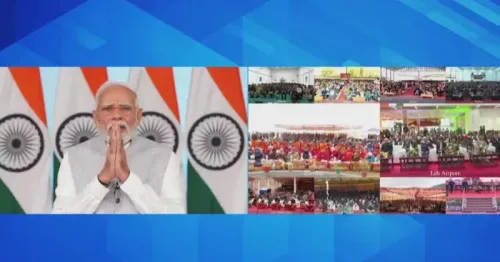
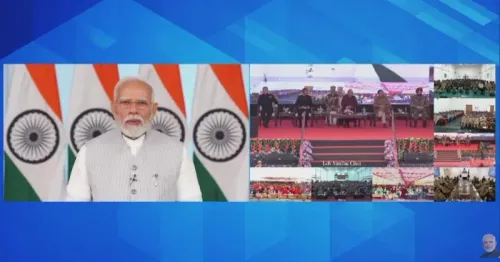
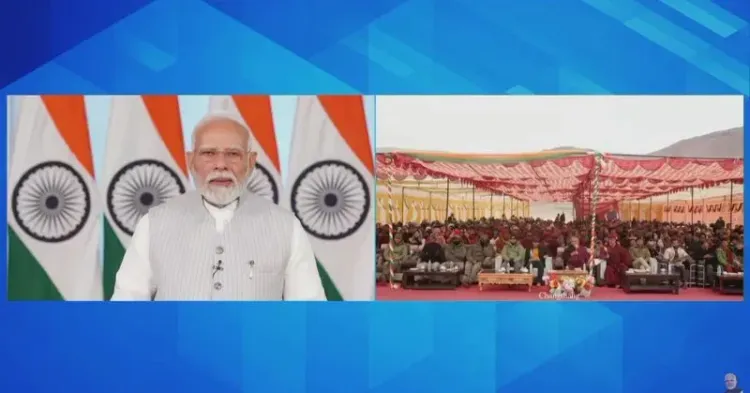
CM Rekha Gupta watches PM Modi launch Ladakh projects live
Synopsis
Prime Minister Narendra Modi launched development projects in Ladakh via video conferencing on 15 October 2026, with Delhi Chief Minister Rekha Gupta amplifying the live broadcast — continuing the BJP's post-Article 370 push to accelerate infrastructure in the strategic Union Territory.
Key Takeaways
PM Narendra Modi launched development projects in Ladakh via video conferencing on 15 October 2026 .
Delhi CM Rekha Gupta shared the live broadcast link on her official X account.
Ladakh has been a Union Territory since 2019 , following the abrogation of Article 370 .
Central infrastructure investment in Ladakh focuses on roads, power, and all-weather connectivity with a strategic border dimension.
Video-conferencing project launches have become a recurring format for central government announcements in remote Union Territories.
The BJP uses coordinated cross-leader amplification on social media to maximise reach for flagship central initiatives.
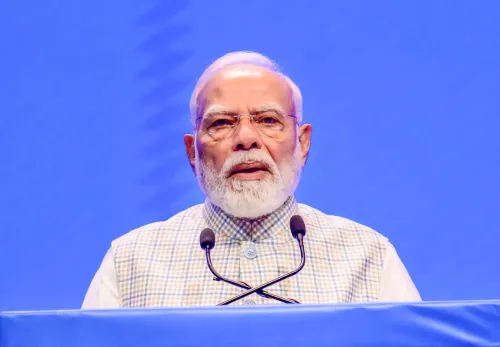
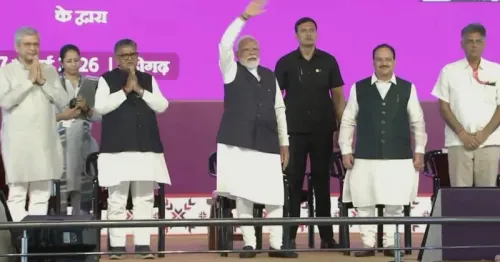
From the remote high-altitude expanse of Ladakh, a new round of central development projects got their formal launch on Thursday, 15 October 2026 — with Prime Minister Narendra Modi presiding via video conferencing and Delhi Chief Minister Rekha Gupta watching and amplifying the moment in real time.
A Union Territory built on remote inaugurations
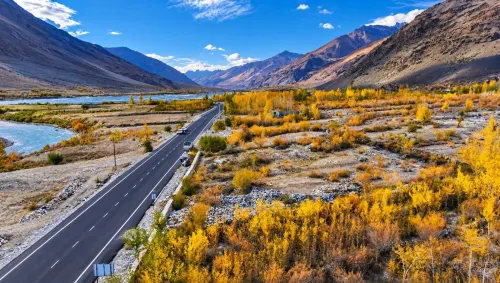
Since Ladakh was carved out as a Union Territory in 2019 following the abrogation of Article 370, video-conferencing launches have become a signature format for central government project announcements in the region. The geography makes it almost inevitable: Ladakh's terrain, altitude, and distance from the national capital mean that remote-format events now substitute for what would otherwise require complex ministerial travel.
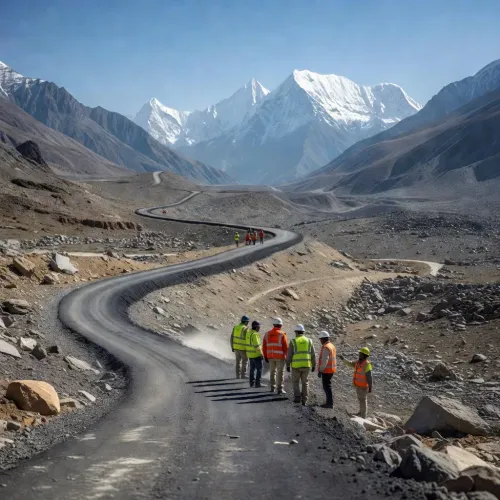
That format has not slowed the pace of announcements. Central funding directed at Ladakh since 2019 has targeted three broad pillars — roads, power infrastructure, and all-weather connectivity — driven by a combination of strategic border requirements along the Line of Actual Control and a genuine need to connect communities that were historically underserved.
Why Ladakh keeps appearing on Modi's project calendar
The Union Territory carries unique strategic weight. After the military standoff along the LAC in 2020, central infrastructure spending in Ladakh took on an explicitly dual-use character — civilian connectivity and defence logistics becoming two sides of the same coin. Successive budget cycles have reflected this, with allocations to the Border Roads Organisation and dedicated schemes for the UT rising year on year.
For the BJP, the optics matter too. Ladakh sits at the intersection of national security and development politics — a region where the party can point to both strategic seriousness and grassroots delivery. A prime ministerial launch, even via screen, carries symbolic weight for Ladakh's roughly 2.7 lakh residents, who have seen the pace of central attention increase sharply since the UT's formation.
Delhi's CM in the frame
Chief Minister Rekha Gupta, who leads the BJP government in Delhi, shared the live broadcast link on her official account — a gesture that signals both party solidarity and personal engagement with a flagship central initiative. Such cross-leader amplification is a standard feature of the BJP's coordinated social-media architecture, but it also keeps the Ladakh development story in front of a wider urban audience.
The specific projects launched in today's broadcast could not be independently detailed ahead of formal government communication, but the pattern is consistent: each successive round has added road kilometres, power capacity, or digital connectivity to a UT that the central government has made a showcase for post-Article 370 governance.
The question now is whether the infrastructure being laid down translates into measurable quality-of-life gains for Ladakhis before the next electoral cycle — and whether parliamentary scrutiny of spending outcomes keeps pace with the announcement cycle.
Point of View
Now routine for Ladakh, reflects a deliberate centralisation of development optics — the Prime Minister remains the visible face of every major project even in a territory governed directly by the Centre. For the BJP, Ladakh serves a dual narrative purpose: proof of post-Article 370 development dividends and a demonstration of strategic seriousness on the northern border. CM Rekha Gupta's amplification underscores the party's discipline in ensuring Delhi-level leaders reinforce central government messaging. The deeper test, however, will come when auditors and local representatives are asked whether announced projects have reached completion and benefitted Ladakh's roughly 2.7 lakh residents.
NationPress
15 Oct 2026
Frequently Asked Questions
What projects did PM Modi launch in Ladakh on 15 October 2026?
PM Modi launched development projects in Ladakh via video conferencing on 15 October 2026 . The specific schemes were part of the central government's ongoing infrastructure push in the Union Territory, though full project details are subject to official government communication.
Why does PM Modi launch Ladakh projects via video conferencing?
Ladakh 's high altitude, challenging terrain, and distance from New Delhi make in-person launches logistically complex. Video conferencing has become the standard format for central government project inaugurations in the Union Territory since 2019 .
When did Ladakh become a Union Territory?
Ladakh became a Union Territory on 31 October 2019 , following the Parliament's abrogation of Article 370 and the bifurcation of the former state of Jammu and Kashmir .
Why is infrastructure in Ladakh a priority for the central government?
Infrastructure in Ladakh is a strategic priority because the region shares a border with China along the Line of Actual Control . Roads, power, and connectivity projects serve both civilian development goals and defence logistics requirements.
Who is Rekha Gupta and why did she post about Ladakh?
Rekha Gupta is the BJP Chief Minister of Delhi . She shared the live broadcast of PM Modi 's Ladakh launch on her official account, consistent with the party's practice of coordinated social-media amplification for major central government events.