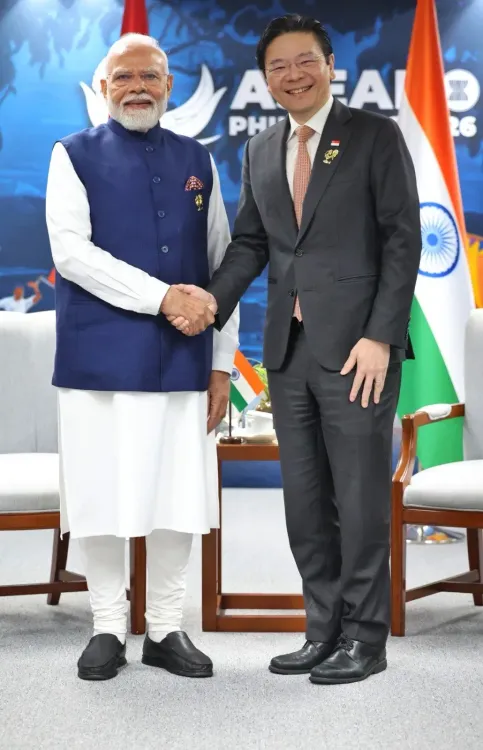
PM Modi meets Singapore PM Lawrence Wong, eyes semiconductors and investment
Synopsis
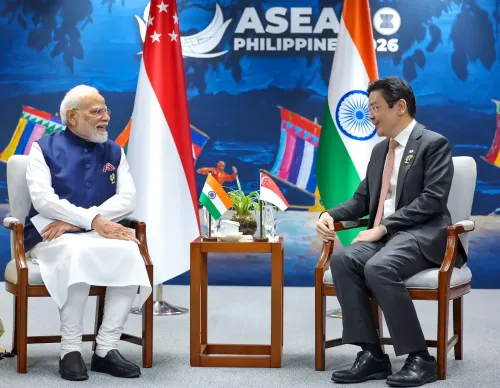
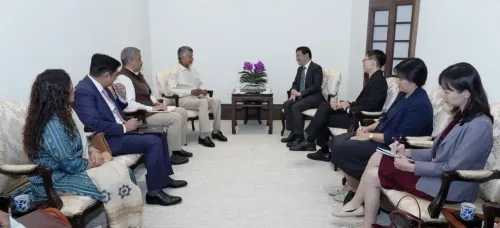
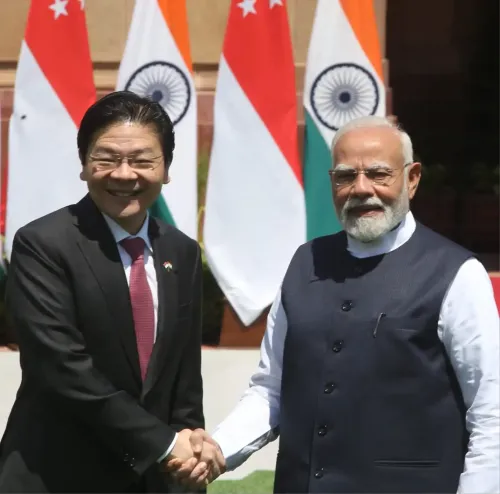
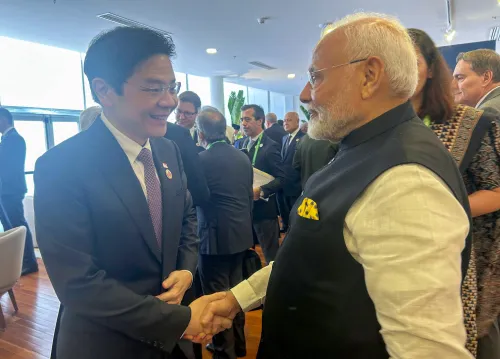
Prime Minister Narendra Modi held a productive bilateral meeting with Singapore PM Lawrence Wong on 17 November 2026, focusing on investment, infrastructure, innovation, semiconductors, and advanced manufacturing under their Comprehensive Strategic Partnership.
Key Takeaways
PM Modi met Singapore PM Lawrence Wong on 17 November 2026 in a bilateral meeting.
Five priority sectors were discussed: investment, infrastructure, innovation, semiconductors, and advanced manufacturing .
The India–Singapore Comprehensive Strategic Partnership was first established during Modi's 2015 Singapore visit.
The bilateral relationship is underpinned by the 2005 CECA , one of India's earliest free-trade agreements.
Singapore is one of India's top sources of FDI and a key node in India's Act East Policy .
India's Semiconductor Mission (2021) aligns closely with Singapore's established electronics and chip manufacturing ecosystem.
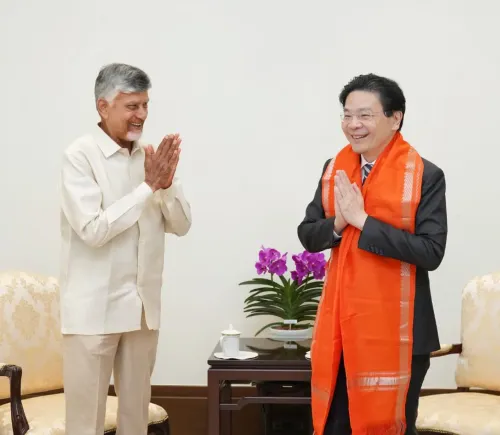
Two leaders, one tightly packed agenda — and a partnership that has quietly become one of Asia's most consequential bilateral relationships got another productive push forward. Prime Minister Narendra Modi met Singapore Prime Minister Lawrence Wong on Tuesday, 17 November 2026, with both sides zeroing in on the high-stakes sectors that will define the next decade of their Comprehensive Strategic Partnership.
Five pillars, one clear signal
Modi framed the meeting around five concrete priority areas: investment, infrastructure, innovation, semiconductors, and advanced manufacturing. That is not a catch-all list — it is a precise map of where India is trying to accelerate and where Singapore, as a global capital hub and electronics supply-chain anchor, can directly deliver. The two sides signalled a clear intent to deepen cooperation 'in the times to come', with the Indian side describing Singapore as a 'valued partner'.
Wong, who took office in May 2024 succeeding the long-serving Lee Hsien Loong, has staked his premiership on maintaining Singapore's centrality in a shifting global economic order. A deepening India tie — with its vast domestic market, expanding manufacturing base, and 1.4 billion consumers — fits squarely into that calculus.
A partnership built over two decades
The India–Singapore relationship has institutional heft that makes today's meeting more than a diplomatic photo-op. It goes back to 2005, when the two countries signed the Comprehensive Economic Cooperation Agreement (CECA), one of India's earliest and most substantive free-trade deals, covering goods, services, and investment. A decade later, in 2015, Modi's visit to Singapore elevated the relationship to a Comprehensive Strategic Partnership, extending cooperation into defence and security.
Singapore today ranks among India's top sources of foreign direct investment — a consistent pipeline of capital that has flowed into everything from real estate and financial services to technology startups. Under India's Act East Policy, Singapore has functioned as a critical gateway: a city-state through which both investment and diplomatic influence travel deeper into Southeast Asia.
Why semiconductors are the centrepiece
Of all five pillars discussed, semiconductors carry the most geopolitical weight right now. India launched the India Semiconductor Mission in 2021 with an ambition to attract global chip fabrication investment and diversify supply chains away from their current concentration in East Asia. Singapore, with its established position in wafer fabrication, precision engineering, and electronics exports, is a natural collaborator — not a competitor — in this effort.
The overlap is real: Singapore's chip ecosystem can supply components, design expertise, and capital that India's nascent semiconductor industry still needs. For Singapore, India's scale offers a downstream market and a hedge against over-reliance on existing trade corridors. The pairing makes strategic sense on both sides of the table.
What signals India's next move
Watch for whether any joint project announcements follow in coming weeks — particularly on semiconductor assembly or infrastructure financing — and for the next ASEAN-India summit, where bilateral commitments often get multilateral traction. The regularity of Modi–Singapore high-level meetings itself signals that this is not a relationship on autopilot: it is being actively managed and upgraded.
Singapore's role as a bridge between Indian ambition and global capital has never been more relevant — and both leaders appear to know it.
Point of View
Reflecting a broader global realignment of chip supply chains. For Modi, deepening ties with Lawrence Wong also sends a signal to the wider ASEAN region that India's Act East Policy has teeth beyond rhetoric. The regularity and specificity of these engagements suggests both sides are building toward concrete project-level outcomes, not just diplomatic warmth.
NationPress
17 Nov 2026
Frequently Asked Questions
What did PM Modi and Singapore PM Lawrence Wong discuss in their meeting?
They discussed ways to strengthen India's Comprehensive Strategic Partnership with Singapore, focusing on five sectors: investment, infrastructure, innovation, semiconductors, and advanced manufacturing.
When did India and Singapore establish their Comprehensive Strategic Partnership?
India and Singapore elevated their ties to a Comprehensive Strategic Partnership in 2015 during Prime Minister Modi's visit to Singapore.
Who is Lawrence Wong and when did he become Singapore's Prime Minister?
Lawrence Wong became Prime Minister of Singapore in May 2024 , succeeding Lee Hsien Loong, who had led the country for two decades.
What is India's semiconductor mission and how does Singapore fit in?
India launched the India Semiconductor Mission in 2021 to attract global chip manufacturing investment. Singapore's established wafer fabrication and electronics ecosystem makes it a natural partner for India's semiconductor ambitions.
Why is Singapore important to India's economy?
Singapore is one of India's top sources of foreign direct investment and serves as a critical gateway under India's Act East Policy, channelling capital and diplomatic influence into Southeast Asia.