PM Modi Meets Slovak President Pellegrini, Advances Bilateral Ties

Synopsis
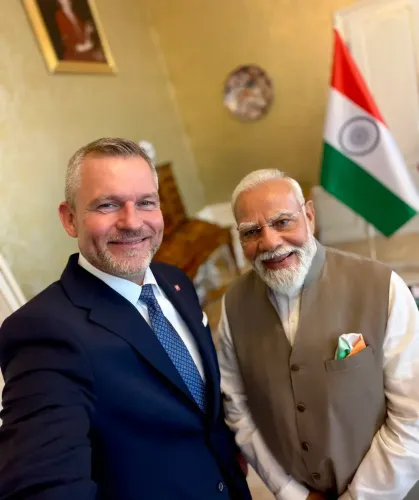
Prime Minister Narendra Modi on June 15, 2026, publicly acknowledged a meeting with Slovak President Peter Pellegrini, describing it as a continuation of earlier bilateral conversations. The exchange underscores India's deepening engagement with individual EU member states, with Slovakia a key Central European partner in trade and defence.
Key Takeaways
PM Modi met Slovak President Peter Pellegrini and described the talks as a continuation of earlier bilateral conversations.
Modi's post on June 15, 2026 confirmed the two leaders have now met on more than one occasion.
India and Slovakia established diplomatic relations in 1993 and signed a defence cooperation agreement in 2018 .
Slovakia is a member of the EU, NATO , and the Visegrad Group , making it a strategically significant partner for India in Central Europe.
The bilateral engagement fits India's broader pattern of direct outreach to individual EU member states alongside wider India-EU strategic partnership talks.
Prime Minister Narendra Modi on Monday, June 15, 2026, expressed warm regard for Slovak President Peter Pellegrini following a meeting between the two leaders, describing the exchange as a continuation of important conversations from their previous engagement. Modi shared his appreciation publicly, noting that Pellegrini's insights were 'great to hear.'
Context
Modi wrote on X: 'Was wonderful meeting you, President Pellegrini. Happy to have continued the important conversations we had when we last met. Your insights are indeed great to hear.' The post, directed at @PellegriniP_, confirms that the two leaders have met more than once, with the latest interaction building on an earlier bilateral conversation.
Peter Pellegrini was elected President of Slovakia in 2024, having previously served as the country's Prime Minister and Speaker of Parliament. His election marked a significant moment in Slovak politics and has since positioned him as a key interlocutor for European and global partners.
Policy Backdrop
Diplomatic relations between India and Slovakia were formally established in 1993, following Slovakia's independence. The two countries signed a defence cooperation agreement in 2018, covering joint training and equipment collaboration — a foundation that continues to underpin bilateral ties.
Slovakia is a member of both the European Union and NATO, and is part of the Visegrad Group of Central European nations. This positioning makes it a strategically relevant partner for India as New Delhi deepens engagement with individual EU member states to complement broader India-EU strategic partnership discussions.
Stakeholders and Impact
Meetings of this nature typically address trade diversification, supply chain resilience, and multilateral coordination. Indian exporters and defence manufacturers stand to benefit from closer ties, given Slovakia's role as a gateway for Indian economic and technology interests in Central Europe.
India's sustained pattern of direct bilateral engagement with EU member states reflects a broader diplomatic strategy — building durable partnerships at the country level even as bloc-wide negotiations proceed. Slovakia's industrial base and its connectivity within Central Europe make it a relevant node in any supply chain diversification calculus for Indian industry.
What's Next
Follow-up engagements could materialise at the India-EU Summit or through new bilateral agreements on investment and technology. The warm tone of Modi's public post signals continued momentum in the relationship, with both sides appearing to find value in sustained dialogue at the leadership level.
As India continues to expand its network of partnerships across Europe, the India-Slovakia relationship — anchored in defence cooperation and growing economic interest — is likely to see further institutional expression in the months ahead.
Point of View
Personal tone of the post reflects India's growing preference for leader-to-leader diplomacy as a tool to accelerate bilateral traction. Slovakia's Visegrad Group membership and defence-industrial capacity make it a useful partner for India's supply chain diversification goals. Sustained engagement at this level typically precedes more formal institutional outcomes, such as MoUs or investment frameworks.
NationPress
16 Sept 2026
Frequently Asked Questions
Why did PM Modi meet Slovak President Pellegrini?
PM Modi met Slovak President Peter Pellegrini to continue bilateral conversations on key areas of mutual interest, including trade, defence cooperation, and broader diplomatic engagement between India and Slovakia.
What are India-Slovakia relations like?
India and Slovakia established diplomatic relations in 1993. The two countries signed a defence cooperation agreement in 2018 covering joint training and equipment collaboration, and share growing interests in trade and technology.
Who is Peter Pellegrini?
Peter Pellegrini is the President of Slovakia, elected in 2024. He previously served as Slovakia's Prime Minister and Speaker of Parliament, and is a prominent figure in Central European politics.
Is Slovakia important for India's foreign policy?
Yes. Slovakia is a member of the EU, NATO, and the Visegrad Group, positioning it as a strategic gateway for Indian economic and technology interests in Central Europe. India has been deepening ties with individual EU member states as part of its broader European engagement strategy.
What could follow from the Modi-Pellegrini meeting?
Potential follow-up steps include engagement at the India-EU Summit or the signing of new bilateral agreements on investment and technology, building on the existing 2018 defence cooperation framework.