PM Modi Plays Football in Gangtok on Sikkim's Golden Jubilee Visit
Synopsis
Prime Minister Narendra Modi surprised Gangtok locals on April 28 by joining young residents for an early-morning football session — spotlighting the Northeast's outsized contribution to Indian football, where just 3.8% of the population produces over a third of the ISL's top talent. The visit coincides with Sikkim's historic 50th statehood anniversary.
Key Takeaways
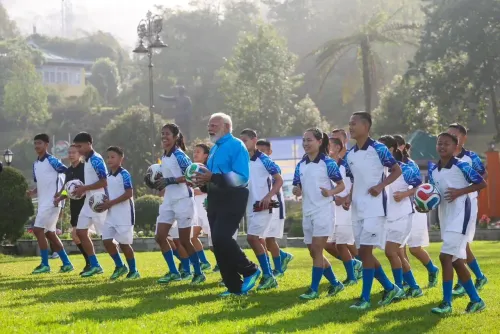
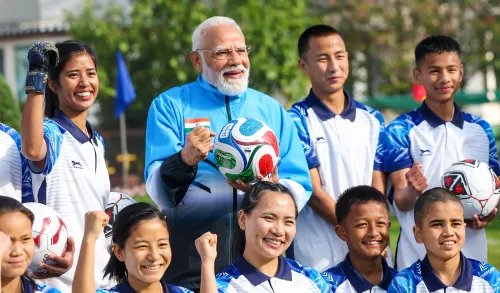
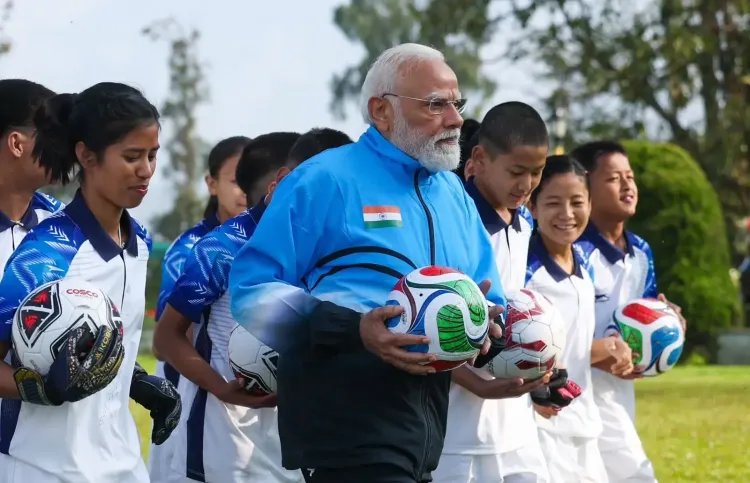
PM Narendra Modi played football with young residents of Gangtok, Sikkim on the morning of Tuesday, April 28, 2025 .
The visit marks the closing ceremony of Sikkim's 50th statehood anniversary , commemorating the state's merger with India in 1975 .
Northeast India's 8 states , comprising only 3.8% of India's population , produce approximately one-third or more of top-tier Indian football talent including ISL players .
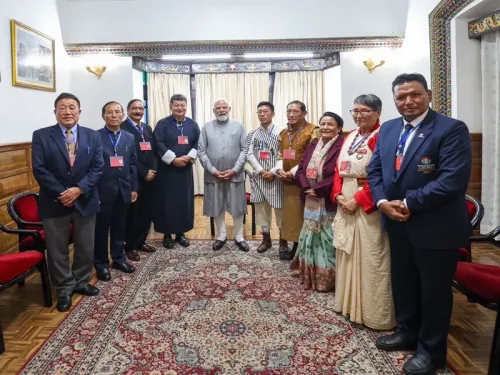
PM Modi held an enriching interaction with Padma awardees, artists, sportspersons, and academics from Sikkim on Monday, April 27 .
The Prime Minister is set to inaugurate a 100-bedded Ayurveda hospital in Yangang , a 30-bedded Sowa Rigpa Hospital at NIT Deorali , and the permanent campus of Sikkim University , among other projects.
IT-enabled infrastructure will be launched across 160 schools in Sikkim during the Golden Jubilee ceremony at Paljor Stadium .
Prime Minister Narendra Modi kicked off Tuesday, April 28, with an impromptu football session alongside young residents of Gangtok, Sikkim, calling it a "lovely morning" and an "energising" start to a landmark day — the closing ceremony of Sikkim's 50th statehood anniversary. The images, shared by the Prime Minister on X (formerly Twitter), quickly drew widespread attention and underscored the Northeast's deep-rooted love for the sport.
A Morning on the Field
Posting photos of the session, PM Modi wrote: "Nothing like playing some football with my young friends in Sikkim on a lovely Gangtok morning!" In a follow-up post, he added, "Clearly, an energising football session with these youngsters!" The spontaneous engagement with local youth reflects a pattern the Prime Minister has maintained during state visits — using informal interactions to connect with grassroots communities beyond the confines of official programmes.
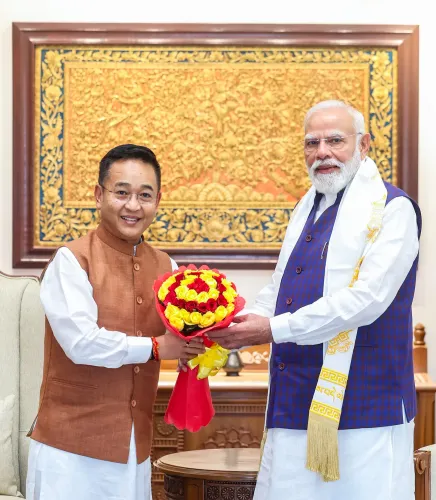
This comes amid Sikkim's Golden Jubilee celebrations, marking 50 years since the state's formal merger with India in 1975. The Prime Minister arrived in Gangtok on Monday, where he was greeted by a 2-kilometre-long cultural roadshow, with enthusiastic residents lining both sides of the road, waving the tricolour and dressed in traditional attire.
Football's Deep Roots in the Northeast
The Prime Minister's choice of sport was hardly coincidental. Football enjoys immense popularity across India's northeastern states, frequently rivalling — and in many cases outshining — cricket in states such as Sikkim, Mizoram, Manipur, and Meghalaya. Notably, the eight northeastern states — Assam, Arunachal Pradesh, Manipur, Meghalaya, Mizoram, Nagaland, Sikkim, and Tripura — account for only approximately 3.8 per cent of India's total population, yet they consistently produce around one-third or more of the athletes competing in the Indian Super League (ISL) and other top-tier leagues. Critics and sports analysts have long argued that this talent pipeline remains underfunded relative to its output.
Interaction with Padma Awardees and Achievers
On Monday, ahead of the football session, PM Modi held what officials described as an "enriching interaction" with Padma awardees, social workers, artists, academicians, sportspersons, and other distinguished personalities. According to officials, discussions spanned development, culture, innovation, education, social welfare, and youth opportunities. Participants reportedly shared their experiences and suggestions directly with the Prime Minister — an engagement format Modi has consistently used across state visits to acknowledge grassroots contributors and understand regional aspirations firsthand.
Key Developments and Project Launches
The centrepiece of the visit is the Golden Jubilee concluding ceremony at Paljor Stadium at approximately 10 a.m., where PM Modi is scheduled to inaugurate, launch, and lay foundation stones for projects spanning infrastructure, connectivity, healthcare, education, power, urban development, environment, tourism, and agriculture.
In the healthcare sector, the Prime Minister will lay the foundation stone for a 100-bedded Ayurveda hospital in Yangang, Namchi district, and inaugurate a 30-bedded Integrated Sowa Rigpa Hospital at NIT Deorali. On the education front, he will inaugurate the permanent campus of Sikkim University at Yangang, the administrative block of Netaji Subhash Chandra Bose University of Excellence at Chakung, Helen Lepcha Medical College at Socheygang, and Dentam Professional College in Gyalshing district. Model residential schools, a new degree college at Mangshila, a monastic hostel-cum-classroom at Boomtar Gumpa, and IT-enabled infrastructure across 160 schools are also on the agenda. The Prime Minister is also scheduled to visit the Orchidarium in Gangtok, developed as a world-class Orchid Experience Centre showcasing the state's ecological and floral heritage.
As Sikkim marks half a century as part of the Indian Union, Modi's visit signals both symbolic recognition and a concrete infrastructure push — with the Northeast's sporting and cultural identity firmly in the national spotlight.
Frequently Asked Questions
Why did PM Modi visit Gangtok in April 2025?
PM Modi visited Gangtok to attend the closing ceremony of Sikkim's 50th statehood anniversary Golden Jubilee celebrations. He arrived on Monday, April 27, and participated in a cultural roadshow, met Padma awardees, and is scheduled to inaugurate multiple infrastructure and education projects.
What happened during PM Modi's football session in Gangtok?
PM Modi played football with young residents of Gangtok on the morning of April 28, 2025. He shared photos on X, describing it as a 'lovely Gangtok morning' and an 'energising football session with these youngsters.'
Why is football so popular in Northeast India?
Football has deep cultural roots in India's northeastern states, often surpassing cricket in popularity in states like Sikkim, Mizoram, Manipur, and Meghalaya. Despite comprising only 3.8% of India's population, the eight northeastern states produce roughly one-third or more of the athletes in the Indian Super League (ISL).
What projects did PM Modi inaugurate in Sikkim during the Golden Jubilee?
PM Modi inaugurated and laid foundation stones for projects spanning healthcare, education, infrastructure, and connectivity. Key announcements include a 100-bedded Ayurveda hospital in Yangang, a 30-bedded Sowa Rigpa Hospital at NIT Deorali, the permanent campus of Sikkim University, Helen Lepcha Medical College, and IT infrastructure across 160 schools.
When did Sikkim become a state of India?
Sikkim officially became the 22nd state of India on May 16, 1975, following a referendum. The 2025 Golden Jubilee celebrations mark 50 years of Sikkim's statehood, with PM Modi's visit serving as the culminating event of the anniversary.