PM Modi Thanks Nigeria's Tinubu, Reaffirms India-Nigeria Ties

Synopsis
Prime Minister Narendra Modi on 10 June 2026 publicly thanked Nigerian President Bola Ahmed Tinubu for warm wishes, reaffirming the India-Nigeria partnership and both nations' shared commitment to advancing the Global South agenda.
Key Takeaways
Prime Minister Narendra Modi responded to President Bola Ahmed Tinubu's warm wishes on 10 June 2026 , reaffirming bilateral ties.
Nigeria is India's largest trading partner in Africa , with cooperation spanning crude oil, pharmaceuticals, and capacity-building.
Modi explicitly invoked the Global South framework, consistent with India's positioning in multilateral forums such as the G20 and UN .
India's ITEC programme has provided technical training to Nigerian professionals, underpinning people-to-people ties.
The exchange signals an active diplomatic channel between the two leaders since Tinubu took office in May 2023 .
Watchers will track the next India-Nigeria Joint Commission meeting and any potential high-level visit by either leader.
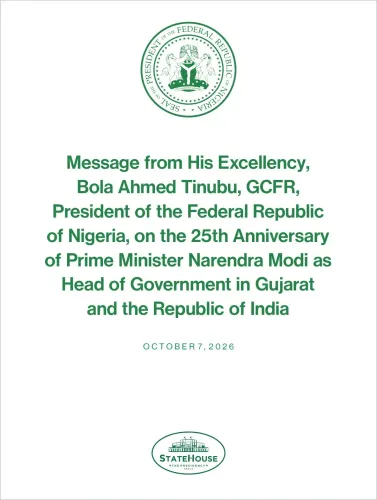
Prime Minister Narendra Modi on Wednesday, 10 June 2026 responded to a message from Nigerian President Bola Ahmed Tinubu, expressing gratitude for warm wishes and reaffirming the depth of the bilateral relationship between India and Nigeria.
Context
In his post on X, Prime Minister Modi wrote: 'Thank you President Bola Ahmed Tinubu for your warm wishes. I deeply value our friendship and the strong partnership between India and Nigeria.' He added that both nations would 'continue to work for the progress and prosperity of our peoples and for the advancement of the Global South.' The specific occasion prompting President Tinubu's original message has not been publicly stated.
The exchange underscores the personal diplomatic rapport that has developed between the two leaders since Tinubu assumed office in May 2023. High-level messaging of this nature between heads of government typically signals an active and mutually valued bilateral channel.
Policy Backdrop
Nigeria is India's largest trading partner on the African continent, with bilateral commerce spanning crude oil imports, pharmaceuticals, and capacity-building programmes. India has long relied on Nigerian crude as a significant component of its energy diversification strategy.
Structured engagement between the two countries has a documented history. At the India-Africa Forum Summit in 2015, Prime Minister Modi announced lines of credit and training slots for African countries, including Nigeria. A subsequent visit in 2018 saw bilateral defence and energy cooperation agreements reviewed at the highest level. India's technical cooperation programme, known as ITEC, has provided training to Nigerian professionals across multiple sectors over the years.
The reference to the Global South in Modi's post reflects a deliberate framing that India has consistently employed in multilateral forums, including the United Nations and the G20, where it has sought to position itself as a leading voice for developing nations.
Stakeholders and Impact
The Indian diaspora resident in Nigeria — engaged primarily in trade, manufacturing, and services — stands as a direct stakeholder in the health of this bilateral relationship. Smooth diplomatic ties facilitate business operations, consular services, and community welfare for this community.
Energy sector companies on both sides, as well as Nigerian students enrolled in Indian universities, also have a material interest in the continuity of strong institutional ties. Pharmaceutical exports from India to Nigeria represent another significant economic thread, with Indian generic medicines widely distributed across West Africa through Nigerian distribution networks.
What's Next
Diplomatic observers will watch for the next meeting of the bilateral India-Nigeria Joint Commission, which periodically reviews cooperation across trade, energy, defence, and people-to-people links. Any follow-up high-level visit — by either Prime Minister Modi or President Tinubu — would be a concrete indicator of how this renewed public warmth translates into policy outcomes.
With India continuing to deepen its Africa engagement as a strategic priority, the India-Nigeria corridor is likely to remain central to New Delhi's broader Global South outreach in the years ahead.
Point of View
Reinforcing India's Africa-first posture at a time when multiple major powers are competing for influence on the continent. The explicit invocation of the 'Global South' is not incidental — it frames the India-Nigeria relationship as part of a wider coalition-building project that New Delhi has pursued consistently since the 2014 India-Africa Forum Summit cycle. Nigeria, as Africa's largest economy and a major oil supplier, is a linchpin of that strategy. The exchange suggests both leaders are maintaining a warm personal channel that could facilitate faster movement on pending energy and defence cooperation files.
NationPress
26 Oct 2026
Frequently Asked Questions
Why did PM Modi thank President Tinubu on X?
PM Modi thanked Nigerian President Bola Ahmed Tinubu for warm wishes sent to him, reaffirming their personal friendship and the strong partnership between India and Nigeria. The specific occasion for Tinubu's original message has not been publicly disclosed.
What is the relationship between India and Nigeria?
India and Nigeria share one of the most significant bilateral relationships on the African continent. Nigeria is India's largest trading partner in Africa, with cooperation covering crude oil imports, pharmaceutical exports, technical training under the ITEC programme, and defence ties.
What does Global South mean in Indian foreign policy?
In Indian foreign policy, the 'Global South' refers to the collective of developing and emerging nations whose shared interests India seeks to champion in multilateral forums such as the UN and G20. India has used this framing to build diplomatic coalitions and position itself as a bridge between developed and developing worlds.
When did India and Nigeria last hold a high-level meeting?
India and Nigeria have engaged at the highest level on multiple occasions, including a bilateral review during PM Modi's 2018 visit to Nigeria, where defence and energy cooperation agreements were discussed. The two countries periodically convene a Joint Commission to review cooperation across all sectors.
What is India's ITEC programme and how does it relate to Nigeria?
The Indian Technical and Economic Cooperation (ITEC) programme provides training and capacity-building slots to professionals from partner countries. Nigeria has been a beneficiary of ITEC, with Nigerian officials and technicians receiving training in India across sectors including agriculture, IT, and public administration.