Sikkim 51st Statehood Day: Modi shares Scindia's tribute to Khangchendzonga legacy
Synopsis
As Sikkim enters its 51st statehood year, PM Modi amplified a rare ministerial essay that reframes the Himalayan state's development through the lens of an ancient mountain legend. Scindia's 'five treasures' framework — people, biodiversity, spirituality, organic farming, and education — is as much a political vision statement as it is cultural tribute, signalling how the Centre wants frontier states read in the Viksit Bharat 2047 narrative.
Key Takeaways
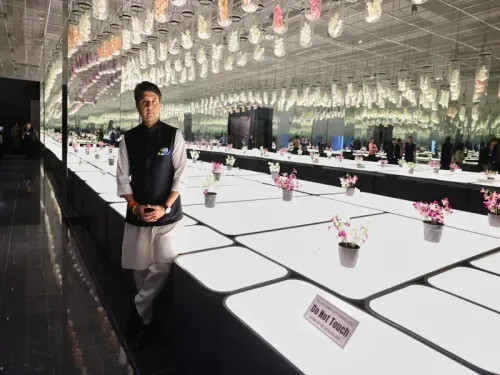
PM Modi shared Union Minister Jyotiraditya M.
Scindia's article on Sikkim's 51st Statehood Day via his X account.
The article uses the Five Treasures of Khangchendzonga — gold, silver, gems, grains, and holy books — as a framework for Sikkim's development story.
Sikkim is highlighted as a 100 per cent organic state , cited as one of contemporary India's most significant developmental achievements.
The Khangchendzonga National Park covers nearly one-fourth of Sikkim's total land area.
The permanent campus of Sikkim State University in Namchi is cited as a symbol of the state's educational future.
Modi's visit emphasised education, connectivity, healthcare, urban development, and tourism as the pillars of Sikkim's next growth phase.
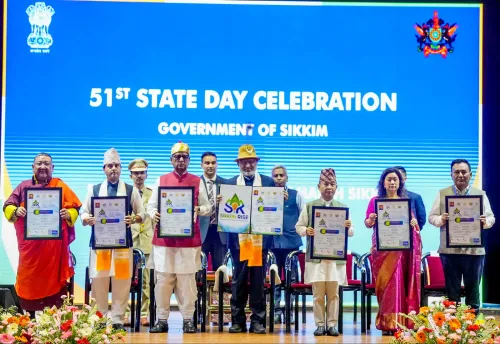
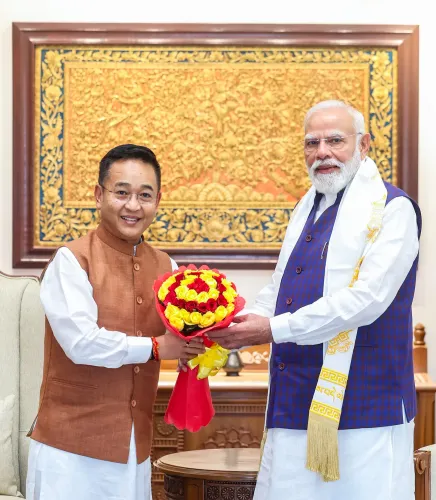
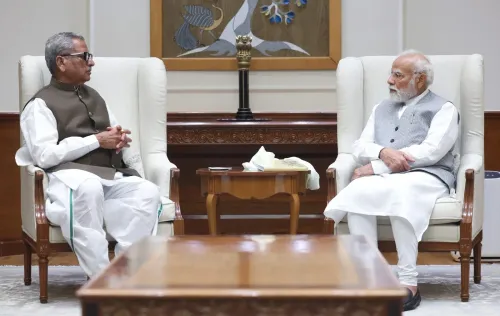
Prime Minister Narendra Modi on Sunday, 25 May 2025, shared an article authored by Union Minister Jyotiraditya M. Scindia as Sikkim marks its 51st year of statehood. Modi, in his post on X, noted that the piece highlights the sacred mountain Khangchendzonga as the protector of the land, memory, and consciousness of Sikkim — and traces how its five legendary treasures continue to shape the state's journey toward Viksit Sikkim 2047.
Khangchendzonga: More Than a Mountain
Scindia's article opens with a vivid invocation of Khangchendzonga, the great Himalayan massif draped in Lungta prayer flags, cloud, and snow. Nearly one-fourth of Sikkim's land area falls within the Khangchendzonga National Park. For centuries, the peak has occupied the folklore of indigenous communities as a sacred civilisational force. The great Lama Lhatsun Chenpo gave this belief its most enduring poetic form, describing the five summits as the Five Treasures of the Eternal Snow — gold, silver, gems, grains, and holy books — each peak assigned its own elemental meaning.
Scindia writes that during his recent visit for the 51st Statehood Day celebrations, this ancient lore revealed itself with striking contemporary relevance.
The Five Treasures and What They Represent Today
The first treasure — gold — is Sikkim's people. Scindia observes that development acquires permanence only when it grows from community confidence, and Sikkim offers compelling evidence of that truth through the unity and social harmony of the Lepcha, Bhutia, and Nepali communities.
The second treasure — silver — manifests through Sikkim's elemental beauty and biodiversity. The Teesta and Rangeet rivers wind between dense forests and clouds, while tea garden slopes hold the quiet promise of seasonal bloom.
The third treasure — gems — is cultural and spiritual. Sikkim's monasteries, the grand Buddha Park at Ravangla, the Bhaleydhunga skywalk, and the sacred geography blessed by Guru Padmasambhava together preserve a sense of spirituality the minister describes as 'increasingly precious and pristine in today's restless world.'
The fourth treasure — grains — carries the story of sustenance. Scindia highlights Sikkim's achievement as a 100 per cent organic state, describing its success in organic farming, cardamom cultivation, and sustainable agriculture as one of the most important developmental milestones in contemporary India.
The fifth treasure — holy books — represents Sikkim's intellectual capital. New educational institutions and the permanent campus of Sikkim State University in Namchi reflect, in Scindia's words, 'a future that respects tradition while opening doors to knowledge, skill and innovation.'
Modi's Vision for Viksit Sikkim
The article notes that Prime Minister Modi's own visit to the state underscored education, connectivity, healthcare, urban development, and tourism as the five pillars of Sikkim's next phase of growth. Scindia concludes that the old and the new meet in Sikkim 'with unusual grace,' producing a development model rooted in heritage.
Significance of the 51st Statehood Year
Sikkim's formal merger with India in 1975 marked one of the most consequential moments in post-independence Indian geography. The state has since emerged as a model for small-state governance — from organic agriculture to biodiversity conservation. As it enters its 51st year, the convergence of spiritual heritage and policy ambition captured in Scindia's piece reflects the Centre's broader effort to position frontier states as engines of the Viksit Bharat 2047 vision.
With Sikkim State University's permanent campus nearing completion and tourism infrastructure expanding, the state's next chapter will test whether its heritage-rooted development model can scale without eroding the very identity that makes it distinctive.
Point of View
Not just policy delivery. The 100 per cent organic status and biodiversity credentials are genuine achievements, but the essay sidesteps harder questions: Sikkim's economy remains heavily dependent on central transfers, and tourism growth carries real ecological risk for the Khangchendzonga ecosystem it celebrates. The Viksit Sikkim 2047 vision will need more than heritage framing — it will need a credible answer to fiscal self-sufficiency and climate resilience in one of India's most seismically vulnerable states.
NationPress
20 Sept 2026
Frequently Asked Questions
Why did PM Modi share Scindia's article on Sikkim?
PM Modi shared Union Minister Jyotiraditya M. Scindia's article to mark Sikkim entering its 51st year of statehood. Modi noted on X that the piece highlights Khangchendzonga as the protector of Sikkim's land, memory, and consciousness, and connects the mountain's five treasures to the state's development vision.
What are the Five Treasures of Khangchendzonga?
The Five Treasures of the Eternal Snow — gold, silver, gems, grains, and holy books — are a centuries-old interpretation attributed to Lama Lhatsun Chenpo, who assigned each of Khangchendzonga's five summits an elemental meaning. Scindia's article maps each treasure onto a contemporary development pillar: people, biodiversity, culture, organic farming, and education respectively.
What is Viksit Sikkim 2047?
Viksit Sikkim 2047 is the state's long-term development vision aligned with the national Viksit Bharat 2047 goal of a fully developed India by the centenary of independence. It encompasses pillars such as education, connectivity, healthcare, tourism, and sustainable agriculture.
Why is Sikkim's organic farming achievement significant?
Sikkim became India's first — and the world's first — fully organic state, a distinction that Scindia's article calls one of the most important developmental achievements in contemporary India. The state's success in cardamom cultivation and sustainable mountain agriculture is cited as a replicable model for other Himalayan economies.
When did Sikkim become a state of India?
Sikkim formally merged with India in 1975, making 2025 its 51st year of statehood. The state has since developed a distinct identity as a model for small-state governance, particularly in organic agriculture and biodiversity conservation.