Kishan Reddy shares PM Modi's Mann Ki Baat call on astronomy

Synopsis
Prime Minister Modi used the 134th Mann Ki Baat to champion India's astronomy heritage, praise grassroots clubs like Bangalore Astronomical Society and Astro Kerala, and urge youth to pursue stargazing. Union Minister G. Kishan Reddy amplified the message on 31 May 2026.
Key Takeaways
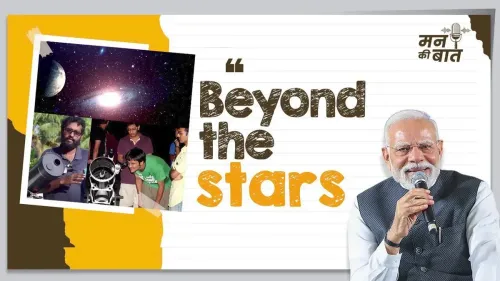
PM Modi devoted a segment of the 134th Mann Ki Baat episode to astronomy outreach and India's ancient astronomical heritage.
The Bangalore Astronomical Society was praised for its mission to carry astronomy education into rural areas.
Astro Kerala was highlighted for running observation camps and hands-on telescope-building workshops for students.
The Prime Minister urged young people to join astronomy clubs and visit planetariums during holidays.
Article 51A(h) of the Constitution makes development of scientific temper a fundamental duty of every Indian citizen.
Kishan Reddy shared the Prime Minister's remarks on 31 May 2026 , extending their reach on social media.
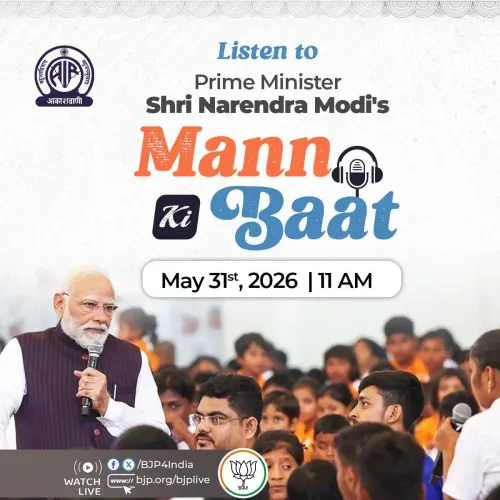
Union Coal and Mines Minister G. Kishan Reddy on Sunday, 31 May 2026, shared remarks made by Prime Minister Narendra Modi in the 134th episode of Mann Ki Baat, highlighting the Prime Minister's appeal to young Indians to pursue astronomy and join science clubs across the country.
Context
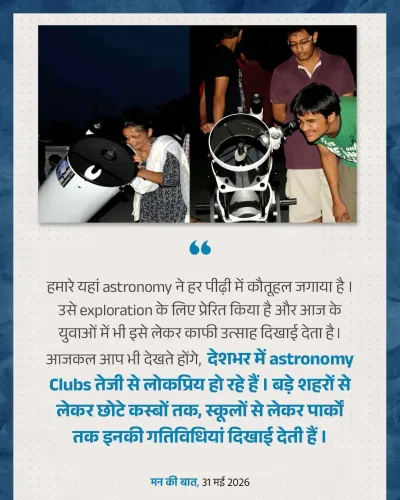
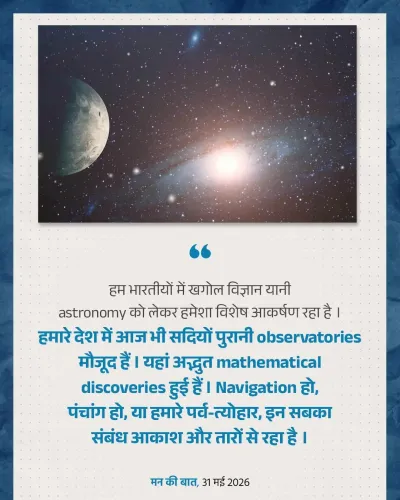
In the 134th Mann Ki Baat episode, PM Modi spoke at length about India's centuries-old fascination with astronomy, tracing its roots from ancient observatories and mathematical discoveries to the role the skies have played in shaping navigation, calendars, and festivals. He described the spread of astronomy clubs — from cities to small towns, from schools to public parks — as 'encouraging,' saying they nurture 'scientific temper and a spirit of discovery among our youth.'
The Prime Minister specifically called out two grassroots organisations by name. He noted that the Bangalore Astronomical Society has launched a mission to take astronomy into rural areas, while Astro Kerala runs observation camps and workshops where young people build their own telescopes and learn to use star maps. 'Gazing at the stars at night is in itself a wonderful experience,' he said, urging students to visit planetariums during their holidays.
Policy Backdrop
Mann Ki Baat was launched on 3 October 2014 as a monthly All India Radio programme through which the Prime Minister communicates directly with citizens on governance, culture, and social themes. The programme has consistently been used to spotlight grassroots movements and civil-society initiatives that align with national policy goals.
The emphasis on 'scientific temper' carries constitutional weight: Article 51A(h), inserted by the 42nd Amendment in 1976, lists the development of scientific temper as a fundamental duty of every Indian citizen. Successive governments have backed public planetariums — including the Birla Planetarium network — and science centres since the 1950s as instruments of informal science education.
The current push through community astronomy clubs continues a long-standing policy of using informal education channels to foster scientific curiosity outside formal school curricula, combining heritage appreciation with hands-on activities.
Stakeholders and Impact
The primary beneficiaries of the Prime Minister's appeal are school students and rural youth, who are being encouraged to look beyond textbooks toward participatory science. Organisations such as the Bangalore Astronomical Society and Astro Kerala are likely to see renewed public interest and membership inquiries following the national-level mention on Mann Ki Baat.
For G. Kishan Reddy, amplifying the Prime Minister's message serves a dual purpose: reinforcing the BJP's science-and-heritage communication strategy and extending its reach within Telangana, where he serves as the party's state president. The post underscores the party's effort to position itself as a champion of both India's scientific legacy and its modern STEM aspirations.
What's Next
Subsequent Mann Ki Baat episodes or circulars from the Ministry of Education may announce expanded support for school astronomy clubs and regional planetarium outreach programmes. The spotlight on community-level organisations could also prompt state governments to channel funds toward rural science infrastructure. For now, the Prime Minister's call stands as an invitation to millions of young Indians to look up — and to engage with the universe beyond their classrooms.
Point of View
The address elevates informal science education to a matter of national priority, potentially unlocking government patronage and public attention for these groups. G. Kishan Reddy's amplification of the message in Telangana signals that the BJP sees science communication as an effective electoral soft-power tool in southern states. The broader arc points toward a convergence of heritage policy, constitutional duty, and youth outreach that successive administrations have pursued but the current government has made more visible through direct-to-citizen platforms.
NationPress
23 Sept 2026
Frequently Asked Questions
What did PM Modi say about astronomy in Mann Ki Baat?
In the 134th episode of Mann Ki Baat, PM Modi celebrated India's ancient astronomical heritage and praised the spread of astronomy clubs from cities to rural areas, specifically mentioning the Bangalore Astronomical Society and Astro Kerala. He urged young people to join astronomy clubs, keep learning, and visit planetariums during their holidays.
What is the Bangalore Astronomical Society?
The Bangalore Astronomical Society is a non-profit organisation focused on astronomy outreach, and PM Modi noted in Mann Ki Baat that it has started a mission to make astronomy popular in rural areas of India.
What is Astro Kerala?
Astro Kerala is a Kerala-based astronomy collective that runs observation camps and hands-on workshops where young people learn to build telescopes and use star maps, as highlighted by PM Modi in the 134th Mann Ki Baat episode.
Why did G. Kishan Reddy share the Mann Ki Baat astronomy post?
Union Minister G. Kishan Reddy, who is also the BJP Telangana state president, shared PM Modi's Mann Ki Baat remarks on 31 May 2026 to amplify the Prime Minister's message on scientific temper and youth engagement with astronomy.
What is Mann Ki Baat?
Mann Ki Baat is a monthly All India Radio programme launched on 3 October 2014 through which Prime Minister Narendra Modi addresses citizens directly on topics ranging from governance and culture to science and social issues.