Anurag Thakur Highlights India's Astronomy Legacy via Mann Ki Baat
Synopsis
BJP MP Anurag Thakur invoked India's centuries-old astronomical tradition — from Jantar Mantar observatories to the panchang — while amplifying PM Modi's Mann Ki Baat spotlight on the surge of youth-led astronomy clubs from cities to small towns across India.
Key Takeaways
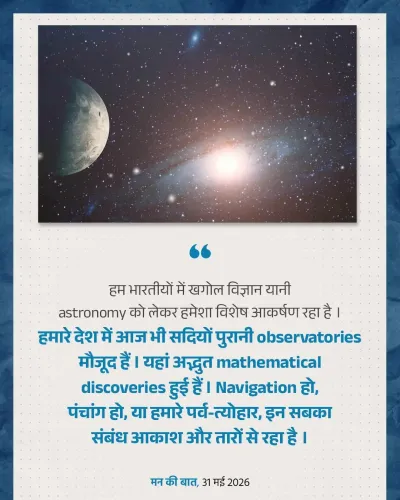
BJP MP Anurag Thakur posted on 31 May 2026 celebrating India's astronomical heritage and its links to everyday life through navigation, the panchang , and festivals.
Prime Minister Narendra Modi addressed the theme of astronomy on Mann Ki Baat , the monthly radio programme running since October 2014 .
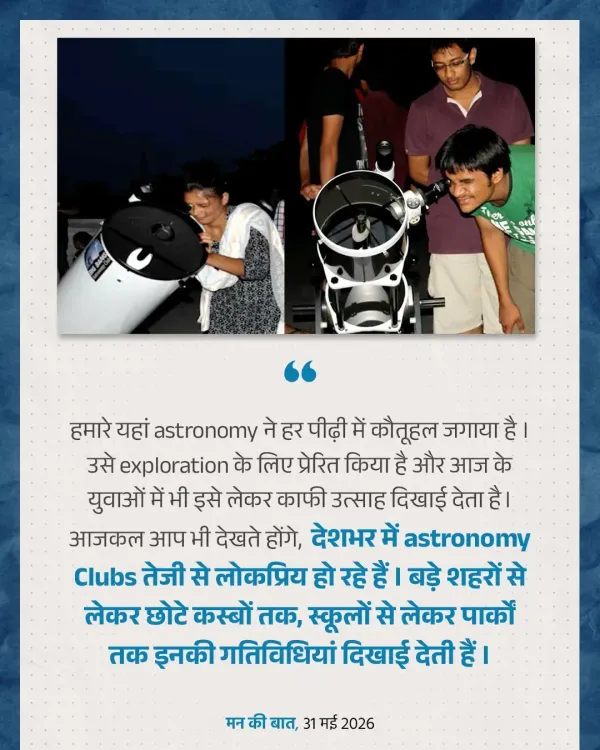
The post highlights the spread of astronomy clubs from large cities to small towns and from schools to parks across India.
Jantar Mantar observatories in Jaipur and Delhi , built in the 18th century , are cited as enduring symbols of India's observational science legacy and are recognised as UNESCO World Heritage sites.
The messaging connects ancient Indian mathematical and astronomical traditions to contemporary STEM and space-sector ambitions, consistent with broader government outreach since the mid-2010s.
BJP MP Anurag Thakur on Sunday, 31 May 2026 shared a post on X celebrating India's deep-rooted fascination with astronomy, linking the country's ancient observational traditions to a growing wave of astronomy clubs among today's youth — drawing attention to Prime Minister Narendra Modi's mention of the theme on his monthly radio programme Mann Ki Baat.
Context
In his post, Thakur wrote that Indians have always held a special attraction toward astronomy. He noted that centuries-old observatories still stand in the country, that remarkable mathematical discoveries were made here, and that navigation, the traditional panchang (almanac), and festivals have all been tied to the sky and stars. Translating his words: 'हम भारतीयों में खगोल विज्ञान यानी astronomy को लेकर हमेशा विशेष आकर्षण रहा है' — 'We Indians have always had a special attraction toward astronomy.'
Thakur anchored his post in the Mann Ki Baat episode by Prime Minister Narendra Modi, underscoring that the PM had himself highlighted this theme in the programme's latest edition. Mann Ki Baat has served since October 2014 as a monthly platform for the Prime Minister to spotlight citizen initiatives, heritage, and scientific curiosity.
Policy Backdrop
India's astronomical heritage is tangible and internationally recognised. The Jantar Mantar observatories — built in the 18th century and located in cities including Jaipur and Delhi — are UNESCO World Heritage sites and remain among the most cited examples of pre-modern Indian scientific infrastructure. Ancient texts and traditions in mathematics and positional astronomy have long been cited by policymakers as evidence of India's indigenous scientific legacy.
The government's broader push to connect this heritage with contemporary STEM engagement has paralleled ISRO's public-outreach efforts and school-level science programmes that gained momentum through the mid-2010s. Thakur, as a former Union Minister of Information and Broadcasting, has previously used cultural and scientific milestones as messaging anchors.
Stakeholders and Impact
Thakur specifically called out the rapid rise of astronomy clubs across the country — from large cities to small towns, from schools to parks — as evidence that curiosity about the cosmos is no longer confined to elite institutions. The primary stakeholders here are students, science educators, and community-level astronomy enthusiasts whose grassroots activities are being amplified by national political messaging.
By tying popular youth interest to ancient tradition and to the Prime Minister's radio address, the post positions astronomy engagement as both a cultural continuity and a contemporary civic movement. This framing is consistent with the government's recurring narrative linking India's scientific past to its aspirations in space and technology.
What's Next
Observers will watch whether subsequent Mann Ki Baat episodes or announcements from the Ministry of Culture translate this narrative into concrete policy — such as heritage-site conservation funding for observatories like Jantar Mantar or structured state-level support schemes for school astronomy clubs. The political salience of science-heritage messaging is likely to grow ahead of any major ISRO mission milestone, making this a theme worth tracking across both cultural and space-policy beats.
Point of View
Not separate from, its ancient heritage. By spotlighting grassroots astronomy clubs alongside UNESCO-recognised observatories, the messaging bridges elite heritage and popular youth engagement in a single frame. This fits a broader pattern in which ISRO missions, heritage conservation, and school STEM programmes are woven into a unified civilisational story. The political utility is clear: science becomes not just policy but identity.
NationPress
14 Oct 2026
Frequently Asked Questions
What did Anurag Thakur say about astronomy in India?
Anurag Thakur said that Indians have always had a special attraction toward astronomy, that ancient observatories and mathematical discoveries are part of India's heritage, and that astronomy clubs are rapidly growing across the country from big cities to small towns.
What is Mann Ki Baat and why is it relevant here?
Mann Ki Baat is a monthly radio programme hosted by Prime Minister Narendra Modi since October 2014, in which he discusses citizen initiatives, heritage, and science. Thakur's post amplifies the PM's mention of India's astronomy tradition on the programme.
Which Indian observatories are UNESCO World Heritage sites?
The Jantar Mantar observatories, built in the 18th century in cities including Jaipur and Delhi, are recognised as UNESCO World Heritage sites and are among India's most celebrated examples of pre-modern astronomical science.
Are astronomy clubs growing in India?
Thakur's post points to a visible rise in astronomy clubs across India, from large cities to small towns and from schools to parks, reflecting growing popular interest among youth — though the exact scale of expansion in smaller towns after 2023 is not independently verified.
What is the connection between India's ancient astronomy and modern STEM?
Government messaging has consistently linked India's ancient traditions in mathematics, navigation, and positional astronomy to contemporary STEM education and ISRO's space programme, framing modern scientific ambition as a continuation of a centuries-old intellectual heritage.