MP CM Office: New Govt Buildings to Meet Green Standards
Synopsis
Madhya Pradesh has mandated that all new government buildings comply with green building standards, focusing on energy efficiency and rainwater harvesting. The 25 June 2026 directive, issued by the Chief Minister's Office and tagged to the Urban Development and Environment departments, marks a cross-departmental push toward sustainable public infrastructure.
Key Takeaways
The Chief Minister's Office of Madhya Pradesh announced on 25 June 2026 that all new government buildings in the state must be built to green building standards.
The initiative specifically mandates energy efficiency and rainwater harvesting as core requirements for new public construction.
The directive is tagged to both the Madhya Pradesh Urban Development Department and the Madhya Pradesh Environment Department , indicating a cross-departmental mandate.
The move aligns with national frameworks including the Energy Conservation Building Code (ECBC) and certification systems such as GRIHA and IGBC .
Detailed implementation guidelines — including which certification standard applies and from which date — are yet to be issued by the Urban Development Department.
The policy follows a broader pattern of Indian states embedding green norms into public infrastructure under the National Action Plan on Climate Change .
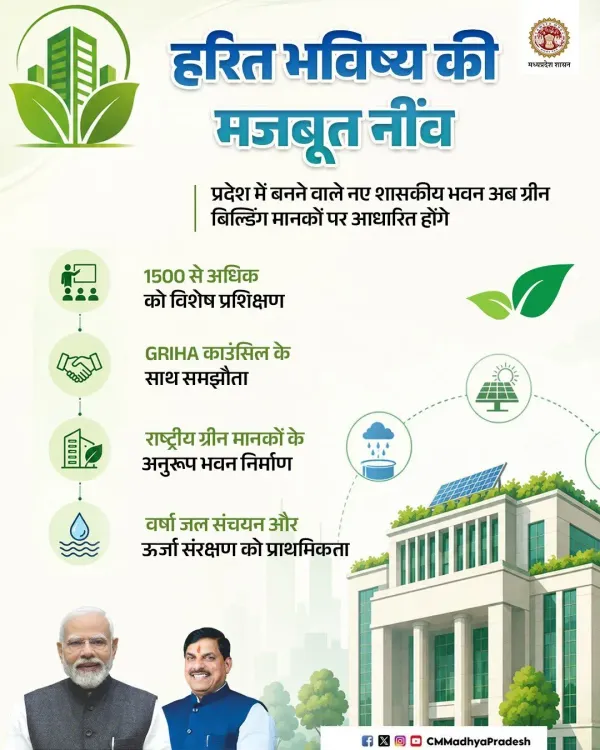
The Chief Minister's Office of Madhya Pradesh announced on Thursday, 25 June 2026 that all new government buildings in the state will henceforth be constructed in compliance with green building standards, signalling a formal policy shift that links infrastructure expansion with environmental responsibility. The directive, shared via the official CMO handle and tagged to Chief Minister Dr. Mohan Yadav, the Madhya Pradesh Urban Development Department, and the Madhya Pradesh Environment Department, frames the initiative as a new model of development alongside environmental conservation.
Context
The CMO's post states, in translation: 'Vikas ka naya model… naye shasakeey bhavan ab Green Building manakon ke anurup nirmit kiye jaenge' ('A new model of development alongside environmental conservation… new government buildings in Madhya Pradesh will now be constructed in accordance with green building standards'). The announcement specifically highlights energy efficiency and rainwater harvesting as the two pillars of this initiative, describing it as 'an important step towards a green future.'
By tagging both the Urban Development Department and the Environment Department, the CMO signals a cross-departmental mandate rather than a single-ministry directive — a structural detail that suggests coordinated implementation is intended from the outset.
Policy Backdrop
India's green building ecosystem is anchored by two primary certification frameworks: the Green Rating for Integrated Habitat Assessment (GRIHA) and the Indian Green Building Council (IGBC) rating system. Both evaluate buildings on parameters including energy consumption, water management, materials sourcing, and indoor environmental quality.
At the national level, the Energy Conservation Building Code (ECBC) — first notified in 2007 and substantially revised in 2017 — sets minimum energy performance standards for commercial and public structures. Madhya Pradesh's move to mandate green norms for government buildings aligns with commitments several Indian states have made under the National Action Plan on Climate Change (NAPCC), which encourages integrating sustainability benchmarks into public infrastructure pipelines.
Multiple states have preceded Madhya Pradesh in embedding such requirements into government construction, but adoption has been uneven. A formal CMO-level announcement of this kind typically precedes the issuance of detailed departmental guidelines and, in some cases, eventual extension of norms to private real-estate projects.
Stakeholders and Impact
The most immediate stakeholders are state government agencies that commission and occupy public buildings — from district offices and secretariat annexes to hospitals and schools built under state capital budgets. Contractors and architects working on government projects will be required to demonstrate compliance with whichever specific certification standard the Urban Development Department designates in its implementation guidelines.
The urban construction sector more broadly is watching the announcement closely. If Madhya Pradesh subsequently extends green norms to private commercial or residential projects — as some states have done — the compliance and consultancy market for green certifications in the state could expand significantly. For citizens, the long-term benefit lies in lower energy and water consumption in publicly funded assets, reducing the operational burden on state finances over building lifecycles.
What's Next
The critical next step will be the release of detailed implementation guidelines by the Madhya Pradesh Urban Development Department, which must specify which certification standard applies, at what building scale, and from which project-approval date the norms become mandatory. The involvement of the Madhya Pradesh Environment Department suggests environmental-impact integration may also be folded into the building-approval process.
Observers will also watch whether the state government sets a measurable target — such as a percentage of new government floor area to be certified annually — or whether the mandate remains a broad directional commitment. Either way, the announcement places Madhya Pradesh firmly within a growing cohort of Indian states treating public buildings as a lever for climate action, not merely as infrastructure expenditure.
Point of View
The state government is framing green construction not as an add-on but as a baseline procurement standard. This mirrors a pattern seen across several Indian states that have used government buildings as a low-resistance entry point for green norms before extending them to the private sector. For Chief Minister Dr. Mohan Yadav, the move also serves a political-optics function — positioning Madhya Pradesh as a proactive actor on climate commitments ahead of what is likely to be an increasingly scrutinised national conversation on state-level environmental governance. The real test, however, will be in the implementation guidelines: without a named certification standard, a mandatory threshold, and an enforcement mechanism, the directive risks remaining aspirational rather than transformative.
NationPress
25 Jun 2026
Frequently Asked Questions
What are the new green building rules for government buildings in Madhya Pradesh?
The Chief Minister's Office of Madhya Pradesh announced on 25 June 2026 that all new government buildings in the state must be constructed in compliance with green building standards, with a specific focus on energy efficiency and rainwater harvesting. Detailed implementation guidelines, including the specific certification standard to be applied, are expected from the Urban Development Department.
What is the GRIHA or IGBC green building certification in India?
GRIHA (Green Rating for Integrated Habitat Assessment) and IGBC (Indian Green Building Council) are India's two primary green building certification frameworks. They evaluate buildings on energy use, water management, sustainable materials, and indoor environmental quality, and are the most commonly referenced standards for government green building mandates across Indian states.
What is the Energy Conservation Building Code (ECBC) in India?
The Energy Conservation Building Code (ECBC) is a national standard first notified in 2007 and revised in 2017 that sets minimum energy performance requirements for commercial and public buildings in India. It is one of the foundational policy instruments that state-level green building mandates typically align with.
Which department will implement the green building policy in Madhya Pradesh?
The Madhya Pradesh Urban Development Department is the primary body responsible for urban planning and public building standards in the state, and is expected to issue the detailed implementation guidelines for the new green building mandate. The Environment Department has also been tagged in the announcement, suggesting coordinated cross-departmental oversight.
Will private buildings in Madhya Pradesh also have to follow green building norms?
The 25 June 2026 announcement applies specifically to new government buildings. However, observers note that several Indian states have eventually extended similar green norms to private commercial and residential projects after first establishing them for public infrastructure, making this a possibility to watch in Madhya Pradesh as well.