MP CMO Pushes Institutional Delivery, Vaccination & Nutrition Drive
Synopsis
The Chief Minister's Office of Madhya Pradesh on 5 July 2026 pledged to accelerate institutional deliveries, timely immunisation, better nutrition, and adequate care for mothers and children, reinforcing the state's alignment with central health missions including JSY, Mission Indradhanush, and POSHAN Abhiyaan.
Key Takeaways
The Chief Minister's Office of Madhya Pradesh on 5 July 2026 publicly reaffirmed a policy push on maternal and child health.
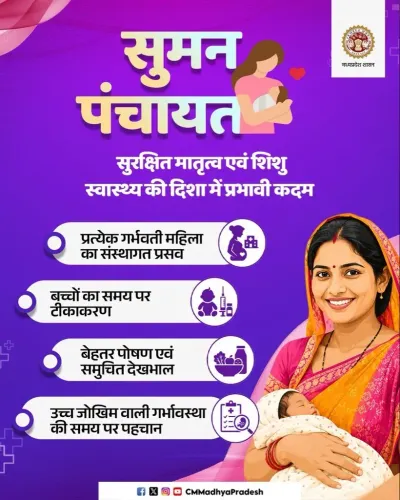
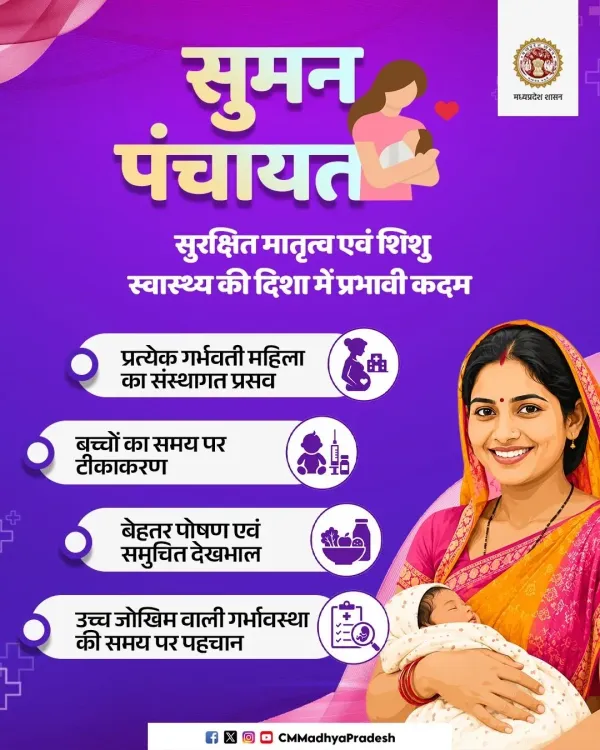
The four focus areas are institutional delivery, timely vaccination, improved nutrition, and adequate care .
The push aligns with central schemes including Janani Suraksha Yojana (2005) , Mission Indradhanush (2014) , and POSHAN Abhiyaan (2018) .
ASHA workers are the primary last-mile implementers connecting families to health facilities and immunisation services.
Madhya Pradesh is a high-focus state under the National Health Mission due to historically elevated MMR and IMR figures.
Concrete implementation signals are expected in the state's 2026-27 health budget and district-level NHM targets.
The Chief Minister's Office of Madhya Pradesh on Sunday, 5 July 2026 reaffirmed the state government's commitment to promoting institutional deliveries, timely vaccination, improved nutrition, and adequate healthcare for mothers and children across the state.
The post, shared from the official CMO handle, stated that the government would give a boost to 'sansthaagat prasav, samay par teekakarana, behtar poshan aur samuchit dekhbhaal' — institutional delivery, timely immunisation, better nutrition, and adequate care — signalling a renewed policy push on maternal and child health outcomes.
Context
Madhya Pradesh has historically been among the high-focus states under India's national health architecture, given its relatively elevated maternal mortality ratio (MMR) and infant mortality rate (IMR) compared to national averages. The state has been a priority target for centrally sponsored health interventions since the launch of the National Health Mission (NHM) in 2005.
Chief Minister Mohan Yadav, who assumed office in December 2023, has continued the state's alignment with central health goals, particularly around reducing preventable deaths among mothers and newborns in rural and tribal districts.
Policy Backdrop
The four pillars highlighted — institutional delivery, timely vaccination, nutrition, and care — map directly onto a cluster of long-running central schemes. The Janani Suraksha Yojana (JSY), launched in 2005, provides cash incentives to below-poverty-line families to encourage hospital births, reducing the risk of unattended deliveries in remote areas.
Immunisation coverage is driven through Mission Indradhanush, intensified from 2014 onward to reach children and pregnant women missed by routine programmes. On the nutrition front, POSHAN Abhiyaan, rolled out nationally from 2018, set district-level targets for Madhya Pradesh to reduce stunting, wasting, and anaemia. The Janani Shishu Suraksha Karyakram, expanded in 2011, further guarantees free transport and in-facility care for institutional deliveries, removing financial barriers for the poorest families.
Together, these schemes form the policy spine that the CMO's statement appears to reinforce at the state level, signalling continued administrative prioritisation heading into the 2026-27 budget cycle.
Stakeholders and Impact
The primary beneficiaries of this push are pregnant women and infants, particularly in Madhya Pradesh's rural, tribal, and economically vulnerable communities. ASHA (Accredited Social Health Activist) workers serve as the last-mile link, mobilising families for antenatal check-ups, guiding women to health facilities for delivery, and tracking children's immunisation schedules.
Improved institutional delivery rates directly reduce maternal and neonatal mortality by ensuring skilled birth attendance and emergency obstetric care. Timely vaccination protects infants from vaccine-preventable diseases that remain a significant cause of under-five mortality in the state. Better nutrition outcomes, measured through reductions in stunting and anaemia, have long-term consequences for cognitive development and economic productivity.
What's Next
The statement sets an expectation of intensified programme activity across Madhya Pradesh's health and women-and-child development departments. Observers will watch for concrete implementation signals in the state's 2026-27 health budget allocations and district-level targets shared with NHM.
The next round of the National Family Health Survey (NFHS) will provide the most authoritative data on whether Madhya Pradesh's institutional delivery rates, full immunisation coverage, and nutrition indicators have improved in line with the National Health Policy 2017 targets and India's Sustainable Development Goal commitments on reducing MMR and IMR. The CMO's public reaffirmation signals that maternal and child health remains a political as well as administrative priority for the Yadav government.
Point of View
Vaccination, nutrition, and care — the administration is aligning itself visibly with the Union government's flagship health missions, a pattern that has become standard practice for BJP-governed states seeking to demonstrate convergence with central policy priorities. The timing, ahead of likely NFHS data scrutiny and budget deliberations, suggests the government is pre-empting criticism over persistent gaps in MMR and IMR in tribal and rural districts. Whether the statement translates into fresh resource allocation or is primarily communicative will be the critical test.
NationPress
5 Jul 2026
Frequently Asked Questions
What did the Madhya Pradesh CMO announce about health on 5 July 2026?
The Chief Minister's Office of Madhya Pradesh announced a push to promote institutional deliveries, timely vaccination, better nutrition, and adequate care for mothers and children in the state.
What is Janani Suraksha Yojana and how does it help in Madhya Pradesh?
Janani Suraksha Yojana is a central government scheme launched in 2005 that provides cash incentives to below-poverty-line families to encourage hospital births, reducing risks from unattended deliveries, and it is a key programme in Madhya Pradesh's maternal health strategy.
What is POSHAN Abhiyaan and what are its goals in MP?
POSHAN Abhiyaan is India's national nutrition mission, rolled out from 2018, which set district-level targets for Madhya Pradesh to reduce stunting, wasting, and anaemia among children and pregnant women.
What is Mission Indradhanush and why is it important for Madhya Pradesh?
Mission Indradhanush is an intensified immunisation drive launched from 2014 to reach children and pregnant women missed by routine vaccination programmes; it is especially important for Madhya Pradesh given the state's rural and tribal populations with historically lower coverage.
Who are ASHA workers and what role do they play in maternal health in MP?
ASHA (Accredited Social Health Activist) workers are community health volunteers who serve as the last-mile link between families and the health system, mobilising pregnant women for antenatal care, guiding them to facilities for institutional delivery, and tracking children's immunisation schedules in Madhya Pradesh.