MP Congress leader gets 2 duplicate voter IDs, alleges SIR irregularities

Synopsis
A Madhya Pradesh Congress spokesperson claims the ECI's Special Intensive Revision process issued two duplicate voter ID cards in his name — same name, same address, different numbers. He now holds three voter cards and is asking: how many votes is one person legally entitled to cast?
Key Takeaways
Mithun Ahirwar , Madhya Pradesh Congress spokesperson, alleged on 30 May that two duplicate voter ID cards were issued in his name during the ECI's SIR process.
Both new cards carry the same name, father's name, and address — differing only in Voter ID numbers .
Ahirwar's name was previously deleted from the voter roll during an earlier SIR round, restored only after media coverage.
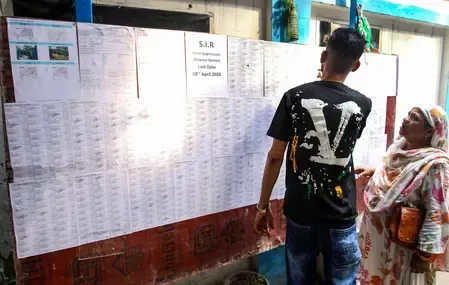
The SIR exercise in MP ran from November 2025 to February 2026 , with Booth Level Officers (BLOs) conducting house-to-house verification.
Ahirwar demanded an independent inquiry into duplicate voter entries and wrongful deletions from electoral rolls.
The ECI had not issued a public response to the allegations at the time of reporting.
Madhya Pradesh Congress spokesperson Mithun Ahirwar on Saturday, 30 May alleged serious irregularities in the Election Commission of India (ECI)'s Special Intensive Revision (SIR) process in the state, claiming that two fresh voter ID cards were issued in his name — despite the poll body's repeated assurances of rigorous door-to-door verification. Ahirwar made the allegations at a press conference at the Congress office in Bhopal.
What Ahirwar Alleged
According to the Congress leader, both newly issued voter ID cards carry the same name, father's name, and residential address — differing only in their Voter ID numbers. He alleged that his name had previously been deleted from the electoral roll during an earlier SIR round, and was restored only after media coverage of the matter. Instead of simply reinstating his name, he claimed, authorities generated two entirely new voter ID cards in his name.
Ahirwar questioned how such duplication was possible given that the ECI's verification framework relies on Aadhaar and other identity documents. 'If BLOs were actually conducting door-to-door verification, how did two separate Voter IDs get issued in the name of one person? The Election Commission should clarify which Voter ID is valid and which one is invalid,' he said.
The Three-Vote Question
Ahirwar escalated his challenge by pointing to an alleged earlier ECI statement that deleted voters would still be permitted to vote using their old voter ID cards. Given that context, he asked whether he would now be eligible to cast votes using all three cards — his original card and the two newly issued ones. 'Has one individual effectively been granted the right to cast three votes? If this can happen with a political party spokesperson, one can imagine what ordinary citizens must be facing,' he alleged.
Background: The SIR Process in MP
The Special Intensive Revision exercise in Madhya Pradesh was launched in November 2025 as part of a nationwide voter roll verification drive by the ECI. Booth Level Officers (BLOs) were tasked with conducting house-to-house verification of electors. The final electoral roll was published in February 2026. The ECI had maintained throughout that the process was transparent, impartial, and grounded in physical verification of voters.
Congress Demands an Inquiry
Ahirwar demanded an independent investigation into potential duplicate voter entries and the deletion of genuine names from electoral rolls during the SIR process. He argued that if such discrepancies could surface in the case of a party spokesperson — someone with the platform to raise the issue publicly — the scale of errors affecting ordinary voters could be significantly larger. The ECI had not issued a public response to the allegations at the time of reporting.
The development adds political pressure on the poll body ahead of any forthcoming electoral exercise in the state, and is likely to intensify scrutiny of how BLO-level verification is audited and cross-checked against existing identity databases.
Point of View
Including two freshly minted ones, is an uncomfortable inversion of that stated goal. The deeper problem is structural: BLO-level verification is largely self-reported, with limited third-party audit against Aadhaar or EPIC databases in real time. If duplication can surface in the name of a spokesperson who has both the visibility and the incentive to flag it, the question of how many silent duplicates exist in the final roll is legitimate and unanswered. The ECI owes a specific, technical response — not a general defence of the process.
NationPress
15 Oct 2026
Frequently Asked Questions
What did Mithun Ahirwar allege about the ECI's SIR process in Madhya Pradesh?
Madhya Pradesh Congress spokesperson Mithun Ahirwar alleged that the ECI's Special Intensive Revision process issued two new voter ID cards in his name, both carrying the same name, father's name, and address but with different Voter ID numbers. He said this exposed serious flaws in the door-to-door verification the ECI had claimed was strictly followed.
What is the Special Intensive Revision (SIR) process?
The Special Intensive Revision is an ECI-mandated exercise to verify and update electoral rolls, conducted through Booth Level Officers who perform house-to-house checks. In Madhya Pradesh, the SIR was launched in November 2025 and concluded with the publication of the final electoral roll in February 2026.
Why does Ahirwar claim he could theoretically cast three votes?
Ahirwar holds his original voter ID card plus two newly issued ones. He cited an alleged ECI statement that deleted voters could still vote using old cards, and argued that with three valid-looking cards in his name, the system has inadvertently created the possibility of multiple votes for one individual — though casting multiple votes remains illegal.
What action has Congress demanded over the alleged voter ID irregularities?
Congress has demanded an independent inquiry into duplicate voter entries and the deletion of genuine voter names from electoral rolls during the SIR process in Madhya Pradesh. Ahirwar also called on the ECI to publicly clarify which of the two new voter IDs is valid and which should be cancelled.
Has the Election Commission of India responded to these allegations?
The Election Commission of India had not issued a public response to Ahirwar's allegations at the time of reporting. The ECI had previously maintained that the SIR process was transparent, impartial, and based on physical verification of electors.