CM Mohan Yadav: MP's irrigated land reaches 60 lakh hectares
Synopsis
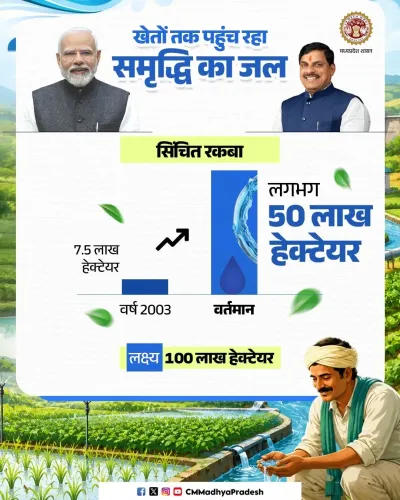
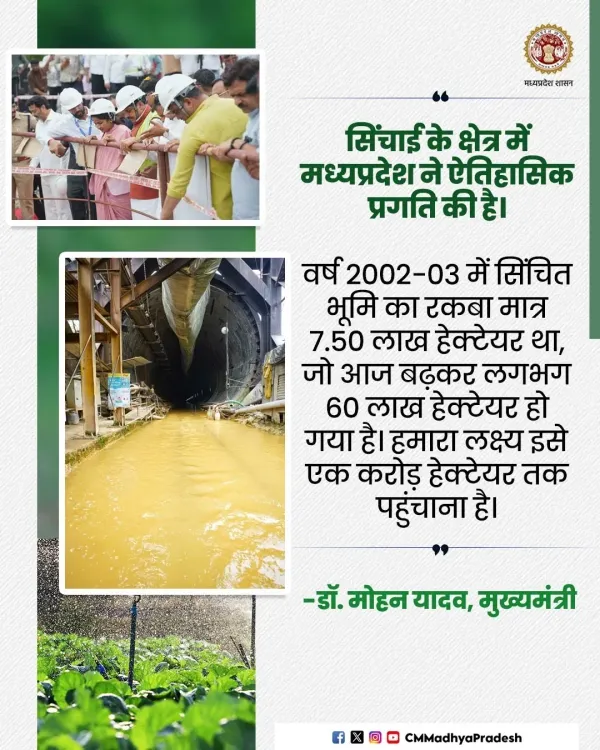
Chief Minister Dr. Mohan Yadav has announced that Madhya Pradesh's irrigated land area has reached approximately 60 lakh hectares, marking what the state calls a historic milestone in its long-running push to expand irrigation infrastructure and reduce rain-fed farming dependence.
Key Takeaways
Mohan Yadav announced on 18 July 2026 that Madhya Pradesh has achieved historic progress in irrigation.
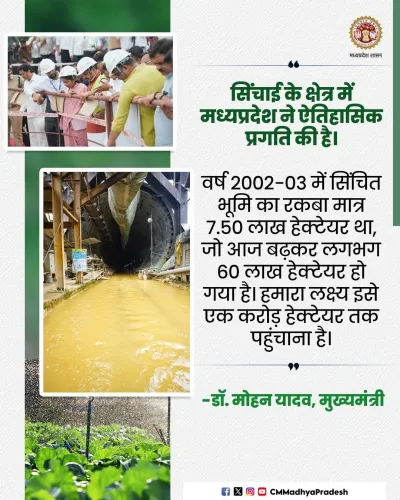
The state's irrigated land area has grown to approximately 60 lakh hectares , according to the Chief Minister's Office.
The announcement was addressed to the state's Agriculture Ministry and Water Resources Department , both key implementing agencies.
The progress builds on a decades-long irrigation push, including project completions between 2005 and 2018 and central support under the Pradhan Mantri Krishi Sinchayee Yojana .
Expanded irrigation coverage is expected to enable multi-crop cultivation and reduce farmers' dependence on monsoon rainfall in central India.
Detailed statistics are expected to be confirmed through the Water Resources Department's annual reports and state budget documents.
The Chief Minister's Office of Madhya Pradesh announced on Saturday, 18 July 2026, that the state has achieved a landmark milestone in irrigation, with Chief Minister Dr. Mohan Yadav stating that irrigated land in the state has grown to approximately 60 lakh hectares.
Context
In a post on X, CM Dr. Mohan Yadav declared: 'Sinchai ke kshetra mein Madhya Pradesh ne aitihasik pragati ki hai' ('Madhya Pradesh has made historic progress in the field of irrigation'). The announcement was addressed jointly to the state's agriculture and water resources ministries, signalling a coordinated administrative push behind the claim. The figure of 60 lakh hectares of irrigated land represents a significant marker in the state's long-running effort to reduce dependence on rain-fed farming across its vast agricultural belt.
Policy Backdrop
Expanding irrigation coverage has been a central plank of governance in Madhya Pradesh for over two decades. Between 2005 and 2018, successive state governments completed multiple major and medium irrigation projects that progressively added several lakh hectares of irrigated area to the state's total. The Pradhan Mantri Krishi Sinchayee Yojana (PMKSY), a central scheme launched in 2015 with the aim of improving irrigation efficiency and expanding coverage, has provided an additional funding and implementation window for states like Madhya Pradesh to accelerate pending projects. The Water Resources Department of Madhya Pradesh oversees the canal networks, dams, and lift-irrigation schemes that form the backbone of this infrastructure.
Dr. Mohan Yadav, who assumed office as Chief Minister in December 2023, has placed agriculture and rural development at the centre of his administration's priorities. The irrigation milestone, as announced, fits within that stated agenda and builds on the project pipeline inherited from earlier administrations.
Stakeholders and Impact
Madhya Pradesh is one of India's largest agrarian states, and the farming community stands as the most direct beneficiary of expanded irrigation access. Greater irrigated area typically enables farmers to shift from single-crop to multi-crop cultivation, raising cropping intensity and reducing vulnerability to erratic monsoon patterns that affect central India. The state's broader irrigation push mirrors similar strategies pursued in other large agrarian states such as Maharashtra and Rajasthan, where governments have used a combination of state funds and central scheme allocations to bring more land under assured water supply. The Water Resources Department and the Agriculture Ministry of Madhya Pradesh, both tagged in the Chief Minister's post, are the key institutional actors responsible for translating this headline figure into ground-level delivery.
What's Next
Detailed verification of the 60 lakh hectare figure is expected to emerge through the state's budget documents and the Water Resources Department's annual reports, which track irrigated-area statistics and new project sanctions. Observers will watch whether the government follows this announcement with specific project completions, new sanctions, or targets for the next agricultural season. The announcement is also likely to set the benchmark against which future irrigation progress in Madhya Pradesh will be measured, both within the state and in comparisons with other major agricultural states across India.
Point of View
If substantiated by official records, would represent a substantial share of the state's total cultivable area and lend credibility to the BJP administration's rural development pitch. The tagging of both the Agriculture and Water Resources ministries in the same post suggests a deliberate effort to project whole-of-government coordination on farm welfare. More broadly, the announcement fits a pattern across large Indian states where irrigation expansion has become a key metric of administrative performance, with real consequences for cropping intensity, farmer income, and electoral goodwill.
NationPress
16 Oct 2026
Frequently Asked Questions
How much irrigated land does Madhya Pradesh have now?
According to an announcement by Chief Minister Dr. Mohan Yadav on 18 July 2026 , Madhya Pradesh now has approximately 60 lakh hectares of irrigated land, which the state describes as a historic achievement.
What is the Pradhan Mantri Krishi Sinchayee Yojana and how does it help Madhya Pradesh?
The Pradhan Mantri Krishi Sinchayee Yojana (PMKSY) is a central government scheme launched in 2015 to improve irrigation efficiency and expand coverage. Madhya Pradesh has used it as a key funding window to accelerate completion of pending irrigation projects.
Who is the Chief Minister of Madhya Pradesh?
Dr. Mohan Yadav is the Chief Minister of Madhya Pradesh , having assumed office in December 2023 . He has prioritised agriculture and rural development as central themes of his administration.
Why is irrigation expansion important for Madhya Pradesh farmers?
Greater irrigated area allows farmers in Madhya Pradesh to shift from single-crop to multi-crop cultivation, reducing their dependence on erratic monsoon rainfall that is common in central India and improving overall farm income.
Which department oversees irrigation infrastructure in Madhya Pradesh?
The Water Resources Department of Madhya Pradesh is the primary state agency responsible for managing canal networks, dams, and lift-irrigation schemes that form the backbone of the state's irrigation infrastructure.