CM Mohan Yadav: MP irrigated area reaches 65 lakh hectares
Synopsis
Chief Minister Dr. Mohan Yadav announced on 18 July 2026 that Madhya Pradesh's irrigated land has reached 65 lakh hectares, marking what the state calls a historic milestone in irrigation expansion driven by major river basin projects and centrally-sponsored schemes.
Key Takeaways
The Chief Minister's Office of Madhya Pradesh announced on 18 July 2026 that the state's irrigated area has reached 65 lakh hectares .
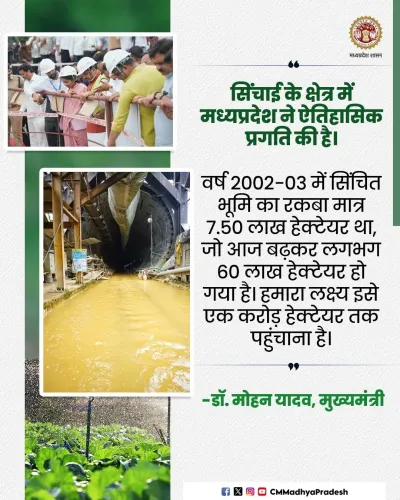
Mohan Yadav described the achievement as 'historic progress' in the irrigation sector.
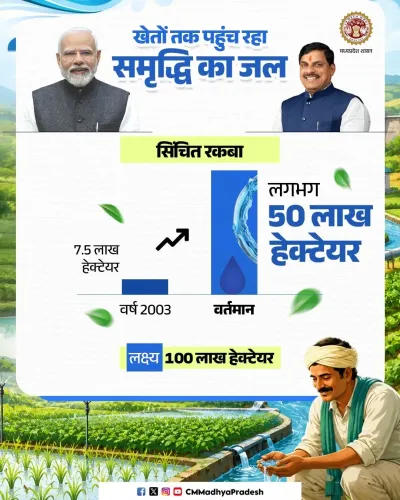
Madhya Pradesh's irrigated coverage has grown from roughly 7.5 lakh hectares in the early 2000s, driven by projects on the Narmada, Chambal, and Betwa basins.
The centrally-sponsored Pradhan Mantri Krishi Sinchayee Yojana (PMKSY) , launched in 2015 , has been a key funding channel for the state's irrigation push.
Independent verification of the 65 lakh hectare figure is awaited through the next state economic survey or agricultural census.
The milestone is expected to benefit farmers and rural households by reducing monsoon dependence and enabling higher cropping intensity.
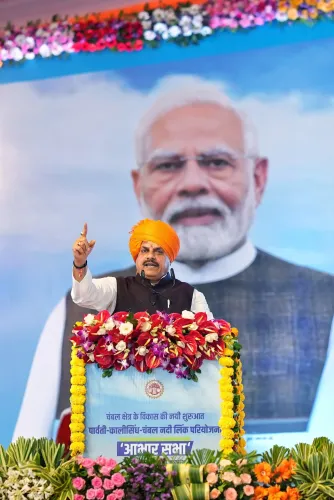
The Chief Minister's Office of Madhya Pradesh announced on Saturday, 18 July 2026, that the state has achieved a historic milestone in irrigation, with Chief Minister Dr. Mohan Yadav stating that the total irrigated land in Madhya Pradesh has risen to 65 lakh hectares.
Context
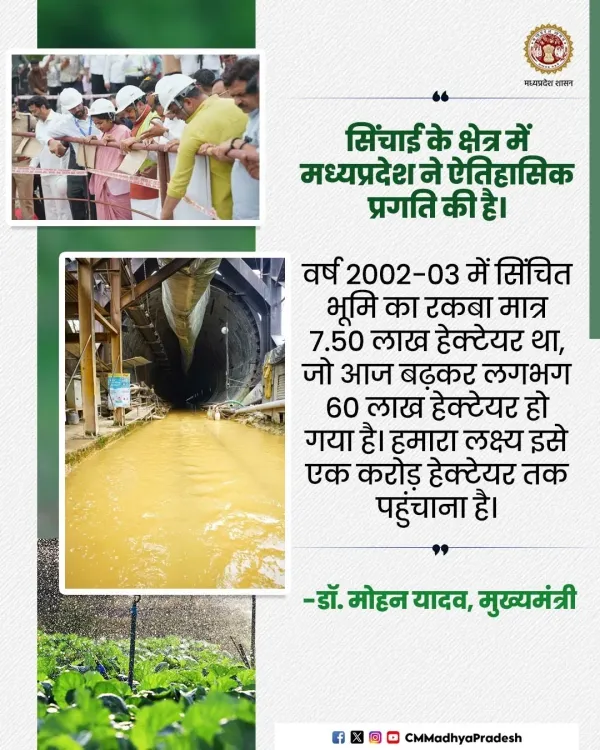
Quoting CM Dr. Mohan Yadav directly, the post declared: 'Sinchai ke kshetra mein Madhya Pradesh ne aitihasik pragati ki hai' ('Madhya Pradesh has made historic progress in the field of irrigation'). The announcement places the current irrigated area at 65 lakh hectares, a figure the Chief Minister's Office is presenting as a landmark achievement for the state's agricultural sector. The post was shared across official handles including the state agriculture and water resources departments.Policy Backdrop
Madhya Pradesh has pursued irrigation expansion across multiple governments since the early 2000s, when irrigated coverage stood at roughly 7.5 lakh hectares. Growth has been driven by major-medium-minor irrigation projects across the Narmada, Chambal, and Betwa river basins, alongside micro-irrigation subsidies. The centrally-sponsored Pradhan Mantri Krishi Sinchayee Yojana (PMKSY), launched in 2015, provided additional federal funding to accelerate both canal infrastructure and on-farm water-use efficiency in the state. Madhya Pradesh holds the distinction of having the largest cultivable area among Indian states, making irrigation coverage a particularly consequential metric for agricultural output.Stakeholders and Impact
The primary beneficiaries of expanded irrigation are the state's farming communities and rural households, who gain reduced dependence on monsoon rainfall and more predictable cropping cycles. Assured irrigation is widely linked to higher cropping intensity — the ability to cultivate more than one crop per year on the same land — and improved access to institutional credit and crop insurance for smallholder farmers. CM Dr. Mohan Yadav, who took office in December 2023 and has emphasised agriculture and rural development as priorities, has used this milestone to signal continuity with the state's long-term infrastructure push. Several Indian states have followed a similar pattern of highlighting cumulative irrigated area figures as a measure of agricultural resilience and reduced climate vulnerability.What's Next
Independent corroboration of the 65 lakh hectare figure is expected through the next state economic survey or agricultural census data, which would provide a verified baseline for comparison. Budget allocations for ongoing irrigation projects — particularly those tied to PMKSY targets — will be closely watched by farmers' groups and policy observers. The state government is likely to leverage this milestone in the lead-up to further announcements on agricultural infrastructure, water resource management, and rural development spending.Point of View
Particularly ahead of budget cycles or electoral seasons. The jump from roughly 7.5 lakh hectares in the early 2000s to a claimed 65 lakh hectares today, if independently verified, would represent one of the more significant state-level irrigation expansions in the country. However, the absence of a contemporaneous independent audit means the figure currently rests on official assertion alone — a recurring limitation with state-reported agricultural statistics in India. The broader policy significance lies in whether this irrigated area translates into measurable gains in cropping intensity, farmer income, and climate resilience, metrics that the next state economic survey will need to address.
NationPress
16 Oct 2026
Frequently Asked Questions
What is the current irrigated area in Madhya Pradesh?
According to Chief Minister Dr. Mohan Yadav's announcement on 18 July 2026, Madhya Pradesh's irrigated land now stands at 65 lakh hectares, up from roughly 7.5 lakh hectares in the early 2000s.
What is Pradhan Mantri Krishi Sinchayee Yojana and how has it helped Madhya Pradesh?
Pradhan Mantri Krishi Sinchayee Yojana (PMKSY) is a centrally-sponsored scheme launched in 2015 that funds irrigation infrastructure and micro-irrigation adoption. It has provided significant federal support to Madhya Pradesh's expansion of canal networks and on-farm water efficiency.
Which rivers support irrigation projects in Madhya Pradesh?
The major irrigation projects in Madhya Pradesh are built across the Narmada, Chambal, and Betwa river basins, which together support a large share of the state's canal-irrigated farmland.
Who is the Chief Minister of Madhya Pradesh in 2026?
Dr. Mohan Yadav is the Chief Minister of Madhya Pradesh, having assumed office in December 2023. He has emphasised agriculture and rural development as key priorities of his administration.
How does expanded irrigation benefit farmers in Madhya Pradesh?
Assured irrigation reduces farmers' dependence on monsoon rainfall, enables higher cropping intensity by allowing more than one crop per year on the same land, and improves access to institutional credit and crop insurance for smallholder farmers.