Nadda Addresses Amar Ujala Samvad-2026 in Dehradun
Synopsis
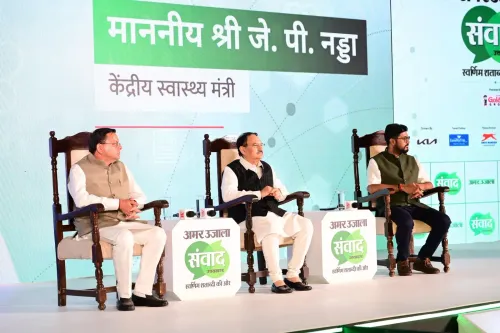
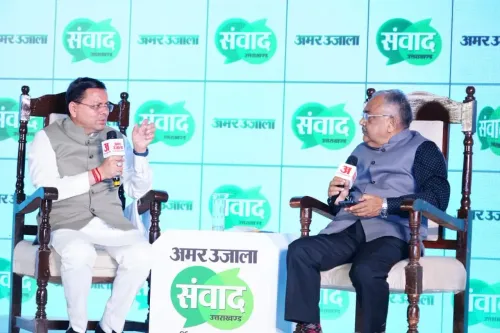
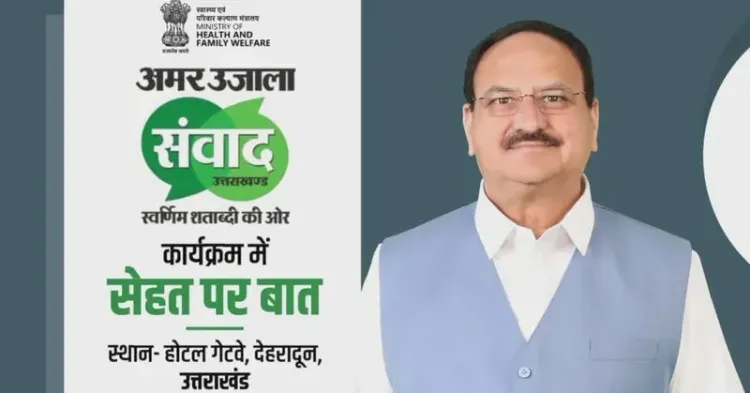
Union Health Minister and BJP national president J. P. Nadda addressed the Amar Ujala Samvad-2026 dialogue programme in Dehradun on June 24, 2026, engaging a regional Hindi-language media platform to discuss governance and policy in Uttarakhand.
Key Takeaways
Nadda , Union Health Minister and BJP national president, addressed the Amar Ujala Samvad-2026 programme in Dehradun on June 24, 2026 .
The event was organised by Amar Ujala , a leading Hindi-language daily with strong circulation across Uttarakhand and northern India.
Nadda shared a live broadcast link on X , extending the event's reach beyond the physical venue in Dehradun .
Union ministers addressing vernacular media forums is an established outreach pattern of the BJP -led government since 2014 .
Uttarakhand's Himalayan geography makes it a key focus area for health infrastructure delivery under India's National Health Policy .
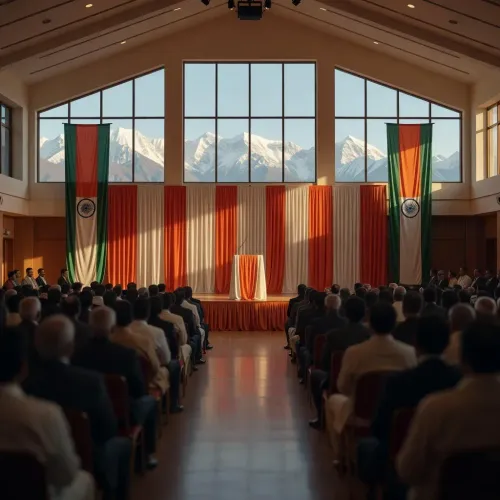
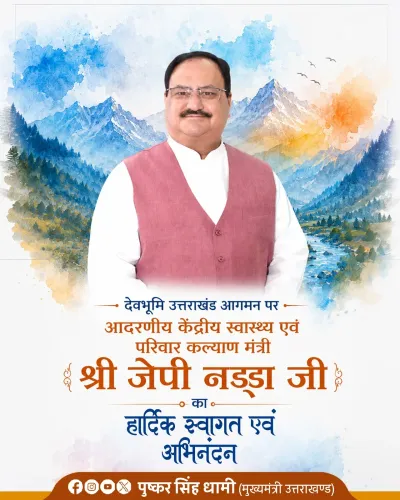
Union Health Minister and BJP national president J. P. Nadda addressed the Amar Ujala Samvad-2026 programme in Dehradun, Uttarakhand, on Wednesday, June 24, 2026, participating in a media dialogue organised by one of northern India's most widely read Hindi-language dailies.
Context
Amar Ujala, which commands significant readership across Uttarakhand and the broader Hindi belt, periodically convenes its 'Samvad' (dialogue) series — bringing together public figures, policymakers, and regional audiences for structured conversations on governance and public affairs. The 2026 edition, held in the state capital Dehradun, drew Nadda in his capacity as a senior Union minister with direct responsibility for health policy and the pharmaceuticals sector.
Nadda posted about his participation on X, tagging @AmarUjalaNews and sharing a live broadcast link, signalling the event was streamed for a wider audience beyond those physically present in Dehradun.
Policy Backdrop
Union ministers addressing regional vernacular media forums has been a consistent feature of the BJP-led government's outreach strategy since 2014, aimed at communicating the implementation of central schemes directly to state-level audiences. Uttarakhand's Himalayan geography presents distinct challenges for health infrastructure delivery, making it a relevant venue for a Union Health Minister to engage with local stakeholders and media.
India's National Health Policy, last revised in 2017, set out a framework for expanding access to healthcare across states, with hill states like Uttarakhand identified as priority regions for infrastructure strengthening. Events such as Samvad forums have served as platforms to discuss on-ground progress on such mandates.
Stakeholders and Impact
The audience for the Amar Ujala Samvad-2026 programme spans media professionals, civil society, and residents of Uttarakhand — a state where access to centrally funded health and welfare programmes remains a subject of active public interest. The live broadcast extended the reach of the dialogue to readers and viewers across the Hindi-speaking north.
Health sector stakeholders in the region, including those engaged with primary health centres and district hospitals, stand to benefit from any policy signals or commitments articulated by the minister at such a forum. Nadda's dual portfolio — covering both health and chemicals and fertilizers — also makes him a key interlocutor for discussions touching on pharmaceutical supply chains that affect medicine availability in remote hill districts.
What's Next
Follow-up statements from Nadda's office or the Uttarakhand government on health scheme implementation timelines or central-state coordination on infrastructure projects would indicate the substantive outcomes of the engagement. Regional media forums of this kind often precede or accompany announcements on state-specific allocations or programme rollouts, making the coming days worth watching for any policy follow-through from Dehradun.
Point of View
As a state capital with growing administrative and media significance, is a calculated choice for a senior minister holding both health and chemicals portfolios. The live broadcast dimension amplifies what might otherwise be a regional event into a wider communication exercise targeting Uttarakhand's dispersed population. The forum also positions Nadda — ahead of any state or national political calendar milestones — as an accessible, on-ground presence rather than a purely Delhi-centric figure.
NationPress
23 Sept 2026
Frequently Asked Questions
What is Amar Ujala Samvad 2026?
Amar Ujala Samvad-2026 is a dialogue programme organised by Amar Ujala, a leading Hindi-language daily, bringing together policymakers and public figures for structured conversations on governance and public affairs.
Why did J. P. Nadda attend the Amar Ujala Samvad event in Dehradun?
As Union Health Minister and BJP national president, Nadda addressed the programme as part of the government's outreach to regional audiences in Uttarakhand through vernacular media forums.
Where was the Amar Ujala Samvad-2026 programme held?
The programme was held in Dehradun, the capital of Uttarakhand, on June 24, 2026.
What is J. P. Nadda's current role in the government?
J. P. Nadda serves as Union Minister of Health and Family Welfare and Minister of Chemicals and Fertilizers, and is also the national president of the BJP.
What health policy issues are relevant to Uttarakhand?
Uttarakhand's Himalayan geography poses challenges for health infrastructure delivery; the state is a priority region under India's National Health Policy revised in 2017, with focus on expanding access to primary healthcare in remote districts.