Rajasthan CM Bhajanlal flags court delays inflating project costs

Synopsis
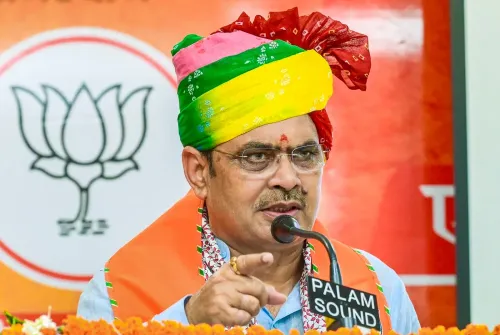
Chief Minister Bhajanlal Sharma of Rajasthan has publicly linked prolonged court pendency to rising project costs and implementation delays, framing judicial efficiency as a core economic governance challenge for the state.
Key Takeaways
The Chief Minister's Office of Rajasthan quoted CM Bhajanlal Sharma on 9 August 2026 flagging judicial pendency as a driver of project cost overruns.
CM Sharma stated that cases pending in courts for years cause both cost escalation and implementation delays in state projects.
Rajasthan is pursuing multiple infrastructure and welfare projects that are directly exposed to litigation-linked delays.
India's National Mission for Justice Delivery and Legal Reforms was launched in 2011 to address pendency, but state-level concerns persist over a decade later.
Future Rajasthan budget sessions or legislative proposals may introduce specialised dispute-resolution mechanisms for project-related litigation.
Years of cases gathering dust in courtrooms are costing Rajasthan real money — and real time. The Chief Minister's Office of Rajasthan posted on Sunday, 9 August 2026, quoting Chief Minister Bhajanlal Sharma on a problem that quietly bleeds state infrastructure budgets: prolonged judicial pendency.
The post, tagged #आपणो_अग्रणी_राजस्थान ('Our Pioneering Rajasthan'), carries CM Sharma's pointed observation: 'When cases remain pending in courts for years, project costs rise and their implementation is delayed.' Short. Blunt. And aimed at a fault line in India's development machinery that states have long struggled to address.
The pendency problem and what it costs a project
India's courts carry one of the heaviest dockets in the world, and the downstream effect on infrastructure is well-documented at the policy level. When a land acquisition dispute, a contractual disagreement, or an environmental challenge sits unresolved for years, a project freezes — but its costs do not. Interest on borrowed capital accrues, material prices shift, and deadlines collapse. Rajasthan, which is pursuing multiple infrastructure and welfare projects under its current government, is directly exposed to this dynamic.
The concern is not new to Indian governance. The National Mission for Justice Delivery and Legal Reforms, launched in 2011, was specifically designed to cut case pendency and sharpen judicial efficiency nationwide. More than a decade later, state governments are still raising the same alarm — a signal that the structural fix remains incomplete.
Why Rajasthan is saying this now
Chief Minister Bhajanlal Sharma took office in December 2023, anchoring his administration on state development and administrative efficiency. Flagging judicial delays publicly fits a broader pattern: states increasingly name pendency as a governance constraint, not merely a legal one, to build pressure for faster dispute-resolution mechanisms. Infrastructure developers and state project departments — the two groups most directly squeezed by litigation-linked delays — are the immediate stakeholders in any reform that follows.
Whether Rajasthan moves toward specialised project tribunals, fast-track benches, or dedicated arbitration mechanisms for state contracts remains to be seen in upcoming budget sessions. What is clear today is that CM Sharma has placed judicial efficiency squarely in the frame of economic governance — and that framing matters.
Point of View
Applying soft pressure on the judiciary and the Centre simultaneously. The statement's timing, under the 'Aapno Agrani Rajasthan' banner, suggests it is part of a deliberate narrative around Sharma's development credentials ahead of future electoral cycles. If Rajasthan follows through with concrete legislative proposals, it could become a template other states reference in their own reform pushes.
NationPress
23 Sept 2026
Frequently Asked Questions
What did Rajasthan CM Bhajanlal Sharma say about court pendency?
CM Bhajanlal Sharma stated that cases remaining pending in courts for years cause project costs to rise and delay their implementation, framing judicial pendency as a direct obstacle to state development.
How does judicial pendency affect infrastructure projects in India?
When legal disputes over land, contracts, or environment sit unresolved for years, projects stall while costs — including interest on capital and rising material prices — continue to accumulate, leading to significant overruns.
What is the National Mission for Justice Delivery and Legal Reforms?
It is a central government initiative launched in 2011 aimed at reducing case pendency and improving judicial efficiency across India's court system.
When did Bhajanlal Sharma become Chief Minister of Rajasthan?
Bhajanlal Sharma took office as Chief Minister of Rajasthan in December 2023 as a BJP leader focused on state development and administrative reform.
What is the meaning of 'Aapno Agrani Rajasthan'?
'Aapno Agrani Rajasthan' translates from Rajasthani as 'Our Pioneering Rajasthan' and is a branding hashtag used by the Rajasthan government to promote its development agenda.