Nadda witnesses NHA-West Bengal MoU for AB-PMJAY rollout
Synopsis
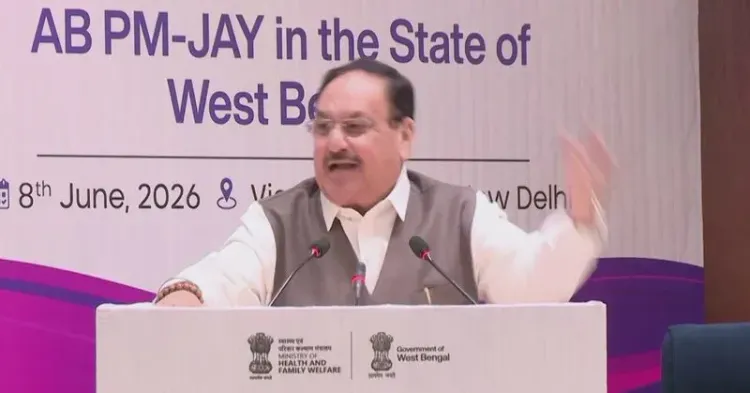
Union Health Minister J. P. Nadda attended the NHA-West Bengal MoU signing in New Delhi on June 8, 2026, formally bringing West Bengal under AB-PMJAY — India's flagship health cover scheme providing up to ₹5 lakh per eligible family — years after the state initially declined to join.
Key Takeaways
Union Health Minister J.
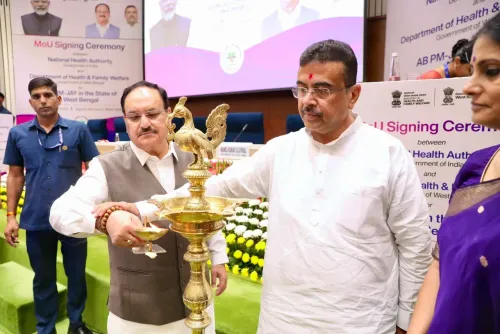
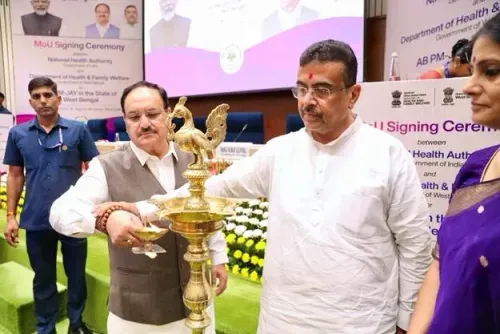
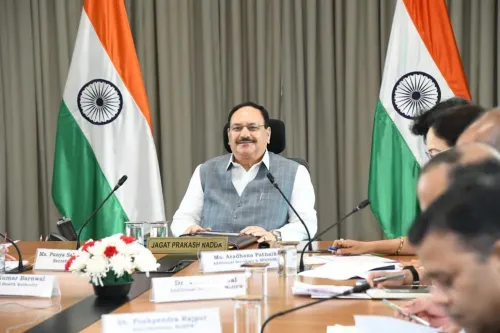
Nadda attended the MoU signing between the National Health Authority and the Government of West Bengal on June 8, 2026 in New Delhi .
AB-PMJAY provides cashless health cover of up to ₹5 lakh per eligible family per year for secondary and tertiary hospitalisation.
West Bengal had declined to join AB-PMJAY at its national launch in September 2018 , running its own Swasthya Sathi scheme instead.
The MoU is the standard bilateral mechanism through which states operationalise the centrally sponsored scheme within their territory.
Integration of Swasthya Sathi beneficiary data with the national PMJAY portal and the rollout schedule are key next steps to watch.
The agreement follows a broader national pattern of holdout states formally converging with the central health assurance framework.
Union Health Minister J. P. Nadda attended the Memorandum of Understanding signing ceremony between the National Health Authority (NHA) and the Government of West Bengal for the implementation of Ayushman Bharat Pradhan Mantri Jan Arogya Yojana (AB-PMJAY) in New Delhi on Monday, June 8, 2026. The agreement marks a significant step toward bringing West Bengal formally under the ambit of India's flagship central health assurance scheme.
Context
The MoU formalises West Bengal's entry into AB-PMJAY, a scheme launched in September 2018 under the Ayushman Bharat mission to provide secondary and tertiary healthcare coverage of up to ₹5 lakh per eligible family per year. West Bengal was among the states that did not join the scheme at its national launch, instead continuing with its own Swasthya Sathi health assurance programme. The signing ceremony, attended by Nadda, signals a formal convergence between the state and the central government on health coverage architecture.
The National Health Authority is the nodal body under the Ministry of Health and Family Welfare responsible for implementing AB-PMJAY and managing its digital health infrastructure. Bilateral MoUs between the NHA and state governments are the standard mechanism through which states operationalise the scheme within their territories.
Policy Backdrop
When AB-PMJAY was rolled out nationally in 2018, several opposition-governed states — including West Bengal — declined participation, citing overlap with their own state-run schemes. West Bengal's Swasthya Sathi scheme, which provides health cover to families in the state, was positioned as an alternative. Over the years, successive central administrations have pursued bilateral agreements to bring holdout states into the national framework, arguing that uniform coverage enables beneficiary portability and reduces fragmentation in the health assurance ecosystem.
The signing of today's MoU fits a broader federal pattern in which states that initially maintained parallel schemes have gradually converged with the centrally sponsored programme through formal agreements, often negotiating integration terms for existing beneficiary databases.
Stakeholders and Impact
The most direct beneficiaries of the agreement are West Bengal residents who are eligible under AB-PMJAY's criteria — primarily families from economically weaker sections identified through the Socio-Economic Caste Census. Full implementation would allow these families to access cashless hospitalisation at any empanelled hospital across India, a portability benefit not available under state-only schemes.
State health departments will need to align their administrative and data infrastructure with the NHA's national portal. Observers will closely watch how the state manages the integration of existing Swasthya Sathi beneficiary data with the central PMJAY database, and what portability arrangements are negotiated for those already enrolled under the state scheme.
What's Next
With the MoU signed, attention will shift to the rollout schedule and the pace at which empanelled hospitals in West Bengal are brought onto the national AB-PMJAY network. Key questions include whether beneficiaries will be issued new Ayushman cards, how duplicate enrolments across Swasthya Sathi and PMJAY will be resolved, and the timeline for full operationalisation. The development also carries political significance as it represents a formal alignment between the Trinamool Congress-led West Bengal government and a flagship programme of the BJP-led central government, underscoring how health policy imperatives can bridge federal political divides.
Point of View
Given the state's size and the political distance between Kolkata and New Delhi. For the central government, it closes a visible gap in the scheme's national coverage map and strengthens the case for AB-PMJAY as a genuinely universal programme. For West Bengal, the calculus likely involves the portability benefits for its residents seeking treatment outside the state, where Swasthya Sathi has no reach. The MoU also signals that pragmatic federal health policy can outlast political friction — a dynamic worth watching as implementation details are negotiated.
NationPress
26 Oct 2026
Frequently Asked Questions
What is AB-PMJAY and how much cover does it provide?
AB-PMJAY, or Ayushman Bharat Pradhan Mantri Jan Arogya Yojana, is India's central government health assurance scheme launched in September 2018. It provides cashless hospitalisation cover of up to ₹5 lakh per eligible family per year for secondary and tertiary care at empanelled hospitals across India.
Why did West Bengal not join AB-PMJAY earlier?
West Bengal declined to join AB-PMJAY at its national launch in 2018, preferring to continue with its own state-run Swasthya Sathi health scheme, which it argued covered a similar population. The June 2026 MoU marks the state's formal entry into the central scheme.
What does the NHA-West Bengal MoU signing mean for residents?
The MoU means eligible West Bengal families will be able to access cashless hospitalisation under AB-PMJAY at empanelled hospitals nationwide, including outside West Bengal — a portability benefit not available under the state-only Swasthya Sathi scheme.
Who signed the MoU between NHA and West Bengal?
The MoU was signed between the National Health Authority, the nodal central body implementing AB-PMJAY, and the Government of West Bengal. Union Health Minister J. P. Nadda attended the ceremony in New Delhi on June 8, 2026. Specific signatories are not yet confirmed in official public records.
What happens to Swasthya Sathi after West Bengal joins AB-PMJAY?
The integration of West Bengal's existing Swasthya Sathi beneficiary data with the national PMJAY portal and any overlap in enrolments are key implementation questions that will be addressed during the rollout phase following the MoU signing.