Nadda pledges hepatitis elimination on World Hepatitis Day
Synopsis
On World Hepatitis Day, 28 July 2026, Union Health Minister J. P. Nadda pledged to scale up prevention, diagnosis, and treatment of viral hepatitis in mission mode, spotlighting India's National Viral Hepatitis Control Programme as the country races toward the WHO 2030 elimination target.
Key Takeaways
Union Health Minister J.
Nadda marked World Hepatitis Day (28 July 2026) by committing India to eliminating viral hepatitis as a public health threat.
The National Viral Hepatitis Control Programme , launched in 2018 under the National Health Mission, provides free hepatitis B and C testing and treatment.
India's push aligns with the WHO Global Health Sector Strategy on Viral Hepatitis (2016) and SDG target 3.3 , which sets a 2030 deadline for ending communicable-disease epidemics.
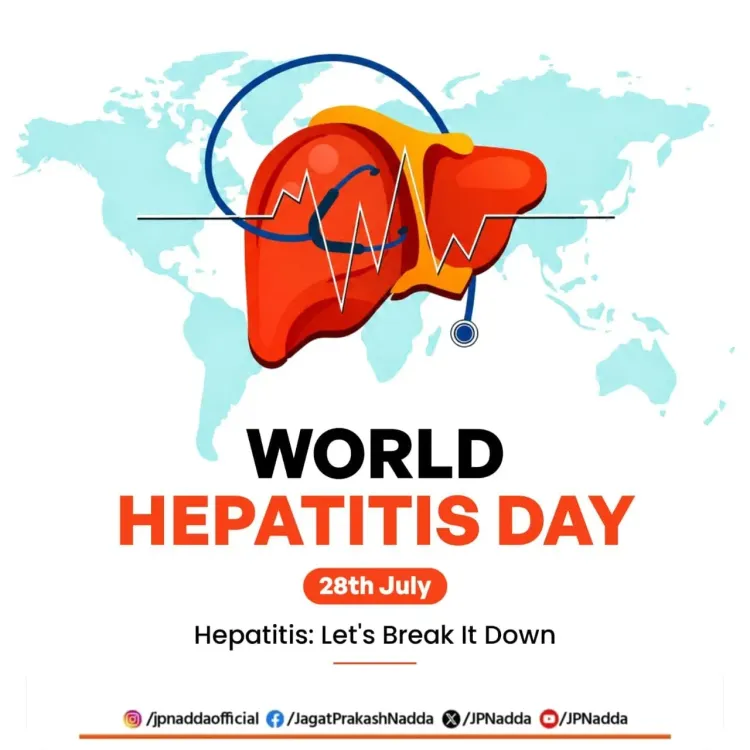
This year's WHO theme — 'Hepatitis: Let's Break It Down' — framed the minister's call for scaled-up prevention, early diagnosis, and treatment.
State health departments are the key delivery arm; their screening and treatment coverage data will determine whether the mission-mode pledge translates into measurable progress.
India's fight against viral hepatitis got a fresh push on Tuesday, 28 July 2026, as Union Health Minister J. P. Nadda used World Hepatitis Day to reaffirm the government's commitment to eliminating the disease as a public health threat — and to signal that the effort is shifting into mission mode.
Posting on X, Nadda invoked this year's WHO theme — 'Hepatitis: Let's Break It Down' — and pointed to the National Viral Hepatitis Control Programme (NVHCP) as the centrepiece of India's response. 'We reaffirm our commitment to significantly scaling up efforts towards the prevention, early diagnosis, and treatment of hepatitis in a mission mode, with the goal of eliminating viral hepatitis from India,' he wrote.
What the NVHCP actually does
Launched in 2018 under the National Health Mission, the NVHCP provides free testing and treatment for both hepatitis B and hepatitis C across government health facilities. It is India's most comprehensive national response to the disease — a population-scale programme that extends the country's earlier playbook on polio eradication and HIV control to a new infectious-disease front. The programme sits within India's broader alignment with the WHO Global Health Sector Strategy on Viral Hepatitis (2016) and the Sustainable Development Goal target 3.3, which calls for ending epidemics of communicable diseases by 2030. That deadline is now four years away — close enough to concentrate minds.Why 28 July matters globally
World Hepatitis Day is observed every year on 28 July, the date chosen by the WHO to mark the birthday of Nobel laureate Dr Baruch Blumberg, who discovered the hepatitis B virus. It is the one day the global public-health community uses to synchronise awareness campaigns, political commitments, and progress reviews across member states. For India — home to a significant share of the global hepatitis B and C burden — the day carries particular weight. State health departments are the primary delivery arm for screening camps and treatment coverage under the NVHCP, and the minister's statement doubles as a signal to them to accelerate. The real test of the pledge will come in state-level implementation data and India's reporting at WHO South-East Asia regional meetings. Scaling up early diagnosis and treatment in districts with low health-system density remains the hard part. The commitment is on record. The clock to 2030 is running.Point of View
Now in its eighth year, is a substantive programme, but the gap between central commitment and district-level delivery has been the persistent weak link in India's infectious-disease campaigns. With the 2030 SDG deadline approaching, the minister's 'mission mode' language raises the stakes for state governments, who will face greater scrutiny on screening coverage and treatment completion rates. Whether this statement translates into fresh funding or structural reform of the NVHCP — or remains a well-timed awareness post — will become clearer in the next budget cycle.
NationPress
28 Jul 2026
Frequently Asked Questions
What is the National Viral Hepatitis Control Programme?
The National Viral Hepatitis Control Programme (NVHCP) is India's national initiative launched in 2018 under the National Health Mission to provide free testing and treatment for hepatitis B and C at government health facilities across the country.
When is World Hepatitis Day and why is it observed?
World Hepatitis Day is observed every year on 28 July , a date established by the WHO to mark the birthday of Nobel laureate Dr Baruch Blumberg, who discovered the hepatitis B virus. It is used globally to raise awareness and drive political action against viral hepatitis.
What is India's target for eliminating hepatitis?
India is aligned with the WHO Global Health Sector Strategy on Viral Hepatitis and SDG target 3.3 , which call for eliminating viral hepatitis as a public health threat by 2030 .
What is the theme of World Hepatitis Day 2026?
The theme for World Hepatitis Day 2026 is 'Hepatitis: Let's Break It Down,' set by the WHO to encourage clearer public understanding and accelerated action on prevention, diagnosis, and treatment.
Does India offer free hepatitis treatment?
Yes. Under the National Viral Hepatitis Control Programme , the Indian government provides free diagnosis and treatment for both hepatitis B and hepatitis C through government health facilities under the National Health Mission.