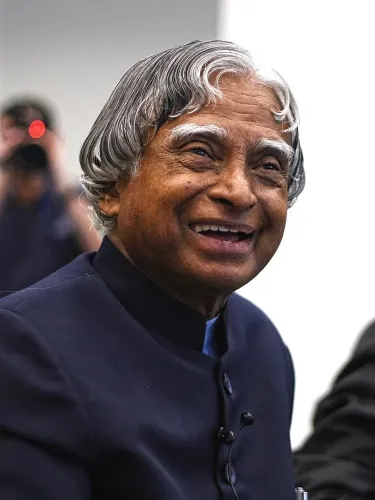
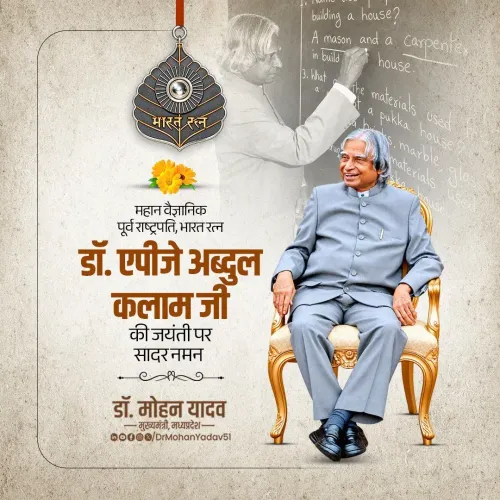
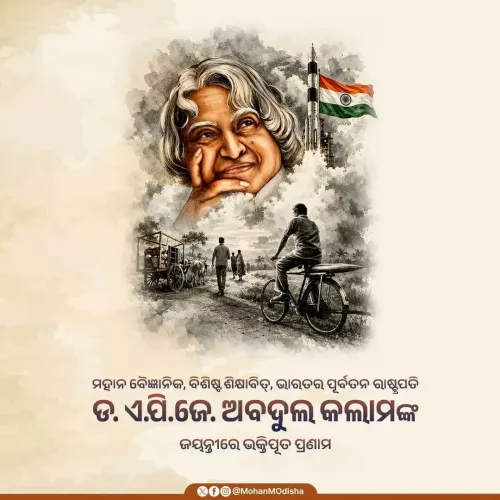
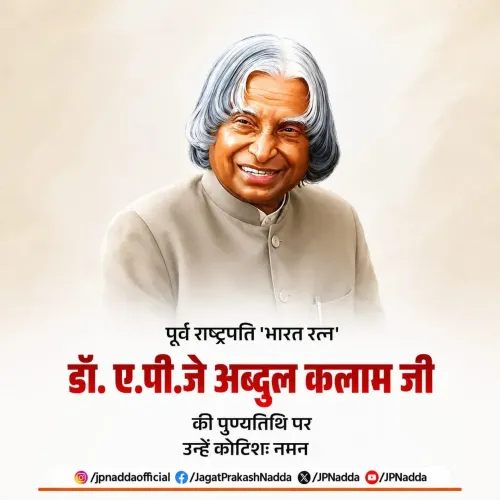
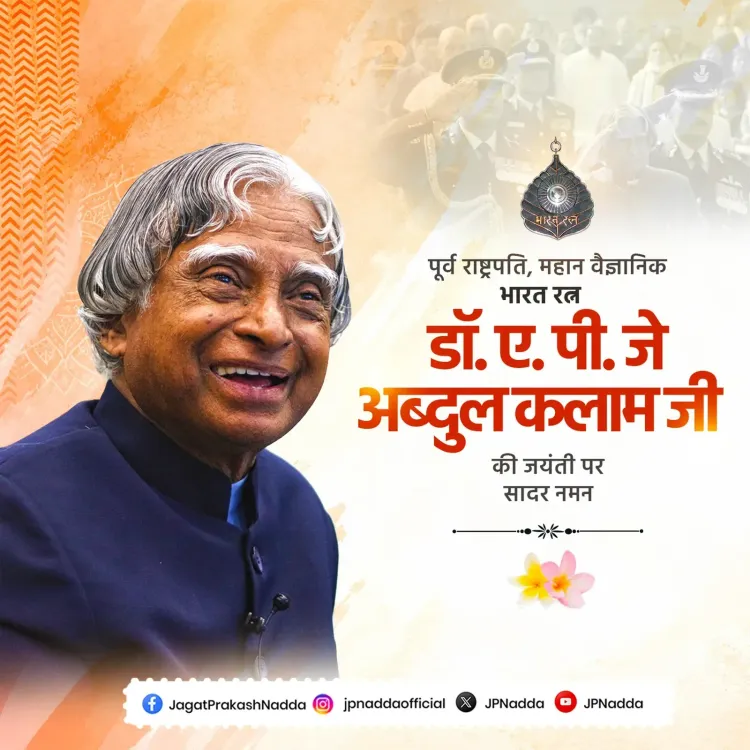
Nadda pays tribute to APJ Abdul Kalam on birth anniversary
Synopsis
Union Health Minister J. P. Nadda marked the birth anniversary of Dr. A. P. J. Abdul Kalam on 15 October 2026, honouring the Bharat Ratna scientist and former President for his foundational role in India's missile and space programmes and his lifelong commitment to national self-reliance.
Key Takeaways
Nadda posted a tribute to Dr.
Abdul Kalam on his birth anniversary, 15 October 2026 .
Kalam, born 15 October 1931 , was awarded the Bharat Ratna in 1997 and served as President of India from 2002 to 2007 .
He led the Integrated Guided Missile Development Programme (IGMDP) launched in 1983 , producing systems including Prithvi and Agni .
Nadda praised Kalam's simplicity, foresight, and inspiring vision for a self-reliant and scientifically advanced India.
Annual tributes on 15 October consistently link Kalam's legacy to India's ongoing indigenous defence and space ambitions.
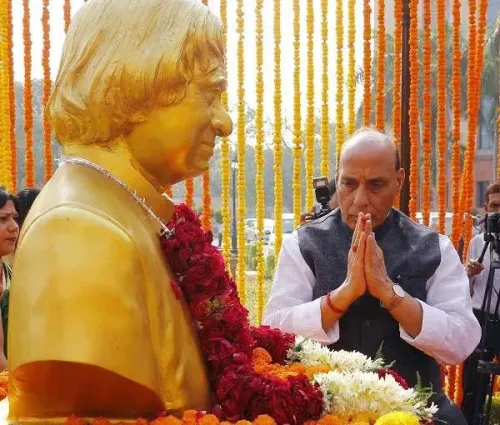
On the birth anniversary of one of India's most beloved scientist-statesmen, Union Health Minister J. P. Nadda on Thursday, 15 October 2026 paid heartfelt tribute to Dr. A. P. J. Abdul Kalam — the 'Missile Man of India', former President, and Bharat Ratna laureate — saluting his unmatched contribution to making India a global power in defence and space science.
Posting on X in Hindi, Nadda wrote: 'Bharat ko mahashakti banane mein atulya yogdan dene wale mahan vaigyanik, Missile Man, purv Rashtrapati, Bharat Ratna Dr. A.P.J. Abdul Kalam ji ki jayanti par unhe kotish: naman karta hoon.' — 'On the birth anniversary of the great scientist, Missile Man, former President and Bharat Ratna Dr. A. P. J. Abdul Kalam, who made an incomparable contribution to making India a superpower, I offer him countless salutations.'
The scientist who gave India its missile backbone
Dr. Kalam was born on 15 October 1931 in Rameswaram, Tamil Nadu. He rose to lead the Integrated Guided Missile Development Programme (IGMDP), launched in 1983, which produced India's now-iconic missile systems including Prithvi and Agni — transforming the country's strategic deterrence from scratch. That singular achievement earned him the enduring title: Missile Man of India.
He was awarded the Bharat Ratna in 1997 and went on to serve as the 11th President of India from 2002 to 2007 — a tenure remembered for its warmth toward young people and a relentless push for a self-reliant, scientifically literate India. Nadda's post captures that legacy precisely: 'His simplicity, foresight and inspiring ideas will always motivate us to walk the path of national service.'
Self-reliance as a living policy inheritance
Kalam's insistence on indigenous capability did not die with him. Successive governments — across party lines — have invoked his vision when framing technology and security roadmaps. The language of Aatmanirbhar Bharat (self-reliant India) that defines current defence and space policy is, in many ways, a direct echo of the philosophy he championed through the IGMDP and beyond.
Every 15 October, tributes from scientists, political leaders, and defence officials converge on that single thread: a man who never chased personal power, yet reshaped India's place in the world. Nadda's salutation — 'kotish: naman', literally 'countless salutations' — places the ruling establishment firmly within that continuity.
India's missile and space programmes continue to advance. The Kalam anniversary serves as an annual reminder of the distance travelled — and the distance still to cover on the path he lit.
Point of View
Foresight, and self-reliance,' Nadda ties the BJP-led government's Aatmanirbhar Bharat agenda to a scientific icon who commands near-universal reverence, lending the policy framing a credibility that purely partisan messaging cannot achieve. The choice of words — nation-building, empowerment, self-reliance — mirrors the government's current defence indigenisation vocabulary almost exactly. It is a reminder that India's strategic culture is increasingly defined not just by what weapons it builds, but by who it chooses to remember.
NationPress
15 Oct 2026
Frequently Asked Questions
When is APJ Abdul Kalam's birth anniversary?
Dr. A. P. J. Abdul Kalam was born on 15 October 1931 in Rameswaram, Tamil Nadu, and his birth anniversary is observed on 15 October every year.
Why is APJ Abdul Kalam called the Missile Man of India?
Dr. Kalam is called the 'Missile Man of India' because he headed the Integrated Guided Missile Development Programme (IGMDP) launched in 1983 , which developed key missile systems including Prithvi and Agni that form the backbone of India's strategic deterrence.
When was APJ Abdul Kalam awarded the Bharat Ratna?
Dr. A. P. J. Abdul Kalam was awarded the Bharat Ratna , India's highest civilian honour, in 1997 .
When did APJ Abdul Kalam serve as President of India?
Dr. Kalam served as the 11th President of India from 2002 to 2007 .
What did JP Nadda say about APJ Abdul Kalam?
Union Health Minister J. P. Nadda paid tribute to Dr. Kalam on his birth anniversary on 15 October 2026 , calling him a great scientist who made an incomparable contribution to making India a superpower and praising his simplicity, foresight, and commitment to national self-reliance.