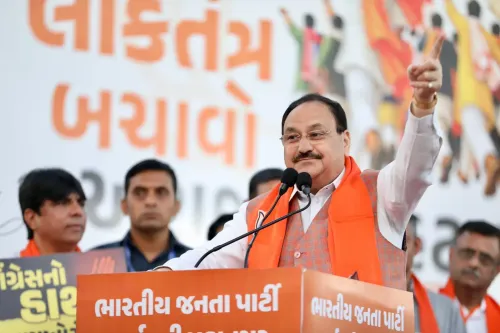
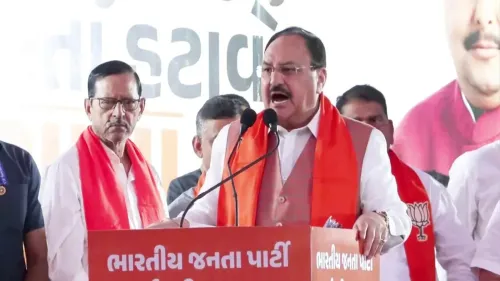
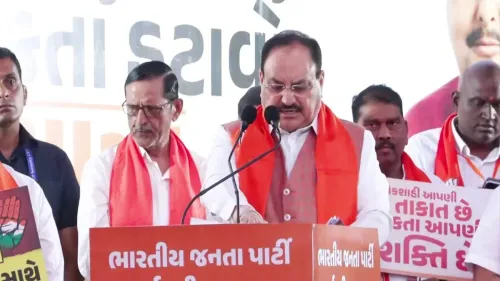
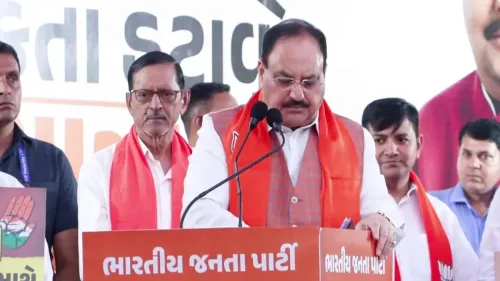
Nadda Slams Congress Over 'Regime Change' Remark, EVM Flip-Flop
Synopsis
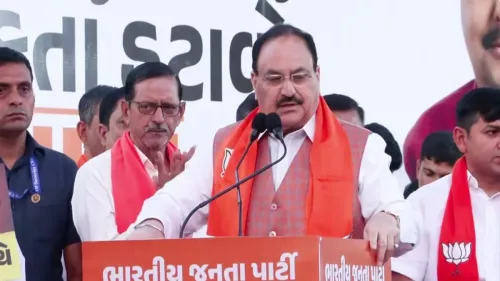
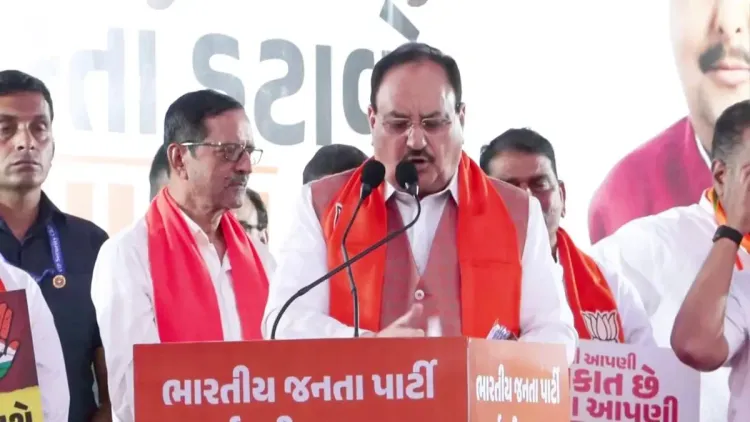
BJP national president J. P. Nadda accused Congress on 27 October 2026 of crossing democratic limits, alleging the party flip-flops on EVMs and ballot papers while now invoking 'regime change' — asserting that PM Modi holds the blessings of 140 crore Indians.
Key Takeaways
BJP national president and Union Minister J.
Nadda posted a sharp attack on Congress on 27 October 2026 .
He accused Congress of flip-flopping — alternately criticising EVMs and demanding ballot papers — depending on electoral convenience.
The most pointed allegation: Congress is now raising the prospect of 'regime change' , which Nadda framed as crossing every democratic limit.
Nadda cited the blessings of 140 crore Indians as the source of PM Narendra Modi's mandate, casting any challenge as a challenge to the electorate itself.
The post was accompanied by the hashtag #SaveDemocracyRemoveAnarchy , signalling a coordinated BJP messaging push.
Congress and opposition parties have raised EVM reliability concerns periodically since the 2014 and 2019 general elections.
A charge of crossing every democratic red line — that is how Union Health Minister and BJP national president J. P. Nadda framed a sharp attack on the Indian National Congress on Tuesday, 27 October 2026, accusing the opposition of abandoning electoral credibility and now openly invoking the language of 'regime change'.
The 'Regime Change' allegation that sharpened the attack
Nadda's post, written in Hindi, opened with a blunt verdict: 'कांग्रेस पार्टी ने आज सारी हदें पार कर दी हैं' — 'The Congress party has crossed all limits today.' The central accusation was layered: first, that the party cannot win elections on ballot paper; second, that it alternately blames electronic voting machines and then demands a return to paper ballots; and third — the sharpest dart — that an opposition 'incapable of winning elections' is now talking about 'regime change.' The research background flags the specific Congress statements referenced as unverified, but the BJP's political framing is unambiguous.
EVM vs ballot paper — a debate that refuses to die
The EVM controversy is not new territory. Opposition parties, led at various points by Congress, raised questions about the reliability of electronic voting machines following the 2014 and 2019 general election results. The demand for a return to paper ballots has surfaced periodically, usually after electoral losses — a pattern Nadda deployed pointedly by arguing that the party's position shifts depending on which format it expects to lose by least. The implicit argument: neither EVMs nor ballot papers are the Congress's real problem.
Modi's 140-crore mandate as the BJP's closing argument
Nadda closed his post by pivoting to Prime Minister Narendra Modi — and to scale. 'Elections are won when the blessings of 140 crore fellow citizens are received,' he wrote, arguing that those blessings belong to PM Modi and that 'everyone should keep this in mind.' The invocation of 140 crore Indians is a well-worn but deliberate rhetorical device in the BJP's political arsenal: it frames any challenge to the electoral outcome not as a dispute with the ruling party but as a dispute with the Indian electorate itself. The hashtag #SaveDemocracyRemoveAnarchy appended to the post signals a coordinated messaging push, not an isolated salvo.
With BJP-Congress exchanges over electoral institutions now a near-permanent feature of the political calendar, Nadda's post is the latest evidence that the battle for institutional legitimacy — not just votes — has become a contest in its own right. Whether Congress responds with formal statements on electoral reform or lets the moment pass will set the next beat of this particular fight.
Point of View
And reinforce the BJP's favoured narrative that opposition challenges are directed at voters rather than at the government. The 'regime change' framing is significant — by foregrounding that phrase, the BJP elevates a rhetorical grenade into a headline charge, forcing Congress to either disown the language or defend it. The EVM flip-flop argument, meanwhile, is a well-tested attack that has consistently put the opposition on the defensive by making consistency the metric of credibility. With the hashtag #SaveDemocracyRemoveAnarchy, the BJP signals this is not an improvised response but a planned campaign line — one worth watching in the weeks ahead.
NationPress
28 Oct 2026
Frequently Asked Questions
What did J. P. Nadda say about Congress and regime change?
Nadda accused Congress of 'crossing all limits' by invoking the language of 'regime change,' arguing that a party unable to win elections through either EVMs or ballot papers has no democratic standing to question the government's legitimacy.
What is the BJP-Congress EVM controversy about?
Congress and other opposition parties have periodically questioned the reliability of electronic voting machines after losing general elections in 2014 and 2019, alternating between demanding EVM audits and calling for a return to paper ballots — a pattern Nadda highlighted as contradictory.
What did Nadda say about PM Modi and 140 crore Indians?
Nadda said elections are won through the blessings of 140 crore Indians and that those blessings are with Prime Minister Narendra Modi, framing any challenge to the electoral outcome as a challenge to the entire Indian electorate.
What does the hashtag SaveDemocracyRemoveAnarchy mean?
#SaveDemocracyRemoveAnarchy is a BJP-led social media campaign hashtag used to frame the party as defenders of democratic institutions against what it characterises as opposition-backed disorder and institutional subversion.
Has Congress officially responded to Nadda's 'regime change' accusation?
As of the time of this report, no formal Congress rebuttal to Nadda's specific post has been verified. Any response from the party would be a key next development to watch.