Nagaland CM Rio launches fellowship, research push to unlock agri-horticulture jobs
Synopsis
Nagaland CM Neiphiu Rio launched two new programmes in Kohima — a fellowship for young talent and a NEDFi-backed research project — built on a grassroots study of all 17 districts and 8,000-plus inputs. The initiative positions Nagaland's niche agri products and creative economy as twin engines of job creation, with export promotion at its core.
Key Takeaways
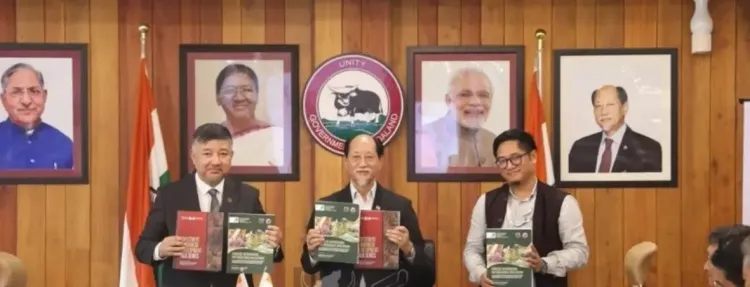
Nagaland CM Neiphiu Rio launched the Chief Minister's Fellowship Programme, Nagaland (CMFPN) and the NEDFi-TEDF Research Project in Kohima on 25 September 2026 .
The research project covered all 17 districts , nearly 300 villages , and gathered more than 8,000 inputs at the grassroots level.
The inaugural CMFPN cohort has 18 selected fellows who will engage with policymakers and development experts.
Rio identified agriculture, horticulture, tourism, music, arts, culture, and sports as key sectors with untapped potential for employment generation.
The research flagged gaps in value addition, market linkages, and promotion as priority areas needing intervention.
IDAN , chaired by Abu Metha , led the study in partnership with NEDFi, focusing on export promotion and investment diversification.
Nagaland Chief Minister Neiphiu Rio on 25 September 2026 launched two new initiatives in Kohima aimed at converting the state's untapped agricultural, horticultural, and creative-economy strengths into employment — declaring that potential alone was insufficient without enterprise, investment, and market access.
What Was Launched
The Chief Minister formally inaugurated the Chief Minister's Fellowship Programme, Nagaland (CMFPN) and the NEDFi-TEDF Research Project, titled 'Strategic Interventions for Endogenous Development through Export Promotion of Niche Agricultural Products, Advancement in the Creative Economy, and Diversification of Investment in Nagaland'. The two programmes, he said, share a common purpose: mapping the state's strengths, identifying emerging opportunities, and building readiness for the future.
Rio's Economic Vision for Nagaland
Speaking at the launch, Chief Minister Rio said Nagaland holds significant potential across agriculture, horticulture, tourism, music, arts, culture, and sports. He stressed that this potential must be converted into tangible economic opportunities through enterprise, investment, and export promotion — particularly to create jobs for the state's population. Rio emphasised building a 'resilient, innovative and investment-ready Nagaland' where private enterprise operates alongside public investment, supported by partnerships with educational institutions, civil society, and development organisations from across India and the world.
The Creative Economy Angle
Rio welcomed the research project's dedicated focus on Nagaland's creative economy, noting that the sector extends well beyond culture and entertainment into livelihoods, technology, tourism, and employment. He said Nagaland's artists, musicians, designers, sportspersons, entrepreneurs, and young innovators represent an underutilised resource. 'Culture can serve as a bridge between Nagaland's local identity and national and global platforms,' he added, framing creativity as an instrument of economic growth rather than a standalone cultural asset.
Fellowship Programme and Research Findings
The Chief Minister's Fellowship Programme has selected 18 fellows for its inaugural cohort. Rio described it as an investment in human capital, urging the fellows to engage meaningfully with policymakers, administrators, and development experts during their tenure. On the research side, Advisor to the Chief Minister and Chairman of the Investment and Development Authority of Nagaland (IDAN), Abu Metha, said IDAN, in partnership with NEDFi, conducted an extensive grassroots study covering all 17 districts, nearly 300 villages, and more than 8,000 inputs. The study identified strengths in agriculture, horticulture, textiles, human capital, and the creative economy, while flagging gaps in value addition, market linkages, and promotion.
What Comes Next
The NEDFi-TEDF research project's findings are expected to inform state policy on export promotion and investment diversification. With Nagaland's creative economy study covering music, art, sports, tourism, textiles, handicrafts, handlooms, and events, the government now has a data foundation to build targeted interventions. Whether these initiatives translate into measurable employment gains will depend on follow-through at the implementation stage — an area where Northeast state programmes have historically faced execution challenges.
Point of View
The other on data-driven policy research — signals a more structured approach to Northeast development than the headline-scheme model that has dominated the region's economic discourse. However, the real stress test lies ahead: the NEDFi research identified value-addition and market-linkage gaps that have persisted across multiple planning cycles in Nagaland. The creative-economy framing is an interesting pivot, but Nagaland's music and arts exports remain largely informal and unmonetised at scale. Rio's emphasis on private-public partnerships is sound in principle, but Northeast states have struggled to attract private capital beyond the hospitality sector. The fellowship programme for 18 fellows is a positive but modest investment in a state that needs sustained institutional capacity-building at the district and village level.
NationPress
25 Sept 2026
Frequently Asked Questions
What is the Chief Minister's Fellowship Programme, Nagaland (CMFPN)?
The CMFPN is a new initiative launched by Nagaland CM Neiphiu Rio on 25 September 2026 to invest in young human capital. The inaugural cohort has 18 selected fellows who will gain exposure to policymakers, administrators, professionals, and development experts to build capacity for Nagaland's future.
What is the NEDFi-TEDF Research Project launched in Nagaland?
It is a study conducted by IDAN in partnership with NEDFi titled 'Strategic Interventions for Endogenous Development through Export Promotion of Niche Agricultural Products, Advancement in the Creative Economy, and Diversification of Investment in Nagaland.' The research covered all 17 districts, nearly 300 villages, and more than 8,000 grassroots inputs to identify the state's economic strengths and gaps.
Why is CM Rio emphasising agriculture and horticulture for jobs in Nagaland?
CM Rio has identified agriculture and horticulture as sectors with significant untapped potential in Nagaland. He stressed that converting this potential into employment requires enterprise, investment, market development, and export promotion — areas where the NEDFi-TEDF research found existing gaps in value addition and market linkages.
What is Nagaland's creative economy and why does it matter?
Nagaland's creative economy encompasses music, art, sports, tourism, textiles, handicrafts, handlooms, and cultural events. CM Rio described it as a driver of livelihoods, technology, tourism, and employment — not just culture — and said it can bridge the state's local identity with national and global economic platforms.
Who led the grassroots research behind the NEDFi-TEDF project?
The research was led by the Investment and Development Authority of Nagaland (IDAN), chaired by Abu Metha, Advisor to the Chief Minister, in partnership with NEDFi. The study gathered more than 8,000 inputs across all 17 districts and nearly 300 villages, drawing on experts, academics, government officials, and other stakeholders.