Navratri 2026: Devotees flock to border temple in J&K on Day 4
Synopsis
Even as Navratri Day 4 brought massive gatherings to temples across India, the most striking scene was at Jammu's Tali Wali Mata Mandir — metres from the Pakistan border — where BSF soldiers prayed alongside civilians, and devotees said the chants could be heard across the border. The shrine survived Operation Sindoor undamaged, and the faithful say that is proof enough.
Key Takeaways
Tali Wali Mata Mandir in Marh, Jammu saw hundreds of pilgrims on 14 October , Day 4 of Navratri 2026 .
BSF personnel deployed at the border were among the devotees visiting the shrine.
The temple reportedly survived the Operation Sindoor campaign — launched after the Pahalgam terror attack — without damage.
Chamunda Mata Temple in Dewas, Madhya Pradesh , recorded nearly 4–5 lakh visitors in three to four days.
Kalkaji Temple, New Delhi set up 3 entry points and 2 exit points with police and paramilitary assistance for crowd management.
Pilgrims from as far as Ranchi visited the Maa Vindhyavasini Temple in Mirzapur, Uttar Pradesh .
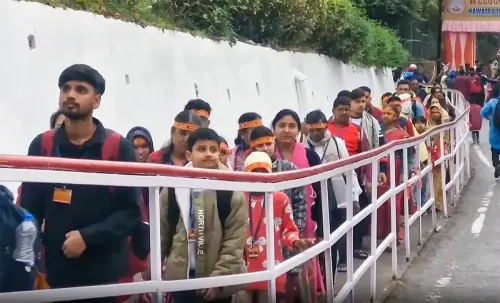
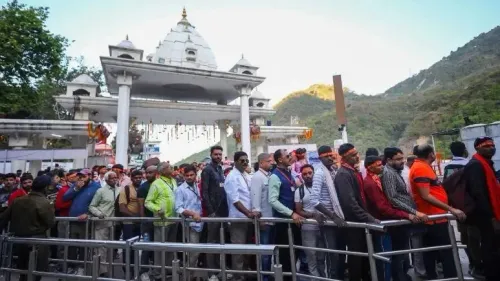
Hundreds of devotees visited the historic Tali Wali Mata Mandir in Marh, Jammu district — located near the India-Pakistan border — on Wednesday, 14 October, the fourth day of Navratri dedicated to Maa Kushmanda. The shrine, one of Jammu's most revered, drew worshippers from across the region even as temples nationwide witnessed large congregations.
Faith at the Frontier
The atmosphere at Tali Wali Mata Mandir was described as deeply spiritual, with devotees singing bhajans and playing musical instruments inside the temple premises. A young devotee said the sound of chants and devotional slogans could reportedly be heard all the way to the Pakistan border. She noted that the crowd was expected to swell further by the ninth day of the festival.
Notably, the shrine's significance has only deepened in recent months. The devotee said that despite the firing and bombings during Operation Sindoor — launched in response to the Pahalgam terror attack — the temple had not suffered any damage. 'The temple is very renowned. People from far-off places visit it. Even soldiers deployed at the border sometimes come here to offer prayers,' she said.
Another devotee confirmed that many Border Security Force (BSF) personnel regularly visited the temple to seek the Goddess's blessings, with worshippers also travelling from Jammu city and Nagrota. She added that people from different religious communities visited the shrine and participated in its service.
Chamunda Mata Temple, Dewas Draws Lakhs
In Madhya Pradesh's Dewas, thousands gathered at the Chamunda Mata Temple on the fourth day of Navratri for the morning aarti. Some devotees were seen crawling on their knees to fulfil religious vows. Temple priest Suresh Nath said nearly four to five lakh people had visited the shrine in the preceding three to four days alone.
According to local religious belief, the deity at Dewas is also known as Raktavahini Chamunda, as the Goddess's blood is believed to have fallen at the site. Suresh Nath explained that the Goddess was believed to assume different forms throughout the day — childlike during the day, youthful in the afternoon, and elderly at night.
Kalkaji Temple, New Delhi: Crowd Management in Focus
At the Kalkaji Temple in New Delhi, special arrangements were made to manage the surge of Navratri visitors. Mahant Surendranath Avdhut said the temple opened its doors to devotees at midnight during the festival. Three entry points and two exit points were set up to ensure smooth movement, and a dedicated outpost was established within the premises for police, paramilitary, and volunteer personnel to assist worshippers.
Mirzapur's Vindhyavasini Temple Sees Steady Footfall
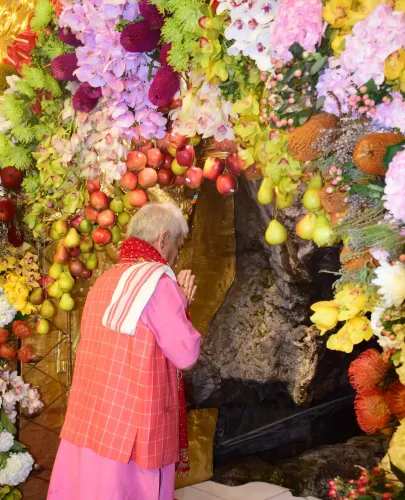
Devotees also visited the Maa Vindhyavasini Temple in Uttar Pradesh's Mirzapur. Avinash Singh, who had travelled from Ranchi, said the temple arrangements were satisfactory and that he had faced no crowding issues during darshan. Manish Kumar Dubey, another devotee who visits the temple every Tuesday and on all nine days of Navratri, described the experience saying, 'I felt as if I was sitting in Mother's lap and being blessed.'
Navratri Fervour Continues
With five more days remaining in the nine-day festival, attendance at major shrines is expected to climb further. The Navratri celebrations this year carry particular resonance in border regions of Jammu and Kashmir, where the proximity of military operations has done little to diminish the faith of local worshippers and pilgrims.
Point of View
Reinforcing a sense of divine protection that resonates powerfully in a region accustomed to conflict. What mainstream coverage tends to miss is the quiet civil-military communion happening at these border shrines: BSF personnel praying alongside pilgrims is not incidental colour but a lived signal of how communities maintain normalcy under persistent security pressure. The broader multi-city snapshot — Dewas, Delhi, Mirzapur — underlines how Navratri functions as a nationwide social mobilisation event that no single administrative authority fully controls.
NationPress
14 Oct 2026
Frequently Asked Questions
Where is the Tali Wali Mata Mandir and why is it significant during Navratri?
The Tali Wali Mata Mandir is located in Marh, Jammu district, close to the India-Pakistan border in Jammu and Kashmir. It draws large crowds during Navratri because of its historical renown and its proximity to the border, with devotees, BSF personnel, and people from distant cities all visiting during the nine-day festival.
What happened to the Tali Wali Mata Mandir during Operation Sindoor?
According to devotees, the temple did not suffer any damage despite the firing and bombings during Operation Sindoor, which was launched in response to the Pahalgam terror attack. Worshippers have cited the shrine's survival as a symbol of divine protection.
Which day of Navratri is 14 October 2026 and which goddess is worshipped?
14 October 2026 corresponds to the fourth day of Navratri, on which Maa Kushmanda is traditionally worshipped. Temple priest Suresh Nath at the Chamunda Mata Temple in Dewas confirmed this, adding local belief holds the deity also appears in different forms throughout the day.
How many people have visited the Chamunda Mata Temple in Dewas so far?
Temple priest Suresh Nath said nearly four to five lakh people had visited the Chamunda Mata Temple in Dewas, Madhya Pradesh, within the first three to four days of Navratri. Footfall is expected to increase as the festival approaches its ninth and final day.
What crowd management steps were taken at Kalkaji Temple in New Delhi?
The Kalkaji Temple in New Delhi set up three entry points and two exit points to manage the Navratri rush. A dedicated outpost was also established inside the temple premises for police personnel, paramilitary forces, and volunteers to assist devotees, according to Mahant Surendranath Avdhut.