How is NDAA Designating India as a Key Partner in US Nuclear and Indo-Pacific Strategies?
Synopsis
The latest NDAA positions India as a pivotal ally in US nuclear and Indo-Pacific strategies, emphasizing ongoing consultations on nuclear liability and collaboration in defense. This development not only strengthens bilateral ties but also addresses the growing challenges posed by China's influence in the region.
Key Takeaways
India is recognized as a key partner in US nuclear strategies.
The NDAA mandates ongoing consultations on nuclear liability.
New Delhi is included in a select group shaping Indo-Pacific defense architecture.
The emphasis on joint capability development highlights long-term strategic goals.
Strengthening US-India relations is crucial for countering China’s influence.
Washington, Dec 8 (NationPress) The recent US defense authorization bill has designated India as a crucial participant in Washington's Indo-Pacific and nuclear strategies. It emphasizes ongoing discussions regarding India's nuclear liability regulations and positions New Delhi among an elite cadre of partners who are instrumental in developing a new defense industrial framework in the Indo-Pacific to counter the challenges posed by China.
On Sunday, Congressional leaders unveiled the reconciled version of the fiscal 2026 National Defense Authorization Act (NDAA), an extensive policy document that integrates India into various facets of US strategic planning—from civil nuclear collaboration to defense co-manufacturing and regional maritime safety. This bill, which has been enacted annually for the past six decades, is anticipated to advance through the House later this week.
A significant section dedicated to India within the NDAA requires the United States to “establish and maintain…a joint consultative mechanism with the Government of the Republic of India” as part of the US–India Strategic Security Dialogue. This mechanism will convene regularly to evaluate the implementation of the 2008 civil nuclear cooperation agreement. Additionally, it is tasked “to explore opportunities for the Republic of India to align domestic nuclear liability regulations with international standards” and “to formulate a strategy” for both bilateral and multilateral diplomatic interactions on these matters.
The bill compels the Secretary of State to provide an annual report to Congress for five years detailing the outcomes of this joint evaluation—an unusually persistent oversight requirement that indicates renewed political focus in Washington on the long-stalled civil nuclear trajectory with India.
India also plays a prominent role in the NDAA’s International Nuclear Energy Act of 2025, categorizing New Delhi as an “ally or partner nation” alongside OECD countries for the aims of global civil nuclear collaboration. Furthermore, the legislation instructs the administration to devise a 10-year strategy to amplify US nuclear exports while explicitly evaluating competition with “the Russian Federation and the People's Republic of China throughout the supply chain.”
Central to the Indo-Pacific provisions, India is identified alongside Australia, Japan, South Korea, the Philippines, and New Zealand as a priority partner in a new Partnership for Indo-Pacific Industrial Resilience. This initiative aims “to enhance collaboration among the defense industrial sectors” of participating nations and to bolster joint capability development, supply-chain security, and defense innovation.
Under the program’s authorities, the Secretary of Defense may form agreements, create working groups, offer technical assistance, and engage the industry and academic institutions to promote co-development and co-production objectives. Annual reporting requirements extend through 2031, underscoring the long-term significance Washington assigns to this industrial network.
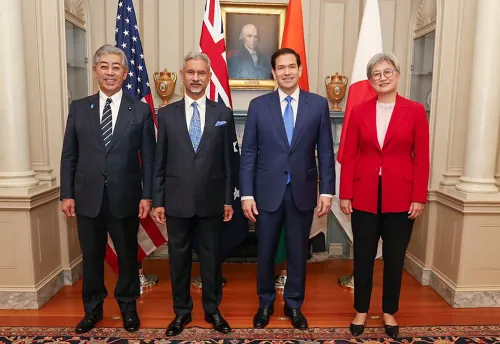
Moreover, Congress outlines a broader strategic directive for the region. It advocates for “expanding United States involvement with India, including via the Quadrilateral Security Dialogue,” to further “the common goal of a free and open Indo-Pacific” through military exercises, defense commerce, humanitarian aid, and “enhanced cooperation on maritime security.” The NDAA also reiterates Congress’s expectation that the Pentagon will continue to fortify its regional presence and multilateral coordination to enhance deterrence against China.
In a further structural adjustment, the bill authorizes a new Ambassador-at-Large for the Indian Ocean Region, charged with coordinating US diplomatic efforts across Indian Ocean coastal states and “identifying…strategic lines of effort.” Among the envoy’s responsibilities is to strengthen US engagement “to counter malign People's Republic of China influence operations in the Indian Ocean region.”
These measures collectively indicate that India is not only a beneficiary of US regional strategy but also an essential contributor to the framework Washington is constructing to manage long-term competition with Beijing. They also revitalize long-dormant nuclear cooperation channels by advocating for alignment on liability regulations—a prerequisite for any significant US reactor initiative in India.
In recent years, India-US defense relations have expanded through foundational agreements, intelligence-sharing partnerships, joint exercises, and emerging co-manufacturing programs. The Indo-Pacific has emerged as the primary theater where the strategic interests of both nations intersect, driven by shared concerns regarding China’s maritime assertiveness and regional influence.
Point of View
I believe this NDAA signifies a pivotal shift in US-India relations, enhancing strategic cooperation amid rising challenges from China. The focus on nuclear liability and industrial collaboration underscores a long-term commitment to mutual security and regional stability.
NationPress
18 Sept 2026
Frequently Asked Questions
What is the significance of the NDAA for India?
The NDAA positions India as a critical partner in US defense strategies, emphasizing collaboration on nuclear issues and defense production to counter regional challenges, particularly from China.
How will the NDAA impact US-India relations?
The NDAA is expected to strengthen US-India ties through enhanced military cooperation, joint exercises, and shared strategic interests, especially in the Indo-Pacific region.
What are the key provisions for India in the NDAA?
Key provisions include establishing a joint consultative mechanism for nuclear cooperation, recognizing India as an ally in nuclear energy, and fostering defense industrial resilience among Indo-Pacific partners.