Nitish Kumar: A Journey Through Student Politics to the Rajya Sabha
Synopsis
Explore the remarkable journey of Nitish Kumar, a seasoned political leader in India. From his early days in student activism to his recent nomination for the Rajya Sabha, Kumar's career reflects significant governance reforms and a strong commitment to women's empowerment.
Key Takeaways
Nitish Kumar's political journey spans over four decades.
He has held significant ministerial roles in the Union government.
His administration has a strong focus on women's empowerment.
Infrastructure development has been a hallmark of his governance.
His recent nomination to the Rajya Sabha signifies a new chapter in his career.
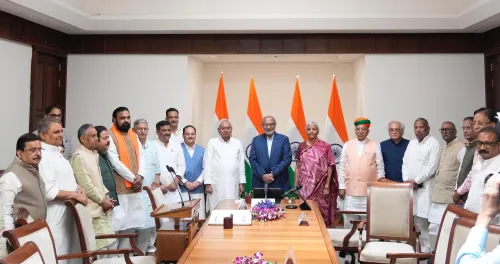
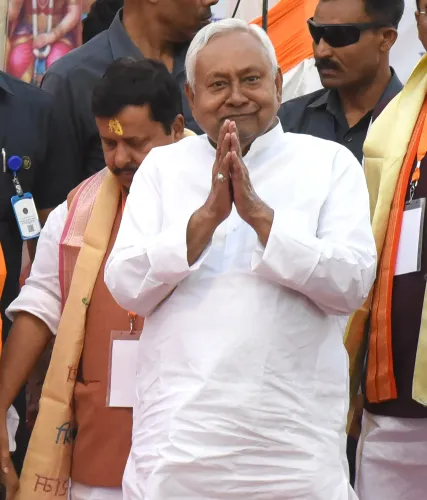
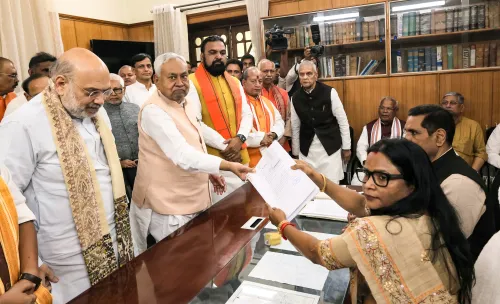
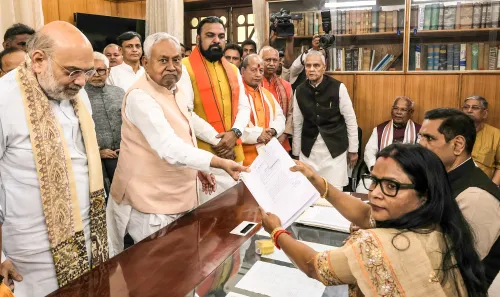
Patna, March 5 (NationPress) Bihar's Chief Minister and JD-U leader Nitish Kumar is recognized as one of the most experienced and versatile figures in Indian politics. His political journey has spanned over four decades, marked by ideological transformations, coalition shifts, and various governance trials. With his recent nomination to the Rajya Sabha, Kumar’s extensive political career is poised to embark on a fresh chapter.
Nitish Kumar's political beginnings lie in student activism. He first ran for the Harnaut Assembly seat in 1977 but was not elected.
His legislative career took off in 1985 when he secured a seat in the Bihar Legislative Assembly from Harnaut. He later entered the Lok Sabha in 1989, representing the Barh constituency.
He successfully regained his position in Barh during the elections of 1991, 1996, 1998, and 1999.
Within the Union government, Kumar held significant roles, including Minister of Agriculture, Railways, and Surface Transport. His time as Railway Minister was particularly noted for its administrative reforms and enhanced safety protocols.
In 2004, he was again elected to the Lok Sabha, this time from Nalanda.
Nitish Kumar's initial oath as Chief Minister of Bihar came in 2000, although that administration lasted just seven days.
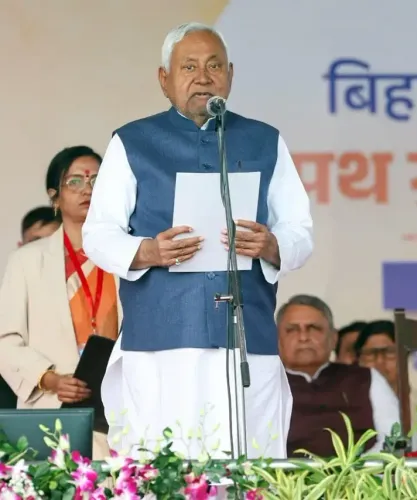
A pivotal moment in Bihar's political landscape occurred in November 2005 when he was sworn in again as Chief Minister. He has since been re-elected in 2010, 2015, 2020, and 2025, adapting to various political alignments.
His governance has seen partnerships with both the NDA and the RJD led by Lalu Prasad Yadav, showcasing a resilient political journey.
Nitish Kumar has been a member of the Lok Sabha, the Bihar Legislative Assembly, and the Bihar Legislative Council, making him one of the few leaders with experience across all three legislative bodies. His transition to the Rajya Sabha is viewed as another significant milestone in his long-standing public service. A hallmark of Kumar’s tenure has been his commitment to women's empowerment.
In 2006, he implemented a 50% reservation for women in Bihar's three-tier Panchayati Raj system, later extending this to municipal bodies, which dramatically increased women's involvement in grassroots governance.
Despite initial ridicule, terms like “Mukhiya Pati” became obsolete as numerous women leaders emerged with confidence and independence.
To promote girls' education, his government initiated the Chief Minister’s Girls’ Cycle Scheme and the Dress Scheme, providing financial support directly to bank accounts for bicycles and uniforms.
These initiatives resulted in a marked increase in girls' school attendance and contributed to closing the gender gap in matriculation results. Several scholarship programs for girls were also established.
The Jeevika programme, supported by the World Bank, has seen the formation of nearly one million self-help groups in Bihar, encompassing over 10 million women. These groups have enhanced savings, credit access, and small-scale entrepreneurship in rural areas.
Nitish Kumar's administration implemented a 35% reservation for women in the state police, significantly boosting their representation in law enforcement.
Furthermore, a 50% reservation for women in primary teacher appointments was enacted. The Chief Minister’s Women Entrepreneur Scheme provides financial aid of up to Rs 10,000 for starting industries, aimed at fostering women-led businesses.
Infrastructure development stands out as another significant aspect of his governance. Extensive road construction projects have been carried out throughout Bihar, including state highways and rural connectivity roads reaching even the most remote hamlets.
With the help of the Asian Development Bank, major infrastructure expansions were executed, alongside the construction of numerous bridges. Considerable advancements in rural electrification were also made.
Many villages now reportedly enjoy electricity for 22 to 23 hours a day, representing a significant improvement from previous decades. From student politics to multiple terms as Chief Minister and now a member of the Rajya Sabha, Nitish Kumar's political journey has experienced numerous highs and lows.
His legacy is often tied to governance reforms, women's empowerment, and infrastructure development. As he prepares for his new role in the Upper House, observers perceive this as the dawn of a new chapter in one of Bihar's most influential political careers.
Point of View
I recognize Nitish Kumar as a pivotal figure in Bihar's political landscape. His extensive experience and ability to navigate complex political waters highlight his importance in shaping governance and women's empowerment in the region.
NationPress
24 Sept 2026
Frequently Asked Questions
What are some key achievements of Nitish Kumar?
Nitish Kumar has implemented significant governance reforms, focused on women's empowerment, and improved infrastructure in Bihar during his political career.
When did Nitish Kumar first become Chief Minister?
Nitish Kumar first took oath as Chief Minister of Bihar in 2000, although that government lasted only seven days.
What initiatives has Nitish Kumar taken for women's empowerment?
He introduced 50% reservation for women in the Panchayati Raj system and the state police, along with financial aid for women entrepreneurs.
How has Bihar's infrastructure improved under Nitish Kumar?
His administration undertook extensive road construction and improved rural electrification, providing many villages with up to 23 hours of electricity daily.
What political roles has Nitish Kumar held?
Nitish Kumar has been a member of the Lok Sabha, the Bihar Legislative Assembly, and the Bihar Legislative Council, and is now elected to the Rajya Sabha.