Nitish Kumar pays tribute to APJ Abdul Kalam on birth anniversary

Synopsis
Former Bihar Chief Minister Nitish Kumar marked the birth anniversary of Bharat Ratna Dr. APJ Abdul Kalam on October 15, 2026, honouring the former president's contributions to nation-building and his enduring inspiration for Indian youth.
Key Takeaways
Nitish Kumar posted a tribute to Dr.
APJ Abdul Kalam on his birth anniversary, October 15, 2026 .
Kalam was awarded the Bharat Ratna in 1997 for his contributions to defence and space research.
He served as India's 11th President from 2002 to 2007 , widely known as the 'Missile Man of India'.
Nitish Kumar specifically cited Kalam's life, nation-building contributions, and his role as an inspiration for youth.
October 15 tributes to Kalam have become a cross-party national tradition, observed by leaders across the political spectrum.
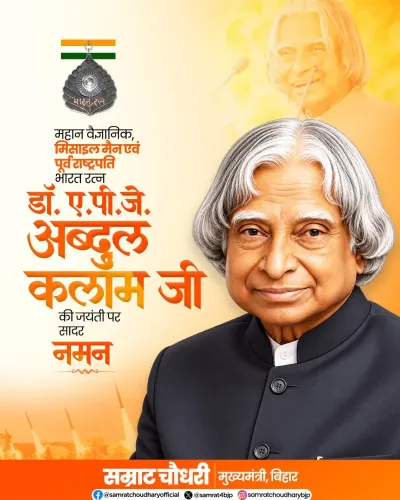
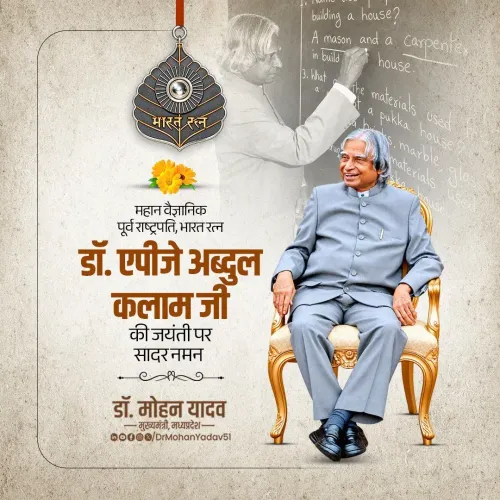
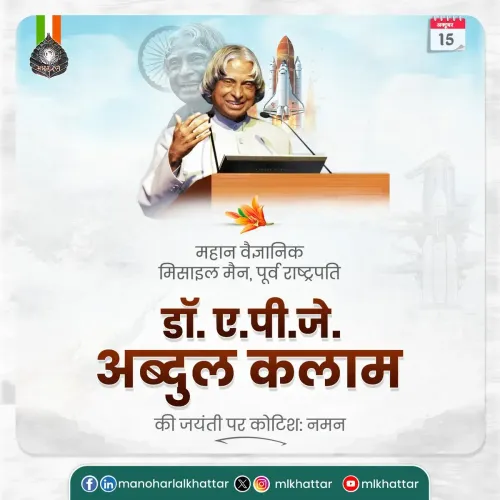
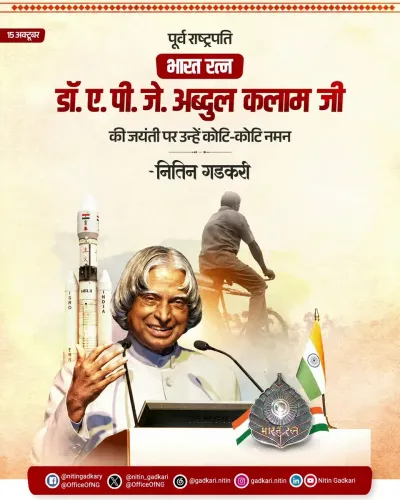
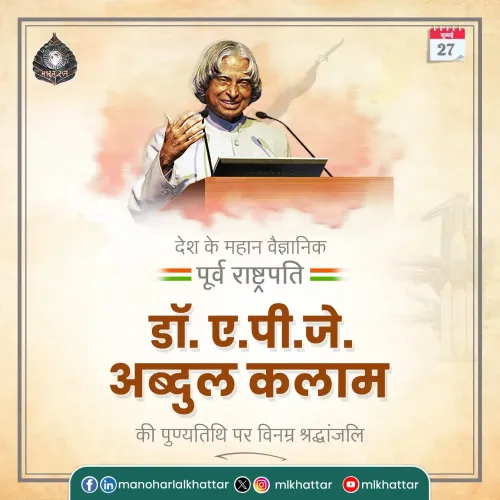
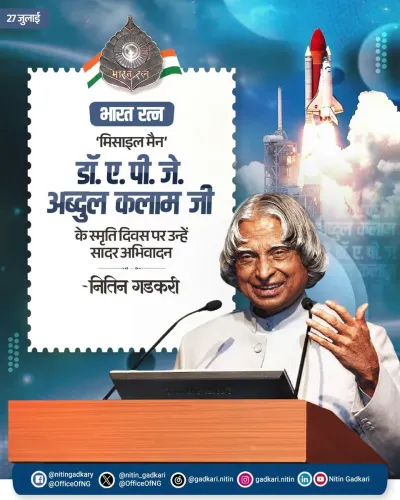
On the birth anniversary of Bharat Ratna Dr. A.P.J. Abdul Kalam, former Bihar Chief Minister and Janata Dal (United) national president Nitish Kumar offered his respects on Thursday, October 15, 2026, remembering India's beloved former president as an enduring source of inspiration for the nation's youth.
In his post on X, Nitish Kumar wrote: 'Bharat Ratna aur desh ke sarvapriy poorv rashtrapati Dr. A.P.J. Abdul Kalam ji ki jayanti par unhe sadar naman.' — 'On the birth anniversary of Bharat Ratna and the nation's most beloved former president Dr. A.P.J. Abdul Kalam, I offer my respectful salute.' He added that Kalam's life, his contributions to nation-building, and the personality that inspired generations of young Indians 'will continue to inspire us always.'
The Missile Man who became a president
Dr. Abdul Kalam was born on October 15, 1931, in Rameswaram, Tamil Nadu. An aerospace scientist who rose through the Defence Research and Development Organisation (DRDO) and ISRO, he became widely known as the 'Missile Man of India' for his central role in the country's ballistic missile and space launch vehicle programmes. He was awarded the Bharat Ratna in 1997, India's highest civilian honour, before serving as the 11th President of India from 2002 to 2007. His presidency was defined by an unusual warmth toward the young — he is remembered as much for classroom visits and open letters to students as for state business.
A cross-party tribute that repeats every October
Kalam's birth anniversary has become one of India's most universally observed political commemorations — a rare moment when tributes flow uncontested across party lines, from the ruling dispensation in New Delhi to state governments and opposition leaders alike. Nitish Kumar's post fits this pattern: a senior leader with deep roots in Bihar's political landscape using a national occasion to invoke Kalam's twin legacies of scientific achievement and youth motivation. Kalam's books — particularly Wings of Fire — remain staples in school curricula and competitive-exam reading lists across India, keeping his influence alive in the classrooms his admirers say he never really left.
Each year, October 15 sees institutional events — seminars, essay competitions, science fairs — at universities and schools invoking Kalam's vision of a scientifically tempered, self-reliant India. For a political figure like Nitish Kumar, the tribute also carries a quiet civic message: that the aspirations Kalam embodied — merit, service, national purpose — remain the benchmark against which public life is measured.
A scientist who dreamed for a billion people, a president who sat on dormitory floors with engineering students — Kalam's story does not age, and India keeps returning to it every October 15 for a reason.
Point of View
Cutting across ideological lines — which itself reflects how successfully Kalam's image was decoupled from partisan politics during and after his lifetime. For Nitish Kumar, invoking Kalam's legacy of scientific temper and youth empowerment also subtly aligns JDU's positioning with development and aspiration rather than caste-arithmetic. The annual convergence of tributes points to a broader pattern: India's political class finds in Kalam a safe, unifying symbol precisely because his achievements belong to state institutions — DRDO, ISRO, Rashtrapati Bhavan — that transcend any single government.
NationPress
15 Oct 2026
Frequently Asked Questions
Why is October 15 celebrated as APJ Abdul Kalam's birth anniversary?
Dr. APJ Abdul Kalam was born on October 15, 1931 , in Rameswaram, Tamil Nadu. The date is observed nationally with tributes from political leaders, educational institutions, and youth organisations every year.
What did Nitish Kumar say about APJ Abdul Kalam?
Nitish Kumar offered his 'respectful salute' to Kalam, stating that his life, contributions to nation-building, and his inspiring personality 'will continue to inspire us always.'
When did APJ Abdul Kalam receive the Bharat Ratna?
Dr. APJ Abdul Kalam was awarded the Bharat Ratna in 1997 , India's highest civilian honour, recognising his contributions to defence research and space science.
Why is APJ Abdul Kalam called the Missile Man of India?
Kalam earned the title 'Missile Man of India' for his pivotal role in developing India's ballistic missile and space launch vehicle programmes through DRDO and ISRO during the 1980s and 1990s.
When did APJ Abdul Kalam serve as President of India?
Dr. APJ Abdul Kalam served as the 11th President of India from 2002 to 2007 , and was widely celebrated for his accessibility and focus on inspiring India's youth.