Odisha CMO Flags ₹65,000 Cr Green Investment Push at Gopalpur SEZ
Synopsis
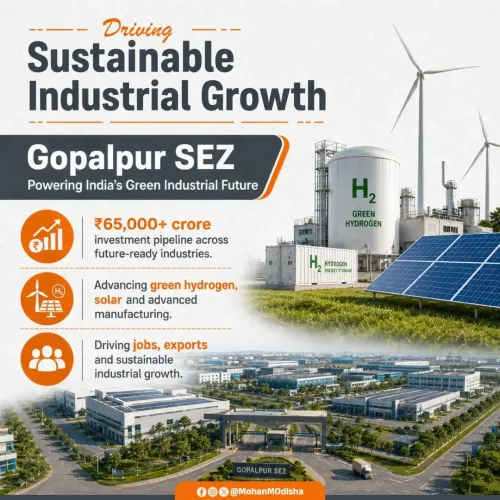
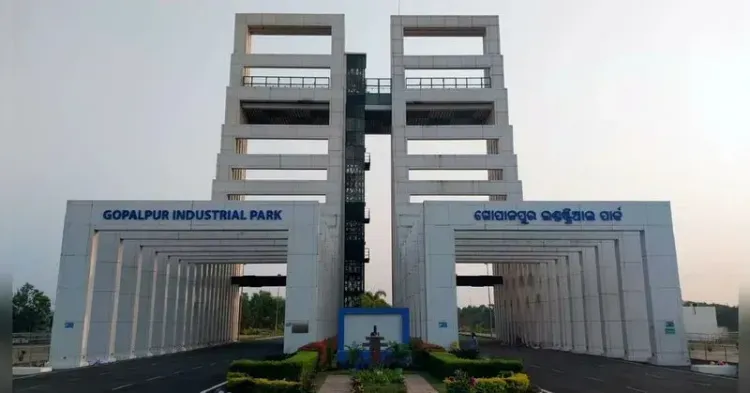
Odisha's Chief Minister's Office has announced a ₹65,000 crore green investment pipeline at Gopalpur SEZ, targeting green hydrogen production and clean-tech manufacturing to drive low-carbon industrial growth in the state.
Key Takeaways
The Chief Minister's Office of Odisha announced a ₹65,000 crore green investment pipeline at Gopalpur SEZ on 20 July 2026 .
The pipeline covers green hydrogen production and clean technology manufacturing as its primary verticals.
Tata Steel is associated with the Gopalpur SEZ development, which is located in Ganjam district , southern Odisha.
The initiative aligns with India's National Green Hydrogen Mission (2023) and the country's net-zero by 2070 commitment made at COP26.
The stated outcomes include strengthening industrial infrastructure, creating sustainable employment, and driving regional economic growth.
Execution timelines, financial closures, and regulatory clearances remain key milestones to watch.
The Chief Minister's Office of Odisha announced on Monday, 20 July 2026 that a ₹65,000 crore green investment pipeline is taking shape at Gopalpur Special Economic Zone in Ganjam district, positioning the eastern state as a major destination for clean-technology and low-carbon industrial capital.
Context
The CMO's post states that Odisha is 'rapidly emerging as a prime destination for green investments,' with the Gopalpur SEZ at the centre of this pivot. The initiative spans green hydrogen production and clean technology manufacturing, with the stated goals of strengthening industrial infrastructure, generating sustainable employment, and driving regional economic growth in southern Odisha.
Tata Steel, which has long-standing operations in the state, is associated with the Gopalpur SEZ development. The zone, located in Ganjam district, was originally developed for large-scale industrial and manufacturing activities and is now being repositioned around green industrial verticals.
Policy Backdrop
The announcement aligns with India's commitment to reach net-zero emissions by 2070, pledged at COP26 in 2021, which has since catalysed a wave of state-level green industrial policies. At the central level, the National Green Hydrogen Mission, launched in 2023, provides a policy scaffold for scaling up green hydrogen capacity — a segment explicitly named in the Gopalpur pipeline.
Odisha's own Industrial Policy 2015 had already laid groundwork for SEZ-based large-scale manufacturing. The current green investment drive represents an evolution of that framework, layering decarbonisation objectives onto the state's existing mineral and steel-sector strengths.
Stakeholders and Impact
The primary beneficiaries of the Gopalpur pipeline are expected to be the local workforce in southern Odisha, steel and clean-technology manufacturers, and renewable energy investors seeking industrial-scale deployment opportunities. Ganjam district, historically dependent on migration-linked remittances, stands to gain significantly from sustainable employment creation if project timelines are met.
For the broader Indian green economy, Odisha's move intensifies inter-state competition to attract clean manufacturing and hydrogen investments. The state is leveraging its established steel base and mineral endowments to embed itself in emerging clean-technology supply chains that are increasingly central to national industrial strategy.
What's Next
Attention will now turn to actual project execution timelines, land allocation within Gopalpur SEZ, and further investment commitments from anchor investors. The scale of the pipeline — ₹65,000 crore — makes it one of the largest green investment announcements at a single SEZ in India, and industry observers will watch closely for financial closures, regulatory clearances, and phased rollout schedules in the months ahead.
If realised, the Gopalpur green cluster could establish Odisha as a benchmark for how resource-rich Indian states translate national decarbonisation mandates into ground-level industrial transformation.
Point of View
000 crore green investment pipeline at Gopalpur SEZ is a significant signal that India's resource-rich eastern states are no longer content to be upstream suppliers in clean-energy value chains — they want to host the manufacturing too. By anchoring the pitch around green hydrogen and clean-tech production, Odisha is directly competing with states like Gujarat and Rajasthan that have moved earlier on renewable-linked industrialisation. The Tata Steel connection lends the announcement credibility, but the gap between pipeline announcements and actual capital deployment remains the critical test for Odisha's green industrial ambitions. If Gopalpur delivers, it could reshape how central planners allocate green manufacturing incentives across Indian states.
NationPress
20 Oct 2026
Frequently Asked Questions
What is the Gopalpur SEZ green investment pipeline in Odisha?
The Gopalpur SEZ in Ganjam district, Odisha, has a ₹65,000 crore green investment pipeline announced in July 2026, focused on green hydrogen production and clean technology manufacturing.
Which company is developing the Gopalpur SEZ green project?
Tata Steel is associated with the Gopalpur SEZ development in Odisha, which is being positioned as a hub for green industrial investments.
What is India's National Green Hydrogen Mission?
The National Green Hydrogen Mission is a central government scheme launched in 2023 to scale up green hydrogen production capacity across India, providing a policy framework for projects like the Gopalpur pipeline.
How does the Gopalpur investment help Odisha's economy?
The ₹65,000 crore pipeline is expected to create sustainable employment in southern Odisha, strengthen industrial infrastructure, and drive regional economic growth by attracting clean-technology investors.
What is Odisha's net-zero or green energy policy?
Odisha is aligning its industrial strategy with India's net-zero by 2070 commitment made at COP26 in 2021, building on its Industrial Policy 2015 to attract green manufacturing and hydrogen investments at SEZs like Gopalpur.