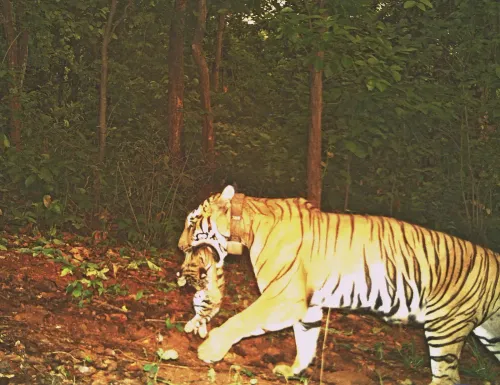
Odisha CM's Office Pledges Tiger Future on Global Conservation Day

Synopsis
On International Tiger Day 2026, the Chief Minister's Office of Odisha committed to the ₹125 crore Ama Similipal Yojana, deploying AI surveillance, anti-poaching measures, real-time fire detection and community ecotourism to secure the state's tiger population for future generations.
Key Takeaways
The Chief Minister's Office of Odisha marked International Tiger Day, 29 July 2026 , with a formal conservation pledge centred on Similipal Tiger Reserve .
The state has announced the ₹125 crore Ama Similipal Yojana covering genetic conservation, scientific habitat management and community participation.
AI-enabled surveillance and real-time forest-fire detection are being deployed as part of a modernised anti-poaching and habitat-monitoring framework.
Community-led ecotourism is positioned as a mechanism to align forest-community livelihoods with tiger conservation goals.
Odisha's approach supplements the Central government's Project Tiger framework, launched in 1973 , and aligns with NTCA policy encouraging state-level innovation in tiger reserves.
Every year on 29 July, the world pauses to reckon with the fate of the tiger — and this year, Odisha answered that call with a concrete conservation commitment. The Chief Minister's Office of Odisha announced on International Tiger Day 2026 that the state is deepening its investment in tiger protection through the ₹125 crore Ama Similipal Yojana, a multi-pronged programme combining genetic conservation, AI-enabled surveillance, and community-led ecotourism.
Similipal at the Centre of Odisha's Tiger Strategy
Similipal Tiger Reserve, nestled in the forested hills of Mayurbhanj district, is Odisha's most significant tiger habitat and one of India's oldest protected biosphere reserves. It has long been part of the national tiger conservation network anchored by Project Tiger, the Central government programme launched in 1973 that created a chain of dedicated reserves across the country. The Ama Similipal Yojana represents Odisha's state-level push to complement that federal framework with targeted, locally-designed interventions — though the scheme's precise components and launch timeline have not yet been independently documented in public records.
The CMO's statement points to genetic conservation and 'scientific habitat management' as twin pillars of the programme, signalling an approach that goes beyond traditional patrolling to address the biological health of the tiger population itself.
AI Cameras, Fire Alerts, and the Anti-Poaching Push
Technology is front and centre in Odisha's updated conservation model. AI-enabled surveillance and real-time forest-fire detection are being deployed across the reserve — tools that mirror a broader national trend of integrating camera-trap networks and digital monitoring into wildlife management. Forest fires are among the most destructive threats to tiger habitat in central and eastern India, making early-detection systems a critical operational priority.
Stronger anti-poaching measures are also cited, reflecting the persistent pressure that illegal wildlife trade places on tiger populations even within protected zones. India's periodic All India Tiger Estimation exercises have recorded steady growth in wild tiger numbers nationally, but sustaining that trend requires constant enforcement at the ground level.
Forest Communities as Conservation Partners
Perhaps the most consequential long-term signal in the CMO's statement is its emphasis on community participation and community-led ecotourism. Tribal and forest-dwelling communities in and around Similipal have historically been both the most affected by conservation restrictions and the most effective informal guardians of the forest. Weaving their livelihoods into the conservation model — rather than treating them as a problem to be managed — is increasingly recognised as the only durable solution.
The CMO framed this as a 'modern conservation model where wildlife and livelihoods thrive together,' a formulation that echoes the direction of national policy under the National Tiger Conservation Authority (NTCA), which has progressively encouraged states to integrate community-based tourism with habitat protection.
The Roar Odisha Wants to Preserve
Odisha's pledge on International Tiger Day is both a policy statement and a political signal — that the state sees tiger conservation not as a burden imposed by Delhi but as a source of ecological identity and economic opportunity. The real measure will come when fund-utilisation reports for the Ama Similipal Yojana are published and when India's next tiger census puts a number to the results. Until then, the forest is watching.
Point of View
Not enforcement alone, are what make tiger reserves sustainable. Politically, framing forest communities as 'safeguards' rather than encroachers is a pointed shift in the government's public language, one that carries implications for how tribal land rights and conservation restrictions are negotiated in Similipal's buffer zones. The real test arrives with the next All India Tiger Estimation — if Odisha's numbers improve, this model becomes a template; if they stagnate, the scrutiny will fall squarely on fund utilisation.
NationPress
28 Oct 2026
Frequently Asked Questions
What is the Ama Similipal Yojana?
The Ama Similipal Yojana is a state government scheme announced by Odisha for tiger conservation, with a stated outlay of ₹125 crore. It encompasses genetic conservation, scientific habitat management, AI-enabled surveillance, anti-poaching measures, real-time forest-fire detection and community-led ecotourism in and around Similipal Tiger Reserve.
When is International Tiger Day celebrated?
International Tiger Day is observed every year on 29 July. It has been marked globally since 2010 to raise awareness about tiger conservation and the threats facing wild tiger populations.
How many tigers are there in Similipal Tiger Reserve?
Exact current tiger numbers in Similipal are determined through the All India Tiger Estimation exercise conducted periodically by the National Tiger Conservation Authority. The latest verified figures from that census should be consulted for precise counts; this article does not assert a specific number.
What is Project Tiger and how does it relate to Odisha?
Project Tiger is a Central government programme launched in 1973 to protect Bengal tigers through a network of dedicated reserves across India. Similipal Tiger Reserve in Odisha is part of this national network, and state-level schemes like Ama Similipal Yojana are designed to supplement the Project Tiger framework with locally-tailored interventions.
How is technology being used for tiger conservation in Odisha?
According to the Chief Minister's Office of Odisha, the state is deploying AI-enabled surveillance cameras and real-time forest-fire detection systems in Similipal. These tools are part of a broader national trend of using digital monitoring and camera-trap networks to strengthen anti-poaching enforcement and habitat management.