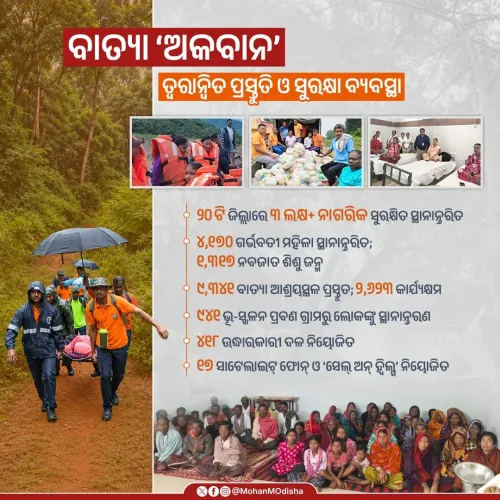
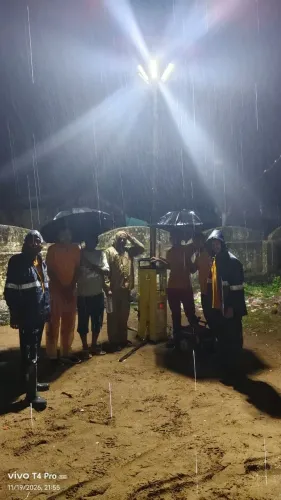
Odisha CM Office: Rescue Teams Battle Cyclone Akvan

Synopsis
Rescue teams in Koraput and Ganjam districts are clearing dangerous trees, securing power lines, and evacuating children and villagers as Odisha mobilises its battle-tested disaster machinery against Cyclone Akvan.
Key Takeaways
The Chief Minister's Office of Odisha confirmed active rescue operations in Koraput and Ganjam districts on 20 November 2026 .
Teams in Koraput are removing hazardous trees and mitigating risks to houses, buildings, and overhead power lines.
In Ganjam , rescue teams have already 'safely evacuated children and villagers' ahead of Cyclone Akvan .
Odisha's disaster response framework was forged through the 1999 super cyclone , refined after Phailin (2013) , and stress-tested during Fani (2019) .
Ganjam is a coastal district in the Bay of Bengal's direct cyclone corridor, historically among the most vulnerable in the state.
Post-storm monitoring of power restoration in Koraput and further evacuation orders in Ganjam are the next key operational milestones.
With Cyclone Akvan bearing down on Odisha, rescue teams fanned out across Koraput and Ganjam districts on Friday, 20 November 2026 — clearing hazardous trees, shoring up power infrastructure, and pulling children and villagers to safety before the storm could land its worst. The Chief Minister's Office of Odisha confirmed the ground operations in a post that showed crews already deep in the work.
In Koraput district, teams targeted the most immediate physical dangers: trees leaning over homes, buildings, and overhead power lines. The logic is well-tested — a downed line in a cyclone does not just cut electricity, it ignites fires and blocks emergency access for days. Removing the threat before the wind peaks is the difference between a manageable crisis and a cascading one.
Children and Villagers Moved to Safety in Ganjam
The more urgent human story was playing out in Ganjam district, a coastal belt that sits almost directly in the Bay of Bengal's cyclone corridor. There, rescue teams had already 'safely evacuated children and villagers', according to the CMO's statement. Ganjam has been hit repeatedly over the decades — it is exactly the kind of district where hours matter.
The district's vulnerability is structural: low-lying coastal villages, densely packed settlements, and limited all-weather roads that can flood fast. Getting people out before the surge, rather than after, is the core lesson Odisha has drilled into every layer of its disaster machinery.
How Odisha Built One of India's Sharpest Cyclone Responses
Odisha's current preparedness did not arrive overnight. The 1999 super cyclone killed nearly 10,000 people and triggered a fundamental rethink of the state's disaster architecture. Cyclone Phailin in 2013 tested the rebuilt system — and held. Cyclone Fani in 2019, one of the most powerful storms to hit India in decades, saw the state evacuate roughly 1.2 million people in under 48 hours, with casualties a fraction of what an earlier era would have produced.
The same framework — pre-emptive tree clearance near power infrastructure, targeted evacuations of the most exposed communities, and real-time district-level coordination — is now activating for Akvan. Koraput, though an inland hilly district with significant tribal populations, faces its own cyclone-linked hazards: flash flooding, landslides, and snapped trees that can isolate villages for days.
What the Next Hours Will Determine
The pace of operations in both districts signals that Odisha's State Disaster Management Authority has already moved past the alert phase into active deployment. The two key indicators to watch: how completely power-line corridors are cleared in Koraput before landfall, and whether further evacuation orders extend to additional coastal blocks in Ganjam as Akvan's track firms up.
Odisha has earned its reputation as a global benchmark for cyclone response — but that reputation is rebuilt from scratch with every storm. The rescue teams on the ground today are the proof of concept.
Point of View
Multi-terrain response doctrine that goes beyond shoreline protection. Politically, Chief Minister Mohan Majhi's administration is leaning on an institutional legacy that predates it — the question is whether operational continuity translates into on-ground outcomes as Akvan tracks closer. For India's broader disaster management conversation, Odisha's pre-emptive tree-clearance model around power infrastructure remains an underappreciated but high-leverage intervention that other cyclone-prone states have yet to fully adopt.
NationPress
20 Nov 2026
Frequently Asked Questions
What is Cyclone Akvan and where is it expected to hit?
Cyclone Akvan is a storm system being tracked in the Bay of Bengal in November 2026 , with Odisha's coastal and inland districts on alert. Official track updates from the meteorological department will determine its precise landfall zone.
Which districts in Odisha are on high alert for Cyclone Akvan?
Ganjam and Koraput are among the districts where active rescue and pre-emptive operations are already under way, as confirmed by the Chief Minister's Office of Odisha on 20 November 2026 .
What are rescue teams doing in Koraput before Cyclone Akvan?
In Koraput district , teams are removing hazardous trees and clearing risks to houses, buildings, and overhead power lines to prevent cascading damage during the storm.
Have people been evacuated in Ganjam because of Cyclone Akvan?
Yes. The CMO of Odisha confirmed that rescue teams in Ganjam district have already 'safely evacuated children and villagers' as part of pre-cyclone preparations.
How has Odisha handled past cyclones like Fani and Phailin?
Odisha built one of India's most effective cyclone-response systems after the devastating 1999 super cyclone . During Cyclone Fani in 2019 , the state evacuated approximately 1.2 million people in under 48 hours , dramatically limiting casualties.