Odisha evacuates coastal residents as Cyclone Akaban closes in

Synopsis
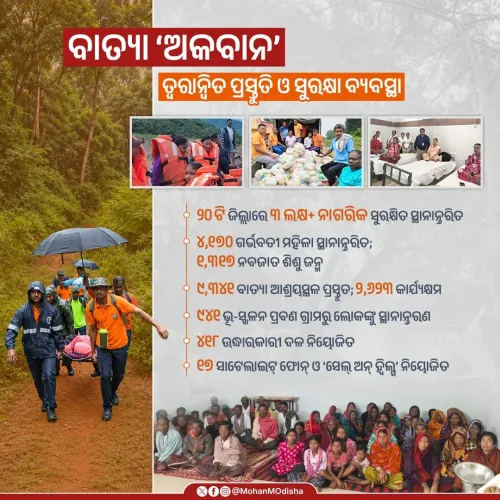
The Chief Minister's Office of Odisha confirmed on 20 November 2026 that rescue teams are evacuating residents from vulnerable coastal zones ahead of Cyclone Akaban, with shelters stocked with dry and cooked food and all essential facilities, as the government prioritises zero casualties.
Key Takeaways
Rescue teams are actively evacuating residents from vulnerable and low-lying areas in Odisha ahead of Cyclone Akaban .
Designated shelters are being stocked with both dry rations and cooked food , as well as essential facilities for displaced residents.
The Chief Minister's Office of Odisha confirmed the operation on 20 November 2026 , stating life safety is the 'highest priority'.
Odisha's response draws on a disaster framework built since the 1999 super cyclone , which killed nearly 10,000 people .
During Cyclone Fani (2019) , the state evacuated over 1.2 million people in under 48 hours under the same institutional model.
Further evacuation phases and post-landfall damage assessments are expected as the cyclone's track becomes clearer.
With Cyclone Akaban bearing down on the Odisha coast, rescue teams are moving residents out of vulnerable zones and into designated shelters — and the state government is making clear that saving lives comes before everything else. The Chief Minister's Office of Odisha confirmed the ongoing operation on Friday, 20 November 2026, posting a Odia-language update that described a coordinated, full-spectrum response already underway.
The post, translated from Odia, states: 'People are being safely evacuated from vulnerable areas to shelters with the assistance of rescue teams to tackle Cyclone Akaban. Dry and cooked food along with essential facilities are being provided for the public at the shelters. The safety and protection of human life is being given the highest priority.'
Rescue teams, food, and shelter — the three-pillar response
The government's communication signals that all three legs of the emergency framework are simultaneously active: physical evacuation by rescue teams, provisioning of both dry rations and cooked meals, and round-the-clock essential services at shelter sites. The explicit mention of cooked food — not just dry rations — matters. It signals that authorities anticipate an extended stay for displaced residents, not a brief overnight exercise.
Coastal and low-lying communities are the most exposed. Historically, it is the gap between early warning and actual movement that costs lives, and Odisha's model deliberately closes that gap through pre-positioned rescue teams tasked specifically with convincing and physically assisting reluctant residents to leave.
A state forged by cyclone after cyclone
Odisha has endured more major Bay of Bengal cyclones than almost any other Indian state, and the institutional memory is long. The catastrophic 1999 super cyclone killed nearly 10,000 people and forced a wholesale rebuilding of the state's disaster architecture — early warning towers, a dense network of multi-purpose cyclone shelters, and standing protocols for mass evacuation.
The results became globally noticed. During Cyclone Phailin in 2013, more than 500,000 people were relocated before landfall. When Cyclone Fani — one of the most powerful storms ever to hit India — made landfall in May 2019, a staggering 1.2 million people had been moved to safety in under 48 hours; the official death toll was held to under 90. The 'zero-casualty' ambition that now defines Odisha's disaster philosophy was not handed down — it was built, iteration by iteration, from grief.
That lineage is visible in the current response. The language of Friday's update — 'highest priority to safety and life protection' — is not rhetorical. It reflects a standing institutional directive that overrides all other administrative concerns the moment a cyclone warning is issued.
What comes next as Akaban approaches
As the cyclone's precise track firms up, the state will likely trigger additional evacuation phases for districts in the projected landfall corridor. Post-landfall, attention will shift rapidly to damage assessment and the activation of relief packages. For now, the government's signal is unambiguous: the machinery is in motion, and no one in a vulnerable zone is being left to wait it out alone.
Point of View
Publicly communicated evacuation response to Cyclone Akaban reflects a disaster-governance model that has become a benchmark for Indian states. The state's shift from reactive relief to proactive mass evacuation — cemented after 1999 and stress-tested through Phailin and Fani — represents a rare case of institutional learning translating directly into saved lives. The CMO's real-time communication on social media also signals how Indian state governments now use digital channels to manage public anxiety and demonstrate administrative readiness simultaneously. The critical variable, as always, will be the post-landfall phase: whether the relief and rehabilitation machinery activates as efficiently as the pre-landfall evacuation will determine the full measure of this response.
NationPress
20 Nov 2026
Frequently Asked Questions
What is Cyclone Akaban and where is it headed?
Cyclone Akaban is a storm system approaching the Odisha coast in the Bay of Bengal. As of 20 November 2026 , Odisha authorities are conducting active evacuations from vulnerable coastal and low-lying zones ahead of its expected impact.
How is Odisha evacuating people before Cyclone Akaban?
Rescue teams are physically assisting residents to move from vulnerable areas to designated government shelters, which are being stocked with dry rations, cooked food, and essential services, as confirmed by the Chief Minister's Office of Odisha .
How many cyclone shelters does Odisha have?
Odisha has built a dense network of multi-purpose cyclone shelters across its coastal districts as part of a disaster management framework developed after the devastating 1999 super cyclone . The exact current number has expanded progressively over the years.
What was Odisha's response to Cyclone Fani in 2019?
During Cyclone Fani in May 2019 , Odisha evacuated over 1.2 million people in under 48 hours, holding the official death toll to under 90 — an operation widely regarded as one of the most successful cyclone evacuations in history.
Is Odisha's zero-casualty cyclone policy official government policy?
Yes. Odisha's disaster management framework explicitly prioritises preventing all loss of life during cyclones. The 'zero-casualty' goal has guided pre-emptive evacuation and shelter provisioning protocols since being formalised after large-scale cyclone responses to Phailin (2013) and Fani (2019) .