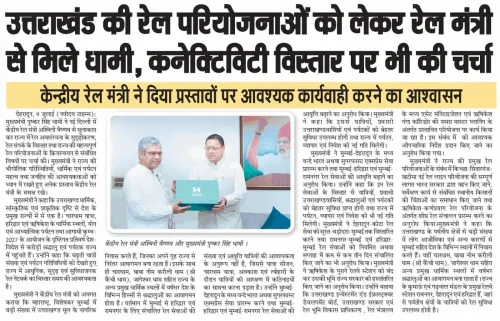
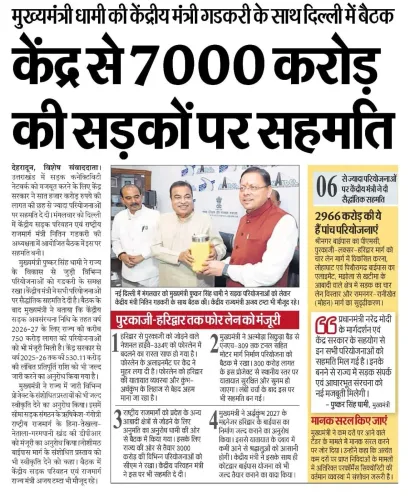
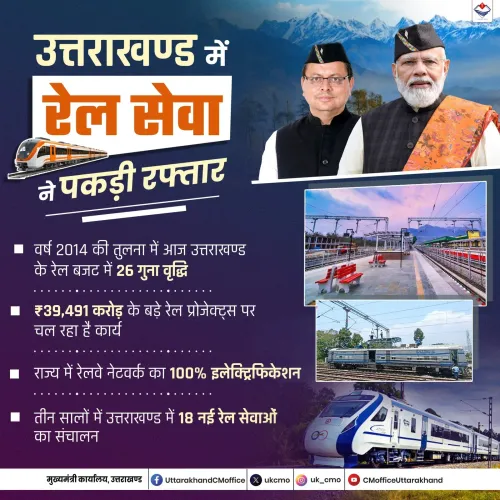
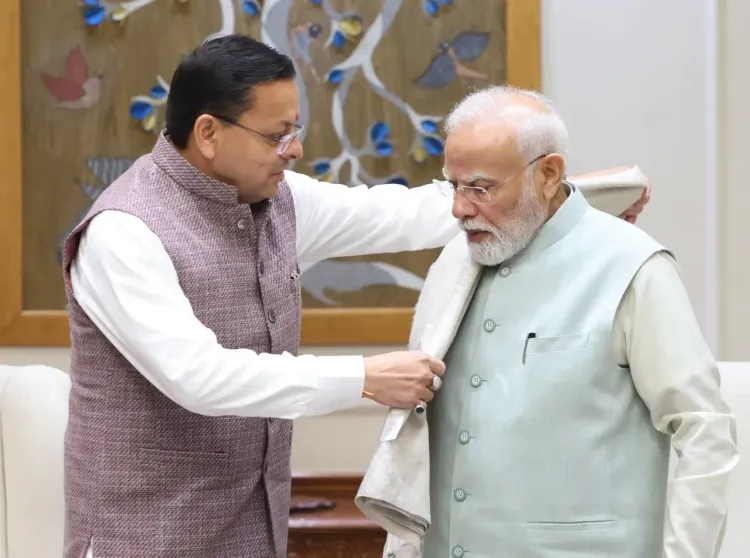
CM Dhami meets PM Modi, seeks approvals for Uttarakhand projects
Synopsis
Uttarakhand CM Pushkar Singh Dhami met PM Narendra Modi in New Delhi on November 20, requesting approvals for a Delhi-Haldwani expressway, five rail corridors, Chiniyalisaur airstrip expansion, an Ayurvedic institute at Kichha, and ₹500 crore for Kumbh 2027, while presenting traditional gifts from the state.
Key Takeaways
CM Pushkar Singh Dhami met PM Narendra Modi in New Delhi on November 20, 2026 to discuss Uttarakhand's development agenda.
Key new approvals sought include a Delhi–Haldwani expressway and surveys or approvals for five rail projects including Tanakpur–Bageshwar and Rishikesh–Uttarkashi lines.
Chiniyalisaur airstrip expansion for civil-military dual use and EAP Capping exemption for hill states were formally requested.
Dhami thanked Modi for ₹500 crore for Kumbh 2027, ₹9,500 crore under SASCI, and ₹3,436.08 crore under the RDSS scheme.
An All India Ayurvedic Institute was requested for Kichha, Udham Singh Nagar ; three new Spiritual Economic Zones identified in the state.
Traditional gifts including Malari coat patti, Dorkha fabric, Badri ghee, Harsil rajma and a Maa Ganga replica for Kumbh 2027 were presented to the Prime Minister.
New Delhi, November 20, 2026 — With a list that spans railway tunnels through the Himalayas, a Delhi-Haldwani expressway, and smart electricity meters in mountain villages, Uttarakhand Chief Minister Pushkar Singh Dhami sat down with Prime Minister Narendra Modi in New Delhi today — and left nothing off the table. The meeting covered nearly every sector of state development, from road and rail connectivity to spiritual tourism, medical education, and disaster management, underscoring just how much of Uttarakhand's developmental agenda runs through the central government's approval window.
A mountain state's long wish-list — and the geography that explains it
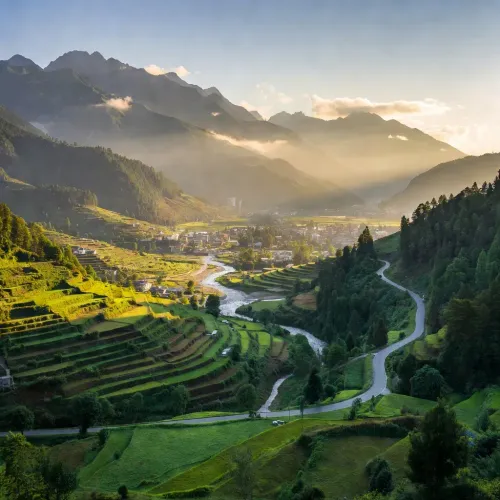
Uttarakhand, carved out of Uttar Pradesh in 2000, is one of India's most topographically challenging states. Its Himalayan terrain makes every road, rail line, and power grid exponentially more expensive to build and maintain than on the plains. CM Dhami made this geography the centrepiece of his ask, stating — in the words of the official account — that 'rajya ki bhaugolik paristhitiyon evam seemit vitteeya sansaadhanon ko dekhte hue' ('given the state's geographical conditions and limited financial resources'), continued central support is what gives Uttarakhand's development real momentum. The state has benefited from special category provisions since its formation, allowing a higher proportion of centrally-sponsored scheme funds to flow in as grants rather than loans.
Rail lines, an expressway, and the Chiniyalisaur airstrip
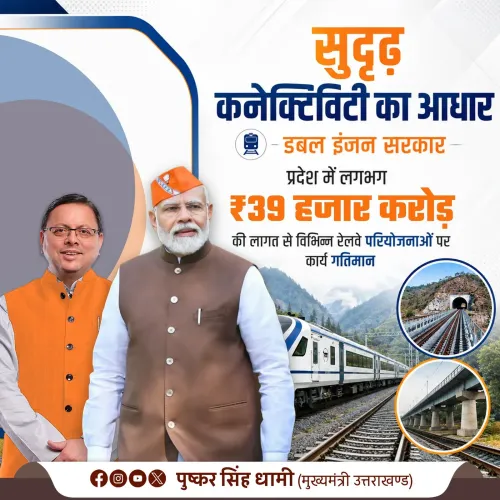
The connectivity agenda was the most ambitious part of Thursday's discussions. Dhami formally requested approval for a Delhi–Haldwani expressway, framing it as a transformative artery for Kumaon region's tourism and economic connectivity. On the rail front, he sought approvals and surveys for no fewer than five corridors: the Tanakpur–Bageshwar line (including a road-cum-rail tunnel), the Bageshwar–Karnprayag line survey, Haridwar–Dehradun doubling, and the Rishikesh–Uttarkashi proposal. Each represents a decades-long aspiration for communities currently dependent on winding mountain roads prone to landslides.
The Chiniyalisaur airstrip — in Uttarkashi district — featured as a pointed request: Dhami sought financial and technical support for its expansion, modernisation, and dual civil-military use, a signal of both connectivity and strategic intent along India's northern border. He also asked for EAP Capping exemption (External Aided Project funding caps) for Uttarakhand, arguing that hill states with thin fiscal bases should not be constrained by the same ceilings applied to richer plains states.
Kumbh 2027, Ayurvedic institutes, and smart power grids
The Haridwar Kumbh Mela 2027 — the next edition of one of the world's largest religious gatherings — was both a gratitude moment and a planning conversation. Dhami thanked the Prime Minister for sanctioning ₹500 crore for Kumbh preparations and approximately ₹9,500 crore under the SASCI framework. A replica of Maa Ganga depicting the Kumbh's grandeur was among the traditional gifts he presented to Modi — a gesture that doubles as a soft reminder of the event's national significance. Haridwar last hosted the Kumbh in 2021, with the central government providing crowd-management and infrastructure support.
On the power side, Dhami acknowledged the sanction of ₹3,436.08 crore under the Revamped Distribution Sector Scheme (RDSS) for smart metering and grid modernisation — a programme launched nationally to cut distribution losses and bring digital billing to consumers. He also flagged ATC tower installation at Char Dham Yatra sites for air traffic management, and sought alignment approval for the Dehradun Ring Road (approximately ₹1,200 crore) along with study support for a Dehradun–Mussoorie ropeway. A new All India Ayurvedic Institute — one of three proposed by the AYUSH Ministry — was requested to be located at Kichha, Udham Singh Nagar.
Wedding destinations, spiritual zones, and the gifts from Devbhoomi
Beyond steel and concrete, Dhami briefed the Prime Minister on Uttarakhand's emerging identity as a wedding destination. Ramnagar, Dehradun, Rishikesh, and Triyuginarayan are being developed for destination weddings, with new sites under consideration at Chopta–Dugalbhitta, Patwadangar, and within the Sharda Corridor. A formal Wedding Destination Policy with detailed guidelines has been issued. Three new Spiritual Economic Zones have been identified — in Belkedar (Pauri Garhwal), Anjani Sain and Tehri (Tehri Garhwal), and Lohaghat and Shyamlataal (Champawat) — to anchor spiritual tourism to local livelihoods.
The gifts Dhami presented to the Prime Minister were themselves a curated map of Uttarakhand's heritage: a hand-woven Malari coat patti, Dorkha traditional woollen fabric, Badri ghee, Harsil rajma, red rice, and pure Uttarakhand honey. Each item is a local product the state is trying to brand nationally — a soft-power pitch wrapped in protocol.
Uttarakhand's developmental calendar is now firmly synced with New Delhi's approvals desk. The speed at which those clearances arrive — especially for the rail surveys and the Delhi–Haldwani expressway — will determine whether today's meeting becomes a turning point or just another milestone in a long conversation.
Point of View
Rail, air, power, tourism — requires central sanction, funding, or both. The sheer breadth of the agenda, from a Himalayan rail tunnel to a wedding destination policy, signals that the Dhami government is trying to diversify the state economy beyond its traditional reliance on pilgrimage flows alone. The strategic dimension — Chiniyalisaur airstrip's civil-military dual use, border-area connectivity — also feeds into the broader national agenda of infrastructure along the China frontier. How quickly New Delhi converts today's requests into surveys and sanctions will be the real measure of the meeting's value.
NationPress
20 Nov 2026
Frequently Asked Questions
What did CM Dhami discuss with PM Modi on November 20, 2026?
CM Pushkar Singh Dhami met PM Narendra Modi in New Delhi to seek approvals and central support for a wide range of Uttarakhand projects including a Delhi–Haldwani expressway , five rail corridors, the Chiniyalisaur airstrip expansion, an Ayurvedic institute at Kichha , and preparations for Kumbh 2027 .
What is the Delhi-Haldwani expressway and why is it being proposed?
The Delhi–Haldwani expressway is a proposed high-speed road corridor that CM Dhami has requested the central government to approve, aimed at boosting connectivity and tourism in Uttarakhand's Kumaon region , which currently depends on the NH-9 highway.
How much central funding has been sanctioned for Haridwar Kumbh 2027?
The central government has sanctioned ₹500 crore specifically for Haridwar Kumbh Mela 2027 preparations, in addition to approximately ₹9,500 crore under the SASCI framework for broader state infrastructure support.
What is the RDSS scheme and how does it apply to Uttarakhand?
The Revamped Distribution Sector Scheme (RDSS) is a central government programme to modernise electricity distribution through smart metering and grid upgrades. Uttarakhand has received a sanction of ₹3,436.08 crore under this scheme.
What traditional gifts did CM Dhami present to PM Modi?
CM Dhami gifted PM Modi items representing Uttarakhand's heritage, including a hand-woven Malari coat patti , Dorkha woollen fabric, Badri ghee , Harsil rajma , red rice, pure mountain honey, and a replica of Maa Ganga depicting the grandeur of Kumbh 2027 .