Odisha CMO: 46,500+ Jobs Issued in 2 Years via Niyukti Melas

Synopsis
The Chief Minister's Office of Odisha announced on 29 September 2026 that over 46,500 appointment letters have been issued through job fairs in 2 years and 3 months, framing the drive as a cornerstone of the government's mission to build a prosperous state by harnessing youth potential.
Key Takeaways
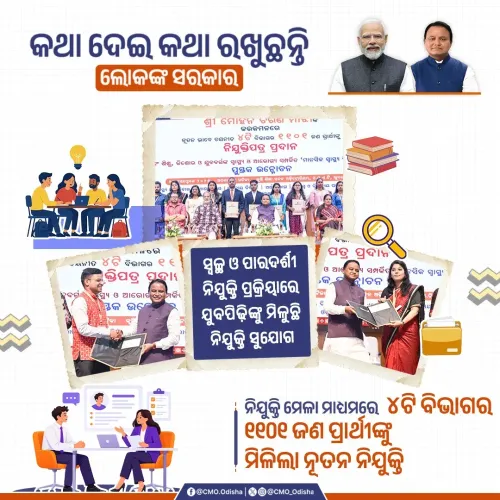
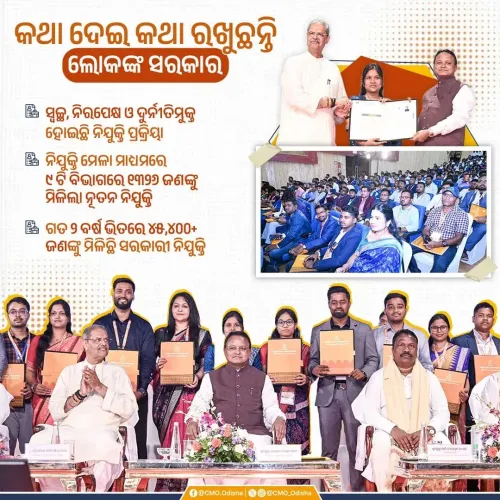
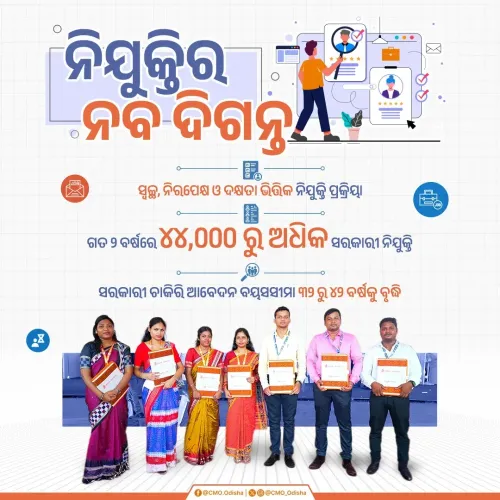
The Chief Minister's Office of Odisha announced that more than 46,500 appointment letters have been issued to candidates through job fairs.
The appointments were made over a period of 2 years and 3 months through state-organised Niyukti Melas .
The government described the initiative as a commitment to youth engagement 'across every sector.' The CMO framed the hiring drive as a 'firm step towards building a prosperous Odisha,' going beyond routine recruitment rhetoric.
Further job fairs and updated employment statistics are expected as the government continues the initiative.
More than 46,500 appointment letters handed to young job-seekers in just 2 years and 3 months — that is the headline number the Chief Minister's Office of Odisha put on the record on Tuesday, 29 September 2026, framing the state's rolling job-fair drive as something larger than a hiring exercise.
The post, written in Odia, declares that the 'lokanka sarkara' (people's government) is 'completely committed to creating abundant opportunities for youth by prioritising their engagement in every sector.' The closing line sharpens the pitch: 'This is not merely employment — this is the people's government's firm step towards building a prosperous Odisha.'
Niyukti Melas as the delivery mechanism
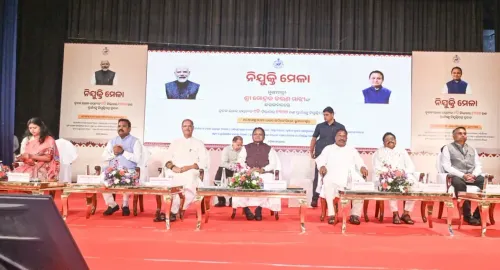
Odisha has structured its youth-employment push around Niyukti Melas — state-organised recruitment fairs where candidates receive appointment letters on the spot, cutting the lag between selection and onboarding. The format has become a visible centrepiece of the government's outreach, allowing officials to stage high-footfall events that make the hiring process tangible and immediate for candidates who often wait months under conventional recruitment cycles.
The model is not unique to Odisha — several Indian state governments have used job fairs to accelerate public and private-sector hiring — but the scale claimed here, over 46,500 appointments across a defined 26-month window, signals that the state is treating these events as a sustained policy instrument rather than a one-off gesture.
Youth employment as Odisha's economic narrative
The framing in the CMO's post is deliberate: each appointment letter is cast as a brick in the construction of a 'samruddha Odisha' (prosperous Odisha). That language anchors individual hirings to a state-building vision — useful political optics, but also a signal of the priority the government places on being seen to deliver measurable outcomes on employment, one of the sharpest anxieties among Odisha's large young population.
The eastern state has long grappled with out-migration, as young workers from districts with limited industrial depth move to metropolitan centres for work. A credible, visible jobs pipeline — particularly one that spans sectors rather than concentrating in a single department — would address one of the structural pressures the state economy faces.
Whether the pace of appointments continues, and whether the government schedules further melas before the year closes, will be the practical test of the commitment the CMO articulated today.
Point of View
Cumulative number — over 46,500 appointments in a defined timeframe — reflects a broader shift among Indian state governments toward quantified, event-driven delivery optics rather than policy promises alone. The Niyukti Mela format gives the government a recurring stage to demonstrate action, turning hiring into a visible, shareable moment. For an eastern state historically marked by significant youth out-migration, a sustained appointments pipeline carries both economic and political weight, positioning the ruling dispensation as the agent of opportunity. The key question going forward is whether the pace of appointments translates into reduced out-migration data and measurable gains in formal employment — metrics that will eventually test the narrative.
NationPress
29 Sept 2026
Frequently Asked Questions
How many jobs has the Odisha government given through job fairs?
The Chief Minister's Office of Odisha stated that more than 46,500 appointment letters have been issued to candidates through job fairs over a period of 2 years and 3 months .
What is a Niyukti Mela in Odisha?
A Niyukti Mela is a state-organised recruitment fair where eligible candidates receive appointment letters on the spot, designed to speed up the hiring process across government and associated sectors in Odisha.
What is the Odisha government's plan for youth employment?
The Odisha government has declared it is 'completely committed' to creating opportunities for youth across every sector, using Niyukti Melas as the primary vehicle for issuing appointments at scale.
When did the Odisha CMO announce the 46,500 jobs milestone?
The announcement was made by the Chief Minister's Office of Odisha on Tuesday, 29 September 2026 , via a post on X.
Which state government is organising job fairs for youth in eastern India?
The Government of Odisha , through its Chief Minister's Office, has been organising Niyukti Melas — job fairs — as part of a sustained effort to address youth unemployment in the state.