Odisha CMO allocates ₹1,715 cr for education in Supplementary Budget
Synopsis
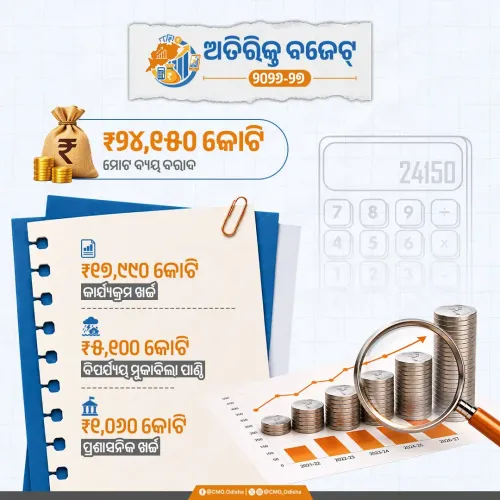
Odisha's Chief Minister's Office announced a ₹1,715 crore allocation for education in the Supplementary Budget 2026–27, aimed at strengthening infrastructure, expanding access to quality learning and building brighter futures for students across the state.
Key Takeaways
₹1,715 crore has been allocated for the education sector in Odisha's Supplementary Budget 2026–27 .
The allocation targets three goals: expansion of educational access , modernisation of the schooling system , and infrastructure development .
The announcement was made by the Chief Minister's Office of Odisha on 20 November 2026 .
Supplementary budgets are mid-year additions, meaning this ₹1,715 crore is on top of the main annual education budget.
The break-up across specific schemes, institutions and districts has not yet been disclosed.
The allocation fits Odisha's established pattern of treating education investment as a long-term socio-economic lever.
A single budget line is making a statement about priorities: Odisha's Chief Minister's Office announced on Friday, 20 November 2026 that the state's Supplementary Budget 2026–27 earmarks ₹1,715 crore exclusively for the education sector — a commitment the government frames as the bedrock of a 'prosperous and progressive Odisha.'
₹1,715 crore and what it signals
The Chief Minister's Office posted in both Odia and English, declaring: 'Quality education is the foundation of a prosperous Odisha. The allocation of ₹1,715 crore for the education sector in the Supplementary Budget 2026–27 will strengthen educational infrastructure, expand access to quality learning and create brighter opportunities for students.'
Supplementary budgets are mid-year fiscal tools — they are not routine. When a state government reaches back into its finances to push fresh money toward education outside the main budget cycle, it reflects either an urgent gap identified in implementation or a deliberate political signal about where the administration wants to be seen acting. Here, the government explicitly names three objectives: expansion of educational access, modernisation of the schooling system, and infrastructure upgrades for students across Odisha.
Odisha's pattern of education-first budgeting
This allocation does not arrive in a vacuum. Odisha governments have, across successive budget cycles, treated education as a core lever for long-term socio-economic progress — a pattern that reflects the state's ongoing push to convert demographic scale into human capital. Repeated emphasis on infrastructure upgrades and broadening access, particularly for students in underserved districts, has defined the state's education policy posture for years.
The supplementary nature of this ₹1,715 crore allocation means it sits on top of whatever the main budget for 2026–27 had already committed to schools, colleges and learning institutions — amplifying rather than replacing the annual education spend.
What the numbers don't yet tell us
The critical detail still missing is the internal break-up: how much flows to primary schools versus higher education, which districts get priority infrastructure projects, what specific schemes are funded, and what the monitoring mechanisms look like. Those granular numbers will determine whether the headline figure translates into classrooms, teachers and technology — or remains a promise on paper. The government has flagged the direction; the implementation calendar is what watchers will now demand.
For Odisha's students — the government's stated beneficiaries — the proof will arrive one school building, one scholarship and one upgraded curriculum at a time.
Point of View
715 crore is best read as a mid-cycle course correction — an acknowledgement that the main budget alone left gaps the state cannot afford to carry into the next academic year. For Chief Minister Mohan Majhi's BJP-led government, education spending also carries political weight: signalling welfare competence in a state where human development metrics have historically lagged national averages. The dual-language announcement — Odia and English — suggests the government is simultaneously speaking to a local electorate and a broader investor audience. The real test, as always, is implementation velocity: how quickly ₹1,715 crore moves from a budget line into bricks, books and broadband.
NationPress
20 Nov 2026
Frequently Asked Questions
How much has Odisha allocated for education in the Supplementary Budget 2026–27?
Odisha has allocated ₹1,715 crore for the education sector in its Supplementary Budget 2026–27, as announced by the Chief Minister's Office on 20 November 2026.
What is the purpose of Odisha's ₹1,715 crore education allocation?
The allocation is intended to strengthen educational infrastructure, expand access to quality learning, and create improved opportunities for students across Odisha.
What is a supplementary budget and why does Odisha need one for education?
A supplementary budget is a mid-year fiscal instrument that allows a state government to allocate funds beyond the main annual budget. Odisha has used this to inject additional resources into education to address gaps in infrastructure and access within the ongoing financial year.
Which students benefit from the Odisha education budget allocation?
The government has stated the allocation is aimed at students across Odisha broadly, with goals covering both school-level infrastructure and broader access to quality learning, though a district-wise or institution-wise break-up has not yet been released.
Is ₹1,715 crore in addition to Odisha's main education budget?
Yes. Because this is a supplementary budget allocation, it comes on top of whatever the main Odisha Budget 2026–27 had already earmarked for the education sector.