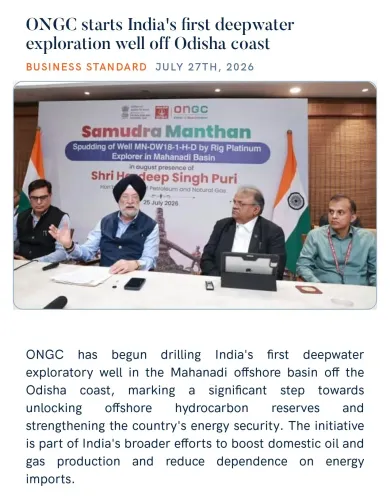
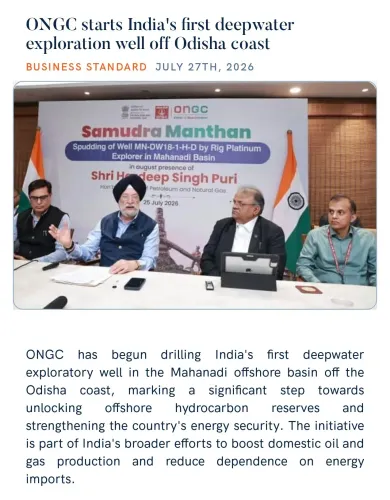
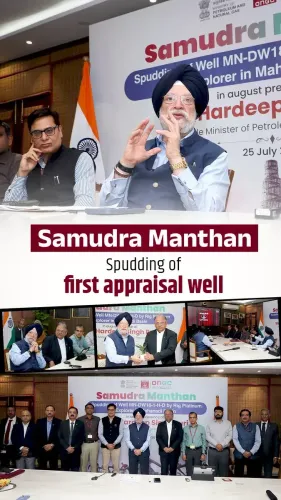
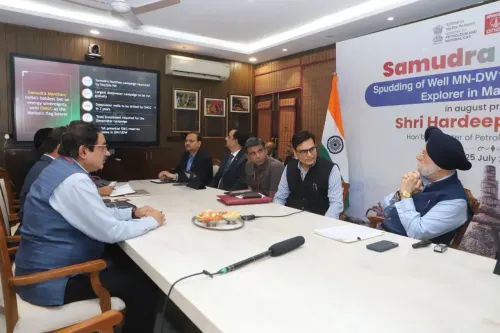
Odisha CMO Hails ONGC Deepwater Drilling in Mahanadi Basin
Synopsis
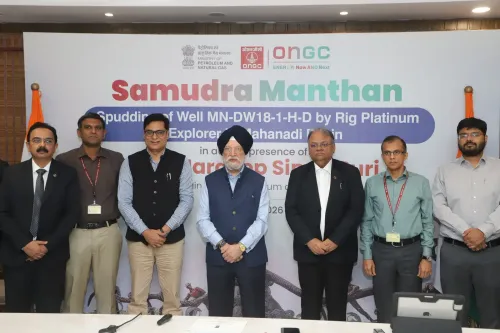
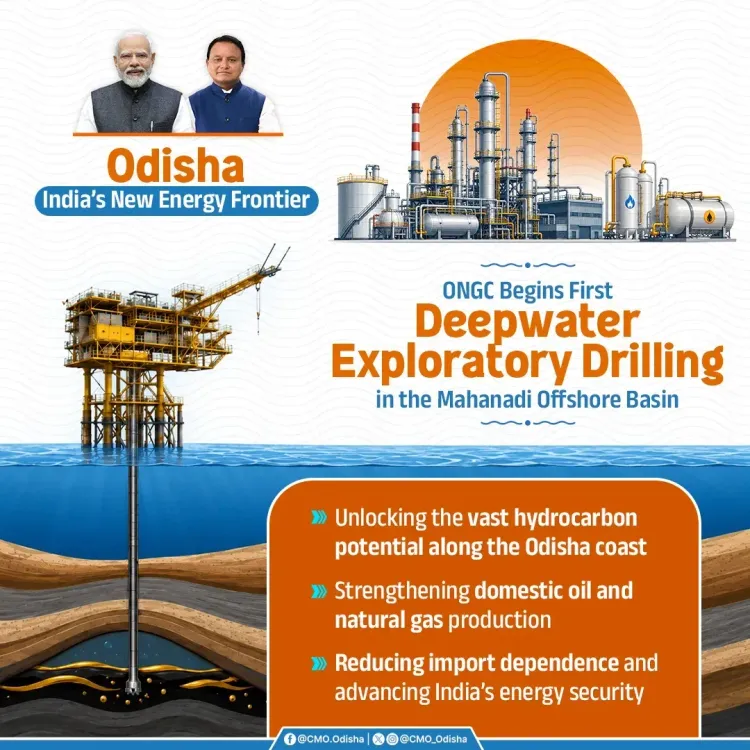
The Chief Minister's Office of Odisha has highlighted ONGC's deepwater exploratory drilling in the Mahanadi offshore basin as a landmark step under the SamudraManthan mission, aimed at cutting India's crude import dependence and advancing energy self-reliance on the east coast.
Key Takeaways
The Chief Minister's Office of Odisha announced ONGC's deepwater exploratory drilling in the Mahanadi offshore basin in the Bay of Bengal .
The initiative is positioned under the SamudraManthan mission, the government's dedicated deepwater hydrocarbon exploration programme.
India imports over 80 percent of its crude oil, making domestic frontier-basin exploration a strategic priority.
Policy enablers include the Hydrocarbon Exploration and Licensing Policy (HELP) of 2016 and the Open Acreage Licensing Policy (OALP) of 2017 .
ONGC , founded in 1956 , is expanding its exploration footprint from traditional western offshore fields to the eastern seaboard.
Commercial discoveries in the basin could benefit Odisha's economy, coastal communities, and India's national energy accounts.
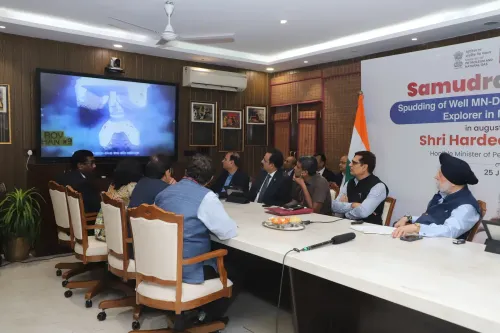
The Chief Minister's Office of Odisha, on Monday, 28 July 2026, announced that ONGC has commenced its first deepwater exploratory drilling in the Mahanadi offshore basin, describing the development as a strategic milestone in India's pursuit of energy security and self-reliance under the SamudraManthan mission.
Context
The CMO's post stated that 'Odisha is emerging as a strategic centre in India's pursuit of energy security and self-reliance,' positioning the state at the forefront of the country's offshore hydrocarbon agenda. The drilling in the Mahanadi offshore basin — a sedimentary basin in the Bay of Bengal off Odisha's coast — represents a shift in domestic exploration toward frontier deepwater areas on India's east coast. The announcement was addressed to @PMOIndia, signalling coordination between the state government and the Centre on the energy security agenda.
Policy Backdrop
India imports more than 80 percent of its crude oil requirements, making domestic exploration in frontier basins a national priority. The government has progressively opened up deepwater and ultra-deepwater areas through the Hydrocarbon Exploration and Licensing Policy (HELP), introduced in 2016, and the Open Acreage Licensing Policy (OALP) of 2017, which allows companies to nominate blocks for exploration — including offshore areas such as the Mahanadi basin. These reforms were designed to move exploration beyond mature fields like Mumbai High toward untapped east coast basins. The SamudraManthan mission, cited in the post, is the government's dedicated initiative for deepwater hydrocarbon exploration aimed at boosting domestic production and reducing import dependence, aligned closely with the broader Atmanirbhar Bharat framework.
ONGC, India's largest public sector oil and gas exploration company, established in 1956, has historically anchored domestic production. Its deepwater push into the Mahanadi basin marks a geographic expansion of its exploration portfolio from traditional western offshore areas to the eastern seaboard.
Stakeholders and Impact
A commercial discovery in the Mahanadi offshore basin could have significant implications for Odisha's economy and for national energy accounts. Coastal communities along Odisha's seaboard, as well as downstream industries dependent on domestically produced hydrocarbons, stand to benefit if exploratory drilling yields viable reserves. For the state government, a successful offshore energy corridor would reinforce Odisha's positioning as an industrial and energy hub on India's eastern coast. For the Centre, any addition to domestic production directly reduces the foreign exchange burden of crude imports, a persistent macroeconomic pressure.
The initiative also carries employment and infrastructure implications, as deepwater operations typically require specialised onshore logistics, port infrastructure, and skilled technical personnel — areas where Odisha has been investing in recent years.
What's Next
The immediate focus will be on results from the ongoing exploratory drilling campaign in the Mahanadi basin. Should the initial wells indicate commercially viable hydrocarbon accumulations, further block auctions and appraisal drilling under OALP rounds are likely to follow. The SamudraManthan mission's broader ambition — to systematically survey and develop India's deepwater sedimentary basins — means that the Mahanadi basin could become a template for similar east coast exploration drives. Progress on this front will be closely watched by energy analysts and investors tracking India's upstream sector reform trajectory.
Point of View
Addressed directly to the PMO, is a deliberate signal of state-Centre alignment on the energy security agenda — framing Odisha not merely as a beneficiary but as an active strategic node in India's hydrocarbon map. The invocation of SamudraManthan ties the development to a national mission narrative, lending it political weight beyond a routine exploration update. This fits a broader pattern in which eastern India's frontier basins are being repositioned as the next frontier of domestic energy production, compensating for declining output from mature western fields. If the Mahanadi basin yields commercial results, it could accelerate OALP bidding rounds and deepen Odisha's profile as an energy-industrial corridor.
NationPress
27 Jul 2026
Frequently Asked Questions
What is ONGC's deepwater drilling in the Mahanadi basin about?
ONGC has commenced exploratory drilling in the deepwater section of the Mahanadi offshore basin in the Bay of Bengal off Odisha's coast, aiming to assess the area's hydrocarbon potential and boost domestic energy production.
What is the SamudraManthan mission?
The SamudraManthan mission is a Government of India initiative focused on deepwater hydrocarbon exploration, designed to increase domestic oil and gas output and reduce India's dependence on imported crude.
Why is the Mahanadi offshore basin important for India's energy security?
The Mahanadi offshore basin is a frontier sedimentary basin in the Bay of Bengal identified as holding significant hydrocarbon potential. Developing it could add to domestic production at a time when India imports over 80 percent of its crude oil.
What policies support offshore oil exploration in India?
Key policies include the Hydrocarbon Exploration and Licensing Policy (HELP) launched in 2016 and the Open Acreage Licensing Policy (OALP) introduced in 2017 , both designed to attract investment into frontier and deepwater basins.
How does this affect Odisha?
A successful deepwater exploration programme in the Mahanadi basin could position Odisha as a significant energy hub on India's east coast, generating economic activity, infrastructure development, and employment for coastal communities.