Odisha CMO Highlights Mining Gains in Two Years of Govt
Synopsis
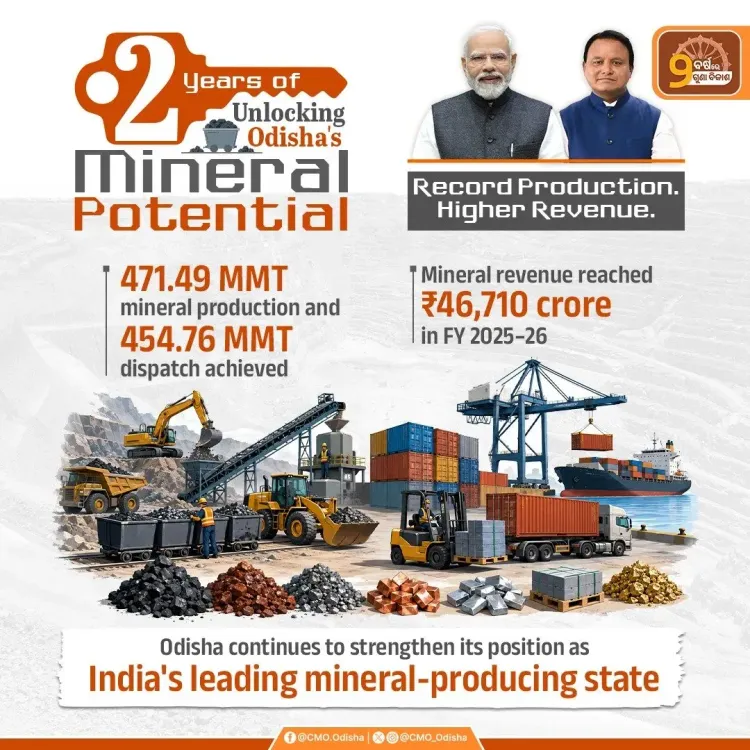
The Chief Minister's Office of Odisha marked two years of the current government on 14 July 2026 by highlighting record mineral production, higher revenue and efficient resource management, reinforcing the state's standing as India's top mineral producer and a key driver of national industrial supply chains.
Key Takeaways
The Chief Minister's Office of Odisha posted on 14 July 2026 to mark two years of the current state government, anchoring its record on mining sector performance.
Odisha holds major deposits of iron ore, bauxite, chromite and coal , making it India's leading mineral-producing state by volume and value.
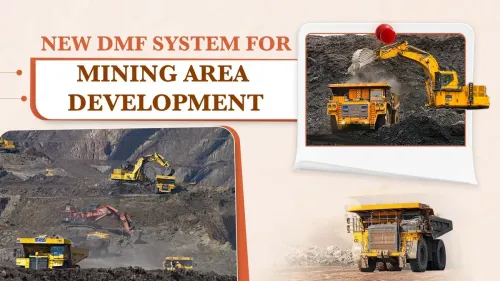
Central reforms — the MMDR Amendment Acts of 2015 and 2020 — shifted mineral allotment to auctions, boosting royalty and District Mineral Foundation collections that fund local infrastructure and welfare.
The state's mineral output feeds steel, aluminium and power industries nationwide, giving its production figures strategic national importance.
The National Mineral Policy 2019 frames higher domestic mineral output and private-sector participation as national objectives that Odisha is positioned to advance.
Official production and revenue figures will be tested against forthcoming Indian Bureau of Mines provisional statistics.
The Chief Minister's Office of Odisha on Tuesday, 14 July 2026 highlighted the state's sustained dominance in India's mining sector, citing record production, higher revenue and efficient resource management over the past two years as markers of economic progress under the current government.
Context
The post, shared under the hashtags #2YearsofLokankaSarakar and #BikasharaDharaOdishaSara, marks two years of the ruling dispensation in Odisha. The Chief Minister's Office stated that 'record production, higher revenue and efficient resource management have reinforced Odisha's position as India's leading mineral-producing state over the last two years.' The messaging frames the mining sector's performance as a central pillar of the government's development narrative.
Policy Backdrop
Odisha holds some of India's largest deposits of iron ore, bauxite, chromite and coal, making it the country's foremost mineral-producing state by both volume and value. The sector's trajectory has been shaped significantly by central reforms, most notably the Mines and Minerals (Development and Regulation) Amendment Act of 2015, which replaced discretionary allotments with transparent auctions, driving up royalty collections and contributions to the District Mineral Foundation (DMF). Subsequent amendments in 2020 allowed captive mines to sell surplus output, further expanding commercial activity and state revenue streams.
The National Mineral Policy 2019 laid out a framework for higher domestic output, sustainable extraction and greater private-sector participation — objectives that resource-rich states such as Odisha have been positioned to advance. These reforms collectively shifted the incentive structure for both state governments and mining lessees toward maximising production within a regulated, auction-based system.
Stakeholders and Impact
The mining sector's performance has direct implications for multiple stakeholders. Steel, aluminium and power industries across India depend on Odisha's iron ore and bauxite supply chains, making the state's output figures a matter of national industrial interest. Elevated royalty receipts and DMF collections translate into greater public investment in local infrastructure, health and education — benefits that accrue primarily to communities in and around mining districts.
Alongside Jharkhand and Chhattisgarh, Odisha forms the core of India's mineral belt. The government's emphasis on 'efficient resource management' signals an intent to align extraction growth with sustainability commitments, a balance that mining lessees, civil society groups and local communities continue to watch closely. The broader national objective of reducing import dependence for critical minerals also gives Odisha's production gains strategic significance beyond state borders.
What's Next
The Indian Bureau of Mines periodically publishes provisional state-wise mineral production statistics, and the next such release will be closely watched to assess whether the claims of record output are borne out in official data. Any fresh round of mineral block auctions notified by the Odisha government would be the next concrete policy signal for investors and industry. As the two-year milestone is marked with sector-wide performance claims, scrutiny from opposition parties, industry bodies and civil society over specific production and revenue figures is likely to intensify in the weeks ahead.
Point of View
Geography-driven advantage, making the claim difficult to dispute in broad strokes even if specific figures remain unverified. The framing of 'efficient resource management' alongside production and revenue gains is notable — it attempts to pre-empt environmental and community-impact critiques that routinely accompany mining expansion narratives in eastern India. Contextually, this sits within a wider pattern of resource-rich BJP-governed states using mineral auction revenues and DMF spending as proof points of development delivery ahead of electoral cycles. The real test will come when the Indian Bureau of Mines releases its next round of official state-wise data, which will either validate or complicate the government's claims.
NationPress
14 Jul 2026
Frequently Asked Questions
Is Odisha the largest mineral-producing state in India?
Yes, Odisha is widely regarded as India's leading mineral-producing state, holding major deposits of iron ore, bauxite, chromite and coal that supply steel, aluminium and power industries across the country.
What is the District Mineral Foundation in Odisha?
The District Mineral Foundation (DMF) is a statutory body funded by contributions from mining lessees. It channels royalty-linked revenue into local infrastructure, health and education in mining-affected districts of Odisha.
What is the MMDR Amendment Act and how does it affect Odisha?
The Mines and Minerals (Development and Regulation) Amendment Act of 2015 replaced discretionary mineral allotments with competitive auctions, significantly increasing royalty income and DMF collections for mineral-rich states like Odisha.
What does #2YearsofLokankaSarakar mean?
'Lokanka Sarakar' translates broadly to 'people's government' in Odia. The hashtag marks two years of the current ruling dispensation in Odisha, with the government using the occasion to highlight development milestones including mining sector gains.
What minerals does Odisha produce the most?
Odisha is a major producer of iron ore, bauxite, chromite and coal. These minerals are critical inputs for India's steel, aluminium and power sectors, and the state's output has national industrial and strategic significance.