Odisha CMO Targets 11 GW Renewable Energy by 2030
Synopsis
The Chief Minister's Office of Odisha has announced an 11 GW renewable energy vision by 2030, backed by rising investor interest. The target aligns with India's COP26 pledge of 500 GW non-fossil capacity and follows similar announcements by Rajasthan, Gujarat, and Tamil Nadu.
Key Takeaways
The Chief Minister's Office of Odisha announced a target of 11 GW of renewable energy capacity by 2030 on 26 June 2026 .
The goal aligns with India's COP26 Panchamrit commitment of 500 GW non-fossil fuel capacity by 2030 .
Odisha joins Rajasthan, Gujarat, and Tamil Nadu in announcing large-scale state renewable targets to attract private investment.
The National Green Hydrogen Mission (2023) opens an additional clean-energy pathway for Odisha given its coastline and industrial base.
Key next steps include state tender schedules for solar, wind, and green hydrogen parks and updates to land and grid-connectivity policy.
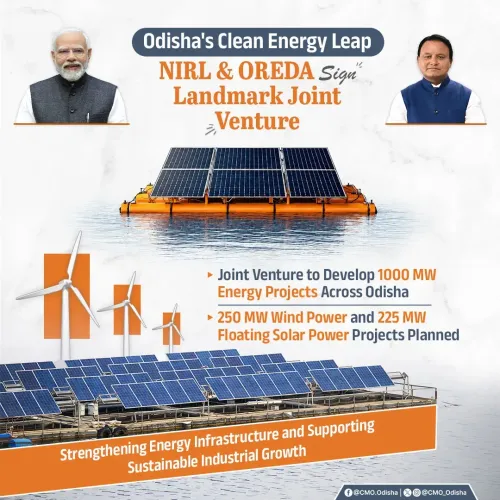
The Chief Minister's Office of Odisha on Friday, 26 June 2026, shared details of the state's ambition to build 11 gigawatts (GW) of renewable energy capacity by 2030, positioning Odisha as a significant contributor to India's national clean-energy goals amid a reported surge in investment interest.
Context
Odisha, an eastern Indian state historically anchored to coal, minerals, and heavy industry, has been signalling a deliberate pivot toward clean power. The state's announcement of an 11 GW renewable energy vision by 2030 reflects an accelerating trend among Indian states to stake out differentiated clean-energy targets that can attract private capital while simultaneously contributing to the country's broader climate commitments.
The post shared by the CMO Odisha account highlights both the scale of the ambition and the investment momentum building around it, though specific project-level details and confirmed financial commitments remain subject to official tender disclosures.
Policy Backdrop
India's clean-energy trajectory was set in sharp relief at the COP26 summit in Glasgow in 2021, where the government announced its Panchamrit (five-nectar) commitments, including a target of 500 GW of non-fossil fuel capacity by 2030. Meeting that national goal requires states to act as execution engines, translating central policy into land allocation, grid connectivity, and competitive bidding frameworks.
The National Solar Mission, launched in 2010, provided the first federal scaffolding for grid-connected solar deployment. More recently, the National Green Hydrogen Mission, launched in 2023, has opened a parallel track for states with surplus renewable potential to pursue electrolyser-based hydrogen production — a pathway Odisha, with its coastline and industrial base, is well-positioned to explore.
Odisha's move follows similar capacity announcements from Rajasthan, Gujarat, and Tamil Nadu, states that have used large renewable targets to anchor investment summits and long-term power-purchase agreements.
Stakeholders and Impact
The primary beneficiaries of a successful 11 GW build-out would be renewable energy investors — both domestic and international — seeking bankable state-level policy frameworks, as well as Odisha's power distribution utilities, which would gain access to cheaper, cleaner generation over time. Industrial consumers in the state's steel and aluminium corridors could also benefit from competitive green-power tariffs.
Project-affected communities, particularly in areas earmarked for large solar or wind parks, will require careful land-acquisition and resettlement planning. Odisha's track record in managing displacement from mining and infrastructure projects will be closely watched by civil society groups as renewable buildout accelerates.
What's Next
Attention will now turn to state tender schedules for solar, wind, and green hydrogen parks, alongside any accompanying land-use or grid-connectivity policy changes. Progress reports on capacity addition are periodically submitted to the Ministry of New and Renewable Energy, and Odisha's performance against the 2030 milestone will be a key indicator of whether the state's ambition translates into commissioned megawatts.
If Odisha can align project pipelines with investor timelines, it stands to cement its position as a renewable-energy hub in eastern India — a region that has historically lagged western and southern states in clean-power capacity addition.
Point of View
Coal-heavy state within India's fast-evolving clean-energy investment landscape. By publicising the vision through the Chief Minister's Office, the government is signalling political ownership at the highest level — a move designed to reassure investors wary of policy reversals. The timing, coming five years before the 2030 deadline, gives the state a credible window to convert targets into tenders, but the gap between announced capacity and commissioned megawatts has historically been wide across Indian states. Whether Odisha can close that gap will depend on how swiftly it resolves land, grid, and community-consent bottlenecks that have stalled projects elsewhere.
NationPress
26 Jun 2026
Frequently Asked Questions
What is Odisha's renewable energy target for 2030?
Odisha has announced a target of 11 GW of renewable energy capacity by 2030 , covering solar, wind, and potentially green hydrogen projects.
How does Odisha's 11 GW target relate to India's national clean energy goal?
India pledged 500 GW of non-fossil fuel capacity by 2030 at the COP26 summit in Glasgow. Odisha's 11 GW target is part of the sub-national contribution needed to meet this national commitment.
Which other Indian states have announced similar renewable energy targets?
Rajasthan, Gujarat, and Tamil Nadu have made comparable large-scale renewable capacity announcements, using such targets to attract domestic and international private investment.
What is the National Green Hydrogen Mission and does it apply to Odisha?
The National Green Hydrogen Mission , launched by the Government of India in 2023 , supports electrolyser and renewable-based hydrogen production. Odisha's coastline and industrial base make it a potential candidate for projects under this scheme.
What should investors and stakeholders watch for next in Odisha's renewable energy push?
Key developments to track include state tender schedules for solar, wind, and green hydrogen parks, land-use and grid-connectivity policy updates, and progress reports submitted to the Ministry of New and Renewable Energy .